What Stunts Your Growth? A Parent's Guide to What's Real and What's Myth
Last updated: September 11, 2026
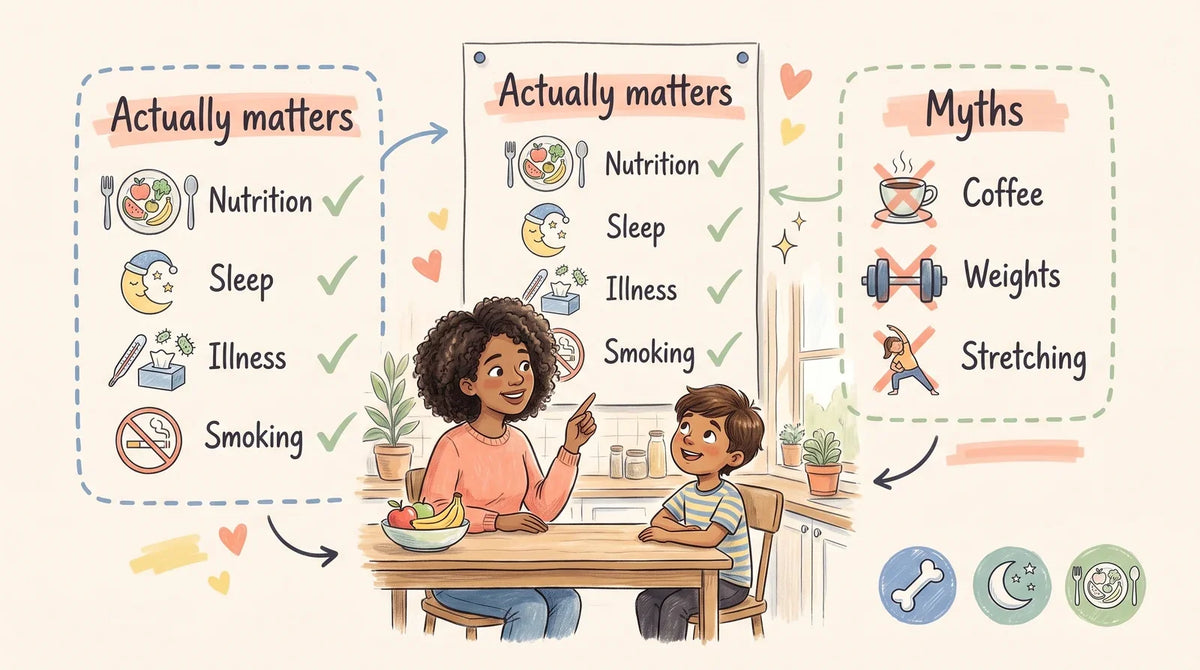
What stunts your growth? In children and teenagers, the list of things that genuinely hold back height is short: not getting enough calories, protein and key nutrients, a chronic illness or a condition that blocks nutrient absorption, a hormone problem such as growth hormone deficiency or an underactive thyroid, long term sleep deprivation, and severe ongoing psychosocial stress. Coffee is not on that list. Lifting weights is not on it. Neither is one late night, or a skipped stretch, or any of the other things teenagers worry about at 11pm.
Search this question and you get two lists jumbled into one. Real medical causes sit next to playground myths with nothing separating them. Almost nobody sorts the list the way a parent actually needs it sorted, which is by the only question that matters at home: which of these can I do anything about?
So that is how this guide is organised. First what the word "stunted" actually means in medicine, then the real causes ranked by how much control a family has over them, then the myths, then the honest limit of what nutrition can and cannot fix. Including ours.
What "stunted growth" actually means
The word is bigger than most people using it realise. The World Health Organization defines stunting as "the impaired growth and development that children experience from poor nutrition, repeated infection, and inadequate psychosocial stimulation." A child is classified as stunted when their height-for-age falls more than two standard deviations below the WHO Child Growth Standards median. WHO focuses on early life, particularly the first 1,000 days from conception to age two, and states plainly that "stunting is largely irreversible: a child cannot recover height in the same way that they can regain weight."
That is a clinical category describing severe, sustained deprivation. It is not the same thing as a healthy American 12 year old who is shorter than his friends.
The clinical term for that second situation is short stature. Yale Medicine explains that short stature with no underlying cause, called idiopathic short stature, is defined by the US Food and Drug Administration as a height two standard deviations from the mean. In practice that works out to a post-pubertal height of 5 feet 4 inches or under for a boy, and 4 feet 11 inches or under for a girl, against US averages of 5 feet 9 inches for men and 5 feet 4 inches for women.
Worth sitting with those numbers for a second. A boy who finishes at 5 feet 6 inches is shorter than average and is not, by any medical definition, a case of anything. Being shorter than your friends is a comparison, not a diagnosis.
The real list: what actually stunts growth in children
Here is every cause that appears consistently across Nemours KidsHealth, Yale Medicine and WHO, sorted by how much a family can realistically change it.
| Cause | Real or myth | How much control parents have | What to do about it |
|---|---|---|---|
| Genetics and familial short stature | Real, and the biggest single factor | None | Nothing. Short parents tend to have short children, and that is not a problem to solve |
| Not enough calories, protein and nutrients | Real | High | Food first. Close real gaps, with a pediatrician's input if you suspect a deficiency |
| Chronic sleep deprivation | Real, over the long term only | Medium to high | Protect sleep hours, especially in-bed screen use |
| Chronic illness (kidney, heart, lung, intestinal) | Real | Low, but treatable | Follow the treatment plan. KidsHealth notes treating the condition helps growth |
| Absorption conditions (celiac, inflammatory bowel disease) | Real | Low, but diagnosable | Get it diagnosed. Nutrients eaten but not absorbed do nothing |
| Hormone problems (growth hormone deficiency, hypothyroidism) | Real | None at home, treatable medically | Pediatrician, then usually a pediatric endocrinologist |
| Severe psychosocial stress | Real, at the toxic end only | Varies | Change the environment. Yale's specialist notes this one can reverse |
| Long term corticosteroid medication | Real | None. Never stop a prescription over this | Raise it with the prescribing doctor, do not act alone |
| Coffee and caffeine | Myth | n/a | Nothing, though caffeine still costs kids sleep, which is its own issue |
| Lifting weights and resistance training | Myth | n/a | Nothing. Activity is good for growing bodies |
| Skipping stretches or hanging exercises | Myth | n/a | Nothing. Spinal decompression is temporary and reverses |
Notice the shape of that table. The two biggest real causes, genetics and medical conditions, are the two a parent has the least say over. The one with the most room for action sits third.
Poor nutrition: the cause parents can actually do something about
KidsHealth lists it first. Teens may grow more slowly if they "don't get enough protein, calories, and other nutrients in their diet." WHO puts it the same way, naming the most direct causes of stunting as inadequate nutrition, meaning not eating enough or eating foods that lack growth-promoting nutrients, plus recurrent infections that stop nutrients being absorbed or used.
This is the part of the list where a family has leverage, and it is also the part the internet spends the least time on, because coffee makes a better story than dinner.
It is worth being precise about what "poor nutrition" means here, because it does not mean picky. A child who eats a narrow range of foods but hits their calorie and protein needs is in a very different position from a child who is genuinely underfed. Most children in Western countries already get two to three times the protein they need, per Cleveland Clinic, so protein is rarely the gap. The gaps that show up more often are the micronutrients that get skipped along with whole food groups: calcium when dairy is out, zinc when meat and legumes are out, iron when red meat is out.
And the size of that effect is real but modest, not dramatic. The best evidence we have on this comes from milk trials: a meta-analysis of twelve controlled studies found "the most likely effect of dairy products supplementation is 0.4 cm per annum additional growth per ca 245 ml of milk daily," which the author rates as moderate quality evidence. The same analysis found that "lower height-for-age and being a teenager increased the effect of supplementation." In plain English, the benefit concentrated in the children who were already going short on nutrition, not in the ones who were fine.
Genetics sets the ceiling. Nutrition sets the floor. Fixing a real gap protects a child's own range. It does not raise the range.
Chronic sleep deprivation, but only when it is chronic
This one is real, and the way KidsHealth phrases it is worth quoting exactly, because the distinction is the whole answer: "A single night of no sleep will not stunt growth. But over the long term, a person's growth may be affected by not getting enough sleep. That's because growth hormone is normally released during sleep. If someone consistently gets too little sleep (known as 'sleep deprivation'), growth hormone is suppressed."
So the teenager who pulled one all-nighter before an exam is fine. The teenager who has been running on five hours a night for two years is a different conversation. KidsHealth also notes sleep deprivation is linked to weight gain and diabetes, and that enough sleep helps focus at school and in sport.
The practical lever here is narrower than "more sleep." Research using camera-based observation found that in-bed screen use is what costs sleep, while evening screen use before bed mostly does not, with gaming and multitasking the worst offenders. That is a much easier rule to enforce than a blanket screen ban.
Chronic illness and the conditions that quietly block absorption
KidsHealth names long-lasting conditions affecting the kidneys, heart, lungs and intestines, plus sickle cell anemia, as reasons a teen may not grow as fast as peers. Yale Medicine adds gastrointestinal diseases that impair nutrition, specifically inflammatory bowel disease and celiac disease, along with hypothyroidism, heart disease, kidney disease and immunological disease.
The absorption ones deserve their own line because they are the sneakiest item on this whole list. A child with undiagnosed celiac disease can eat a genuinely good diet and still fall short, because the nutrients go in and do not get taken up. No amount of improving the menu fixes that. Only a diagnosis does.
KidsHealth's note on all of these is the hopeful part: following the treatment plan worked out with a doctor can help these children grow better.
Hormone problems, and the one number that flags them
Growth is run by hormones, so endocrine problems show up directly in height. Hypothyroidism slows growth because the thyroid is not making enough hormone to support it, and a blood test will show it. Growth hormone deficiency happens when the pituitary gland does not make enough, either from birth or later after a head injury, brain infection, brain surgery or a tumour near the pituitary.
KidsHealth gives parents a usable threshold here: children and teens with growth hormone deficiency grow less than 2 inches (5 centimetres) a year. That is a number you can actually check against the marks on a door frame.
Yale Medicine is refreshingly blunt about what treatment involves. Growth hormone means daily injections for years, costs more than tens of thousands of dollars annually, and works best in children who actually have a deficiency rather than in unexplained short stature. For idiopathic short stature, three to four years of treatment may improve final height by two to four inches. Dr Anisha Patel of Yale also notes the treatment has only been in use about 35 years, so long-term data is thin.
This is the only item on the real list with a genuine medical treatment behind it, and it is worth saying clearly: no supplement does what growth hormone therapy does, and no supplement should be described as though it might.
Severe psychosocial stress, and what everyday stress does not do
The research here draws a hard line that most articles blur. A 2023 review in Hormone Research in Paediatrics found the short-term stress response is "antigrowth, antireproductive, and catabolic with no lasting adverse consequences," while chronic activation of the stress system "has consequential negative impacts on growth, thyroid function, reproduction-puberty, and metabolism."
So the exam week, the house move, the tough season: not a growth issue. Sustained toxic stress, which Nationwide Children's defines as continual activation without sufficient adult support, including abuse, neglect and exposure to violence: a different category entirely.
Yale's Dr Patel describes the same thing from the clinic side, noting children in war, famine or a home environment that is not nurturing can experience psychosocial stress that keeps them from growing properly, and that it "can be reversed just by removing them from the stressful environment." Of everything on this list, that reversibility is the most hopeful finding on it.
One warning. No supplement affects cortisol or growth hormone, and any product marketed on that mechanism is overselling. The honest route from stress to growth runs through disrupted eating and disrupted sleep, which are the two things a family can actually work on.
Smoking and vaping: the honest state of the evidence
This one keeps appearing on "what stunts your growth" lists, and it deserves a more careful answer than it usually gets.
Teen smoking and vaping carry serious, well documented harms. The specific claim that they reduce final height is less settled than the confident lists suggest. Individual longitudinal studies have gone in different directions, and a recent paper on tobacco smoke exposure and adolescent bone health opens by noting that while primary tobacco smoke exposure has been associated with poorer bone health in adults, "there is a dearth of information on such exposure in healthy growing adolescents."
Here is a detail worth knowing. When Google's own AI Overview asserts that smoking stunts growth, the source it cites for that specific claim is the marketing site of a company that sells nicotine replacement products. That is not a reason to start smoking. It is a reason to notice that a confident sentence at the top of a search results page is not the same thing as settled evidence.
The defensible version: there are excellent reasons for a teenager not to smoke or vape, and final height is one of the weaker ones on that list.
What does not stunt growth
Coffee. Harvard Health states it flatly: "There is no scientifically valid evidence to suggest that coffee can stunt a person's growth." The myth traces back to an old and since-abandoned theory linking coffee to osteoporosis. When researchers looked closer, heavier coffee drinkers simply drank less milk, so it was the calcium and vitamin D intake, not the coffee. Harvard's bottom line is worth repeating to any teenager who asks: "Just as drinking coffee won't make you shorter, avoiding it won't make you any taller." The full version of that answer is here, including the part that does matter, which is that caffeine costs kids sleep and displaces milk.
Lifting weights. A 1995 review in Sports Medicine found exercise provides the mechanical stress needed for growth and remodelling of the musculoskeletal system. Properly supervised resistance training does not damage growth plates. It does not add height either, but the growth-plate fear is unfounded.
There is one genuine caveat inside that same review, and it is the exception that proves the nutrition point: "Exercise can transiently block the expression of statural growth by competitively removing the necessary nutritional support for growth." An elite young athlete training hard on inadequate calories is the one situation where activity and growth collide, and the problem there is the food, not the training.
Stretching, hanging and inversion tables. These produce temporary spinal decompression that reverses within hours. They do not lengthen bones.
One bad night. Covered above, but worth saying twice, because it is the version of this question most teenagers are actually asking.
The honest limit of nutrition, including ours
This is the line we think every parent researching this topic should read, and it comes from Nemours KidsHealth, not from us: growth conditions like familial short stature or constitutional growth delay usually need no special treatment, and "extra vitamins or special diets won't make a person with one of these conditions grow any taller or faster."
That is a supplement brand publishing the sentence that limits supplements. We think it belongs here, because the alternative is letting a parent spend money on the wrong problem.
Research suggests genetics accounts for roughly 60 to 80 percent of final height, with the remainder influenced by nutrition, sleep and overall health during the years growth plates are still open. Nutrition matters inside that remainder, and the milk evidence above shows the effect concentrates in children who were short on nutrition to begin with. If your child eats well and grows steadily, a supplement is closing small gaps. If whole food groups are missing, the gap is bigger and closing it matters more. Neither scenario involves adding inches that genetics never allocated.
When to talk to a pediatrician
Yale Medicine's guidance is specific and worth acting on: if parents are concerned, around age 8 to 10 is a good time to get an evaluation, or at least to raise it with the doctor. The window for intervention closes when puberty does, and Dr Patel notes bones generally fuse around age 16 for boys and 14 for girls.
Raise it sooner rather than later if:
- Your child is growing less than 2 inches (5 centimetres) a year
- A growth rate that was normal has recently flattened, tracked over several months rather than judged in one visit
- There are digestive symptoms alongside slow growth, which can point to celiac disease or inflammatory bowel disease
- Your child is not showing any signs of puberty by around 13 for girls or 15 for boys
- Your child is persistently tired, pale or low energy, which can signal anemia or thyroid problems
The useful question at that appointment is not whether your child is as tall as their classmates. It is whether they are still growing at a normal rate for them. A steady curve at the shorter end is a healthy pattern. A curve that flattens is the one worth investigating.
Where Tallori fits, and where it does not
Tallori Growth Gummies is a zero sugar, pectin based gummy multivitamin designed for ages 5 to 18, the years growth plates are typically open. Its job on the list above is narrow and specific: the nutrition row, and only the part of it that a daily multivitamin can reach.
The panel prints all seven vitamin and mineral doses: vitamin C 25mg, vitamin D3 25mcg, vitamin K2 as MK-7 100mcg, calcium 300mg, magnesium as glycinate 50mg, zinc as citrate 6mg, and omega-3 DHA 50mg from algae oil rather than fish. The botanicals sit in a 112.4mg Clean Growth Blend, which is the same structure most brands in this category use, and we do not print the individual doses inside it. Sweetened with monk fruit and xylitol, with no added sugar.
What it does not do: it does not treat a hormone disorder, it does not fix an absorption condition, it does not replace sleep, and it does not make children taller. If your child is on this page because their growth curve flattened, the first call is a pediatrician, not a supplement.

Try Tallori Growth Gummies
Zero sugar. All 7 vitamin and mineral doses printed on the label. 60-day money-back guarantee. Ages 5 to 18.
Shop NowRelated Reading
Frequently Asked Questions
What actually stunts your growth?
In children and teens, the real causes are not getting enough calories, protein and nutrients, chronic illness or conditions that block absorption such as celiac disease and inflammatory bowel disease, hormone problems like growth hormone deficiency and hypothyroidism, long term sleep deprivation, severe ongoing psychosocial stress, and long term corticosteroid medication. Genetics is the largest factor of all, and it is not something that gets stunted, it is the range a child grows within.
Does coffee stunt your growth?
No. Harvard Health states there is no scientifically valid evidence to suggest that coffee can stunt a person's growth. The myth came from an old theory linking coffee to osteoporosis, which was not confirmed. Heavier coffee drinkers simply drank less milk, so the calcium intake explained the association. Caffeine does still cost children sleep, which is a separate and more real concern.
Can lack of sleep stunt growth?
Only when it is chronic. Nemours KidsHealth states that a single night of no sleep will not stunt growth, but over the long term growth may be affected by not getting enough sleep, because growth hormone is normally released during sleep and consistent sleep deprivation suppresses it. One all-nighter is not the problem. Years of short nights is a different conversation.
Does lifting weights stunt growth in kids?
No. A 1995 review in Sports Medicine found exercise provides the mechanical stress needed for growth and remodelling of the musculoskeletal system. Properly supervised resistance training does not damage growth plates. The one real caveat from that same review is that exercise can transiently block statural growth by competitively removing the nutritional support growth requires, which is an issue of underfeeding a hard-training young athlete, not of the training itself.
What is the difference between stunted growth and short stature?
Stunting is a WHO classification for impaired growth from poor nutrition, repeated infection and inadequate psychosocial stimulation, applied when height-for-age falls more than two standard deviations below the WHO Child Growth Standards median, and it is largely irreversible. Short stature is the clinical term used when a child's height is two standard deviations from the mean, which for a post-pubertal boy is about 5 feet 4 inches or under and for a girl about 4 feet 11 inches or under. Being shorter than classmates is neither one of these.
When should I take my child to a doctor about slow growth?
Yale Medicine suggests that if parents are concerned, around age 8 to 10 is a good time to get an evaluation, before the window for intervention closes with puberty. Go sooner if your child is growing less than 2 inches or 5 centimetres a year, if a previously normal growth rate has flattened over several months, if there are digestive symptoms alongside slow growth, or if there are no signs of puberty by about 13 in girls or 15 in boys.
Can vitamins reverse stunted growth?
No. Nemours KidsHealth states directly that extra vitamins or special diets will not make a person with familial short stature or constitutional growth delay grow any taller or faster. Where nutrition helps is in closing a genuine gap in a child who was falling short, and even there the measured effects are small. Milk trial evidence puts the benefit at roughly 0.4 cm per year per daily glass, concentrated in children who were already undernourished.
Does Tallori prevent stunted growth?
No. Tallori is a zero sugar daily multivitamin for ages 5 to 18 that helps fill nutrition gaps during the growing years. It does not treat hormone disorders, absorption conditions or any medical cause of slow growth, and it does not make children taller. If a child's growth curve has flattened, the right first step is a pediatrician, not a supplement.
This article is for informational purposes and is not medical advice. Talk to your child's pediatrician about any nutrition or growth concerns.