When Do Growth Plates Close? Boys vs Girls Timeline
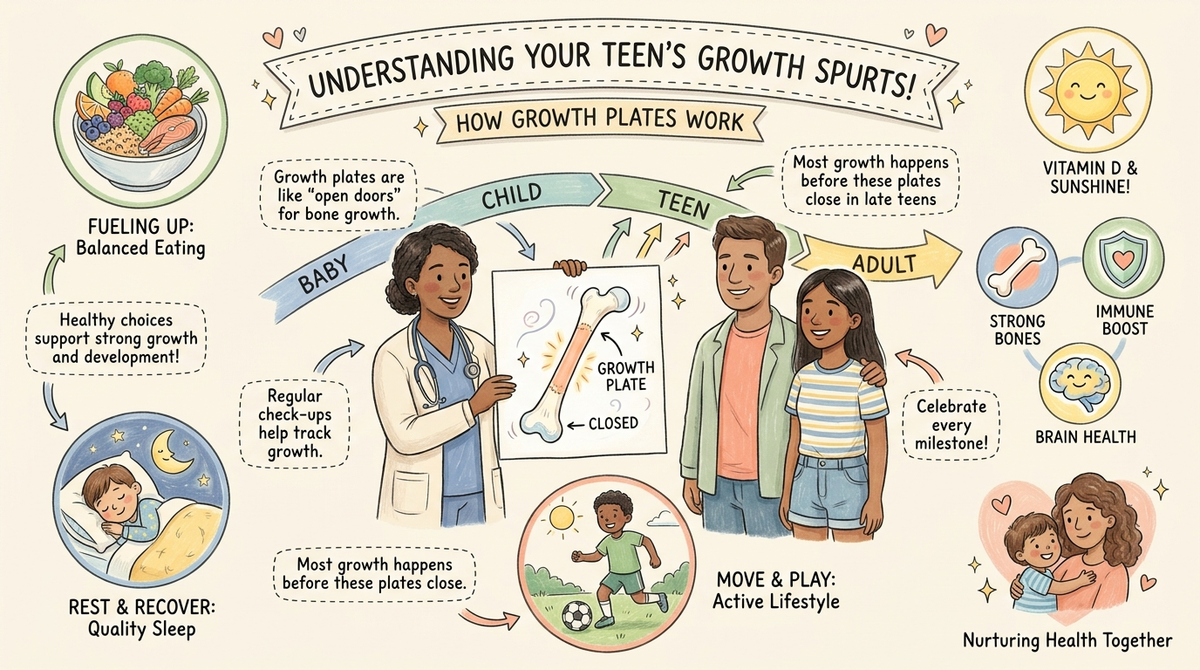
Quick answer: when do growth plates close?
Growth plates usually close near the end of puberty. For girls, that is often around ages 13 to 15. For boys, it is often around ages 15 to 17. Once a plate closes, that bone stops getting longer. A child who starts puberty later often finishes later, so these are ranges, not fixed birthdays.
Source: Nemours KidsHealth, Growth Plates. Want to check your own child? See how to tell if growth plates are open or closed.
If you are reading this at 11pm with a worried feeling, you are not alone. Most parents who search this question are really asking something quieter: how much time do we have left.
This guide gives you the honest answer. The timeline, the signs, and what actually matters while the window is still open.
What Are Growth Plates?
Growth plates are areas of soft, growing cartilage near the ends of a child's long bones, like the bones in the legs and arms. They are where new bone is made. As long as the plates stay open, a child can keep growing.
During puberty, rising hormone levels signal the plates to slowly harden into solid bone. Doctors call this fusion. When a plate fuses, that bone is done growing. According to Nemours KidsHealth, this is a normal part of finishing development, not a problem to fix.
When Do Growth Plates Close in Girls?
In girls, growth plates usually close around ages 13 to 15. Girls tend to start puberty earlier than boys, so their fastest growth and their final growth both happen sooner. Many girls reach close to their adult height within a year or two of their first period.
This is a range, not a fixed date. A girl who starts puberty later may keep growing a little longer. A girl who starts early may finish sooner.
When Do Growth Plates Close in Boys?
In boys, growth plates usually close around ages 15 to 17. Boys start puberty later than girls, so their growth window stays open a couple of years longer on average. That is why a boy who is shorter than his classmates at 14 can still have real growing left to do.
Again, the range matters more than the number. Late puberty often means a later close. This is the honest version of the old "he is a late bloomer" line.
Growth Plate Timeline: Boys vs Girls
Here is the difference at a glance.
| Topic | Girls | Boys |
|---|---|---|
| Growth plates usually close | About 13 to 15 years | About 15 to 17 years |
| Growth window open | Childhood to early or mid teens | Childhood to mid teens |
| Main driver of closure | Puberty hormones | Puberty hormones |
| Height gain possible after closure | No | No |
Ages from Nemours KidsHealth. Every child grows at their own pace.
What Causes Growth Plates to Close?
Puberty is the main driver. As a child moves through puberty, hormone levels rise. Over time they tell the cartilage in the growth plates to harden into bone. When that process finishes, the plate is closed.
This is why the timing of puberty matters more than a child's height today. Two boys can be the same height at 13. The one who starts puberty later will usually have a longer runway.
How Do You Know If Your Child's Growth Plates Are Still Open?
You cannot tell for sure by looking. The only reliable way to know is a bone age X-ray, usually of the hand and wrist. Your child's doctor can order one and compare bone age to actual age.
There are softer signs that a child is still growing: needing bigger shoes, outgrowing pants, and steady gains at checkups. We walk through each sign, and how much to trust it, in our guide on how to tell if growth plates are open or closed. If you really need to know, ask your child's doctor about a bone age scan. A guess from a forum is not the same as an X-ray.
Can You Still Grow After Growth Plates Close?
No. Once growth plates fuse, the long bones cannot add length. No supplement, stretch, or exercise reopens them. Claims that a product can keep growth plates open longer or restart them are not supported by evidence.
This is the part the supplement industry tends to go quiet about. It is also the most important thing for a parent to understand, because it changes what you should focus on.
You do not get the growth window back. That single fact is what this whole topic comes down to.
What Actually Matters While the Growth Window Is Open
Here is the honest framing. Genetics sets the ceiling. It accounts for roughly 60 to 80 percent of a child's final height. You cannot change that.
Nutrition, sleep, and activity influence the rest. They do not raise the ceiling. What they do is help decide whether a child reaches the upper end of their own range, or falls short because of a gap that was fixable.
The research is specific about this. A study of 140 children who were low in zinc found that fixing the shortfall supported more growth than a placebo over six months. But a large trial in JAMA Pediatrics gave 8,851 school children in Mongolia weekly vitamin D or a placebo for 3 years. The vitamin D did not change their height for age, even though 95.5% of the children were low in vitamin D at the start.
Read those two findings together and you get the real rule. Fixing a real nutrition gap can help growth in some kids. It is not a sure thing, and piling extra nutrients onto a child who is already well fed does not help. The job is to close gaps, not to chase a number.
For most kids the common gaps are calcium, vitamin D, zinc, magnesium, and omega-3 DHA. Picky eaters who skip dairy or vegetables often fall short, and DHA is hard to get from a picky eater's plate. The NIH Office of Dietary Supplements sets the daily calcium target at 1,000 mg for ages 4 to 8 and 1,300 mg for ages 9 to 18. Many children fall short.
If you are comparing options, our guide to the best growth gummies for kids in 2026 shows what to look for on a label before you buy.
This is the thinking behind Tallori. It is a zero sugar, 7-in-1 daily gummy for ages 5 to 18, the years when the plates are still open. Each serving has vitamin C, vitamin D3, vitamin K2, calcium, magnesium, zinc, and Omega-3 DHA from algae oil. It helps fill common nutrition gaps and supports healthy growth and bone health. It cannot change what genetics allow. Nothing can. What it can do is help make sure a fixable gap is not what holds a child back.
The Bottom Line
Growth plates usually close around 13 to 15 in girls and 15 to 17 in boys, and the timing follows puberty more than the calendar. After they close, height stops, and nothing reopens them.
While the window is open, the honest goal is simple. Support good sleep, keep your child active, and close any real nutrition gaps. If you want to understand the supplement side of that, read do height growth gummies actually work for kids and our science-backed parent guide to kids growth supplements.
Try Tallori Growth Gummies
Zero sugar. 7-in-1 nutrients with Omega-3 DHA from algae oil. 60 day money back satisfaction guarantee. Ages 5 to 18.
Shop NowKeep Reading
- How to Tell if Your Growth Plates Are Open or Closed (Without an X-Ray)
- Growth Plates in Children: A Parent's Complete Guide (Ages, Signs, and How to Support Them)
- Average Height for 13 Year Old Boy: 2026 Growth Guide
- Do Height Growth Gummies Actually Work for Kids?, the science behind growth supplements
- Kids Growth Supplements: A Science-Backed Parent Guide, what to look for and what to skip
- Best Growth Gummies for Children in 2026, an honest ranking of the major brands
Frequently Asked Questions
At what age do growth plates close?
Can growth plates reopen after they close?
How can I tell if my child's growth plates are still open?
Do girls or boys stop growing first?
Can you still grow after 18?
Does nutrition affect when growth plates close?
Can a supplement keep growth plates open longer?
Medical disclaimer: This article is for information only and is not medical advice. Talk with your child's doctor about any growth concerns. They can order a bone age X-ray and check for any underlying issues. Last updated November 13, 2026.