How Much Calcium Do Growing Kids Need? Ages 5 to 18 Breakdown
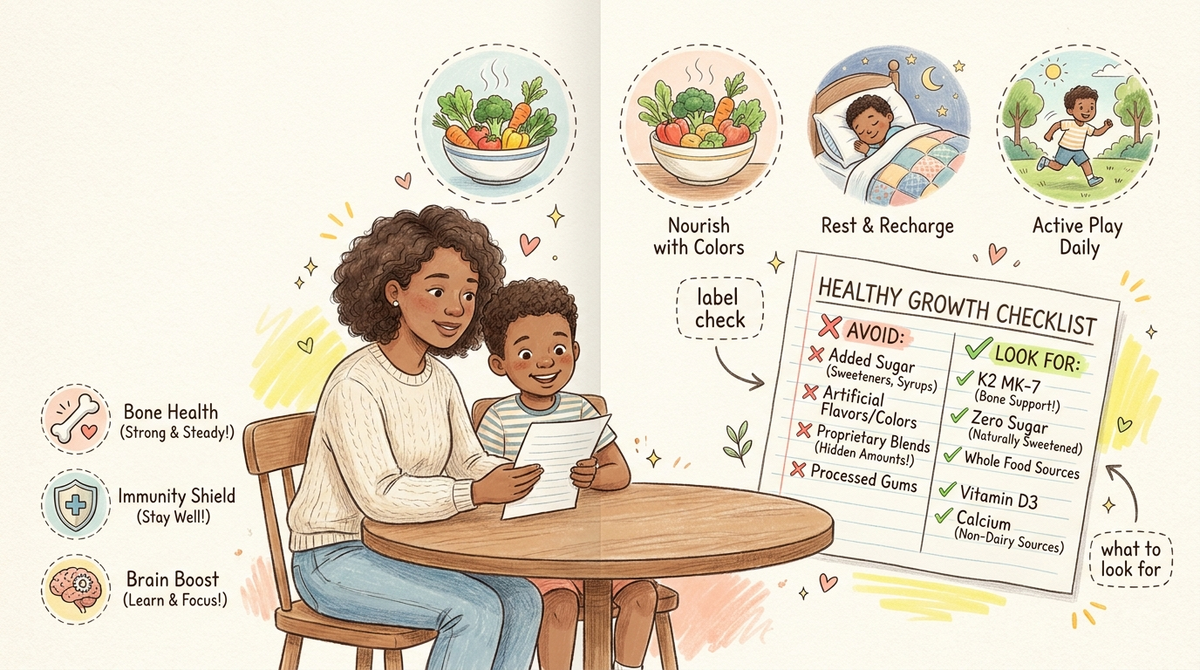
Last updated: August 29, 2026
Calcium for growing kids means the daily mineral amount a child's body needs to build bone mass during the years the skeleton is actively growing, and the number changes fast with age. Kids ages 4 to 8 need 1,000mg a day. At age 9, the requirement jumps to 1,300mg and holds there through age 18, the single biggest jump on the entire pediatric nutrient chart.
You bought the milk. You poured the glass. Some nights he drinks it, some nights it sits there while he pushes it toward the sink. You have no real way of knowing if any of that adds up to enough. Here's the honest math on what "enough" actually means, by age, and what has to happen after the calcium goes in before it does anything for his bones.
How much calcium does my child need each day?
The National Institutes of Health sets the Recommended Dietary Allowance at 700mg for ages 1 to 3, 1,000mg for ages 4 to 8, and 1,300mg for ages 9 to 18. That 9-to-18 figure holds steady through the entire teenage growth window, because that's when a person builds most of the bone mass they'll carry for life.
Most parents assume the number climbs slowly with age. It doesn't. It's flat for years, then jumps 300mg overnight at age 9 and stays elevated for a full decade. That's not a rounding choice. It maps to when the skeleton actually needs the material.
Why does the requirement jump so much at age 9?
Ages 9 through 18 cover the fastest bone-building years of a person's life. Cleveland Clinic notes the adolescent growth spurt can add three to four inches a year during peak height velocity, and that's exactly when the skeleton needs the most calcium to keep pace. Miss this window and there's no second growth spurt to make up the shortfall later.
Girls tend to hit peak height velocity between ages 10 and 14. Boys tend to hit it between 12 and 16. Either way, the calcium requirement doesn't wait for puberty to start. It's already elevated at 9, ahead of the spurt, because bone-building starts before the growth chart shows it.
Can my child get enough calcium from food alone?
Often, yes, if a child eats dairy, fortified plant milk, or leafy greens on a regular basis. The real problem is picky eating. A kid who refuses milk, cheese, and vegetables has almost no remaining path to 1,300mg a day through food alone, which is exactly the gap a targeted formula is built to close.
This is the scenario we hear most from parents. Not "my kid eats nothing." More like "my kid eats the same six foods, and none of them are dairy." The math doesn't work out through willpower or a stricter dinner rule. It works out by finding another delivery method the kid will actually take. If dairy itself is the blocker, our guide to non dairy calcium foods for kids ranks the alternatives by real NIH numbers.
Does calcium alone build strong bones, or does it need help?
No, and this is the single most common gap in a basic calcium supplement. Calcium needs Vitamin D3 to get absorbed from the gut in the first place. Then it needs Vitamin K2 to get routed into bone instead of sitting in soft tissue. Calcium on its own, without D3 and K2 doing their jobs, is roughly a 30 percent solution.
More calcium without K2 doesn't build more bone. It just gives the body a mineral with nowhere useful to go. And calcium is not the only nutrient parents ask about during the growth years. If protein is on your list, our guide to protein for growing kids covers how much they actually need and why most children already get enough.
"My son is nine, and I worry about his growth more than I admit. I always ask myself if I am doing enough for him."
Amanda R., Tallori customer review
Why does Vitamin K2 matter for calcium absorption?
K2 activates a protein called osteocalcin through a process called gamma-carboxylation, which directs calcium into bone. The MK-7 form of K2 has roughly a three-day half-life in the body, compared to K1's few hours, giving it far more time to do that job. A label that just says "Vitamin K" without naming the form is usually K1, the weaker one.
This is one of the biggest differences between a plain calcium gummy and a complete formula, and it's almost never on the front of the package. You have to flip it over and check the form. Emma, who built Tallori's formula, treats this as non-negotiable. If the label doesn't say MK-7, the K2 isn't doing much.
Can a child have too much calcium?
In excess, yes, which is why the NIH sets an upper limit for supplemental calcium. That ceiling exists to guard against stacking high-dose supplements on top of an already calcium-rich diet, not against normal food plus a modest daily gummy. A 300mg serving added to typical food intake sits comfortably within a normal daily total for most kids.
Is a calcium and vitamin gummy safe for a picky eater?
Generally yes, when it's formulated specifically for kids, free of added sugar, and made without hormones. Tallori's 300mg of calcium per serving is paired with 25 mcg of Vitamin D3, Vitamin K2 in the MK-7 form, and magnesium, which NIH data shows makes up 50 to 60 percent of the body's total magnesium stores in bone. Parents should still check with a pediatrician for kids under 5 or with existing conditions.
It comes in a zero-sugar, pectin-based strawberry gummy built for ages 5 to 18, the exact format a picky eater is more likely to actually take every day instead of leaving on the counter.
How is Tallori's calcium dose different from a plain calcium supplement?
A plain calcium supplement usually stops at calcium and maybe D3. Tallori's 300mg of calcium is designed to work alongside food, not replace it, and comes bundled with D3, K2 in the MK-7 form, magnesium, and zinc in one zero-sugar gummy, so a picky eater gets the full absorption chain in a single daily step instead of a shelf of separate bottles.
When should I talk to a pediatrician about my child's calcium intake?
Bring it up at any annual physical, especially if your child avoids dairy, has a milk allergy, follows a vegan diet, or has dropped in growth percentile. A pediatrician can order bloodwork if there's a real concern. Genetics still sets roughly 60 to 80 percent of a child's final height. Nutrition, including calcium, is part of the remaining share.
No gummy overrides that ceiling. What a complete formula can do is make sure a picky eater isn't leaving preventable inches on the table because of a nutrient gap that was fixable the whole time.
What should I actually look for in a kids' calcium supplement?
| Criteria | Plain calcium supplement | Tallori Growth Gummies |
|---|---|---|
| Calcium per serving | Varies by brand, often unpaired | 300mg |
| Includes Vitamin D3 | Sometimes | Yes, 25 mcg |
| Includes Vitamin K2 (MK-7 form specified) | Rarely specified | Yes, MK-7 |
| Includes magnesium | Rarely | Yes |
| Added sugar | Often 2-3g in gummy form | 0g |
| Ingredient dose transparency | Often listed as a "proprietary blend" | All 7 vitamin and mineral doses printed (botanicals sit in a 112.4mg Clean Growth Blend) |
| Age range | Varies by brand | 5 to 18 |
Botanical blends are near universal in this category, and Tallori has one too. Our Clean Growth Blend is 112.4mg and we do not print the individual doses inside it. The useful question is not whether a blend exists, it is whether the nutrients with a published pediatric RDA, the ones you can check against NIH guidance, carry their own milligram figure. Tallori prints all seven of those. A blend that swallows the calcium dose is hiding the number that matters most.

Calcium Needs a Team, Not a Solo Act
Tallori pairs 300mg of calcium with Vitamin D3, K2 in the MK-7 form, magnesium, and zinc in one zero-sugar gummy built for ages 5 to 18. Backed by a 60-day money-back guarantee.
Shop Tallori Growth GummiesRelated Reading
- Non Dairy Calcium Foods for Kids: The Real Numbers Parents Need
- Protein for Growing Kids: How Much They Need and Where It Comes From
- Kids Growth Supplements: A Science-Backed Parent Guide
- Vitamin D3 Dosage for Kids: Correct Amounts by Age
- Vitamin K2 for Kids: Why the Form Matters More Than the Dose
- Magnesium for Kids: Sleep, Recovery, and Growth
Frequently Asked Questions
How much calcium does a 6-year-old need per day?
A 6-year-old falls in the 4-to-8 age band, which the NIH sets at 1,000mg of calcium a day. That's roughly three to four servings of dairy or fortified alternatives. Picky eaters who skip milk and cheese often fall well short, which is why a food-first approach paired with a targeted gummy can help close the gap.
Why does a child's calcium need go up so much at age 9?
At age 9 the RDA jumps from 1,000mg to 1,300mg and holds there through age 18. This covers the entire adolescent growth spurt, when Cleveland Clinic notes kids can gain three to four inches a year at peak height velocity. That's the fastest bone-building window of a person's life, and it needs more calcium to match.
Can kids get enough calcium from food without a supplement?
Many kids can, through dairy, fortified plant milk, and leafy greens. The real-world problem is picky eating. A child who refuses dairy and vegetables has few remaining food sources that add up to 1,300mg a day, which is when parents start looking at a supplement to fill the specific gap food isn't covering.
Does more calcium mean stronger bones on its own?
Not by itself. Calcium needs Vitamin D3 to be absorbed from the gut and Vitamin K2 to be directed into bone instead of soft tissue. A calcium-only supplement without those two co-factors is doing roughly a third of the job. That's why Tallori pairs 300mg of calcium with D3 and K2 in the MK-7 form.
Why does Tallori include 300mg of calcium instead of the full 1,300mg RDA?
Tallori is designed to complement food, not replace it. Most kids get some calcium from meals and snacks already. The gummy is built to close the remaining gap alongside D3, K2, magnesium, and zinc, not to be a child's only calcium source for the day.
Can too much calcium be harmful for kids?
In excess, yes, which is why the NIH sets an upper limit for supplemental calcium. That ceiling is designed to guard against stacking high-dose supplements on top of an already calcium-rich diet, not against normal food plus a modest daily gummy. Tallori's 300mg per serving is well within a typical daily total for most kids.
Is a calcium and vitamin gummy safe for a picky eater?
Generally yes, when it's formulated for kids, zero sugar, and free of hormones. Tallori is pectin-based, sweetened with monk fruit and xylitol, made in a cGMP-compliant facility, and designed for ages 5 to 18. Parents should still check with a pediatrician for kids under 5 or with existing medical conditions.
When should I talk to a pediatrician about my child's calcium intake?
Bring it up at any annual physical, especially if your child avoids dairy, has a milk allergy, follows a vegan diet, or has dropped in growth percentile. Genetics still sets roughly 60 to 80 percent of a child's final height. Nutrition, including calcium, is part of the remaining share a pediatrician can help you optimize.