Minerals for Bone Development in Kids: Beyond Calcium
July 12, 2026

Last updated: July 12, 2026

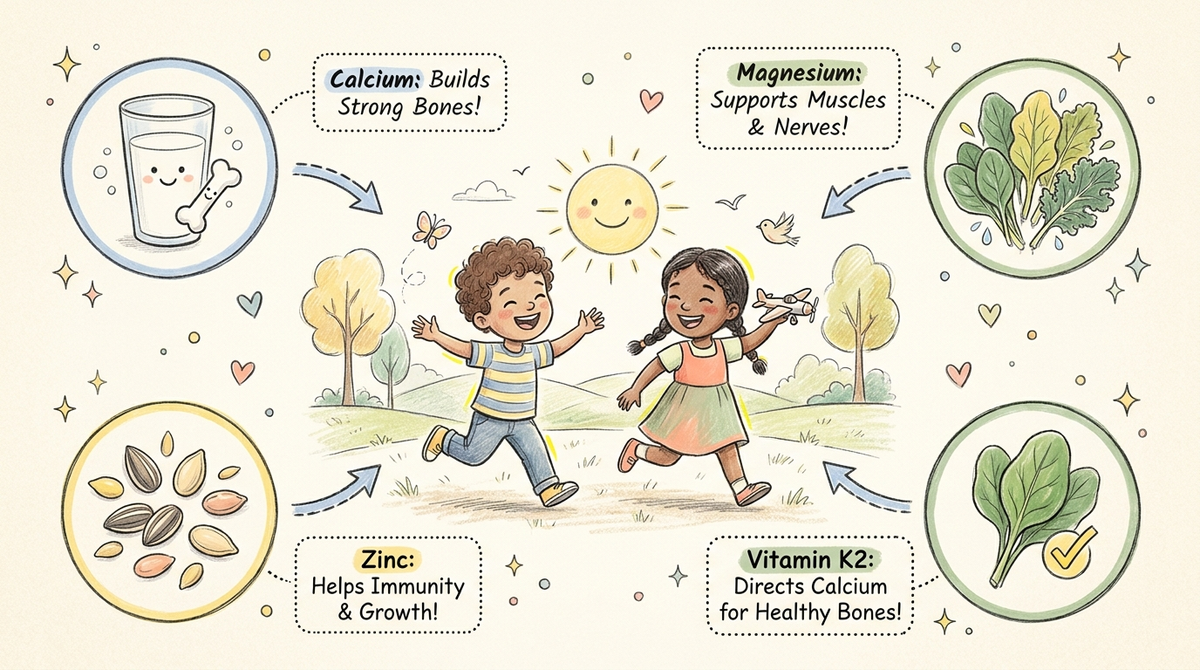
Roughly 50 to 60 percent of the magnesium in a child's body is stored in bone, not muscle. Most growth-gummy labels never mention it. Calcium gets top billing on every bottle, but calcium can't build bone matrix on its own. It needs a supporting cast: magnesium, zinc, and Vitamin K2, each doing a specific job calcium can't do by itself.

Here's what each of these minerals actually does, how much a child needs by age, and what to check on a label before assuming "calcium" is the whole story.

What minerals matter for bone development besides calcium?

Calcium is the raw building material for bone, but three other nutrients determine how well that calcium gets used: magnesium, zinc, and Vitamin K2 (a vitamin, not a mineral, but it belongs in this conversation because of the job it does). Skip any one of them and a child can have adequate calcium intake and still be missing part of the process that turns that calcium into strong bone.

What does magnesium do for a growing skeleton?

Magnesium is structural, not just supportive. Roughly 50 to 60 percent of the body's total magnesium is stored directly in bone tissue, according to the NIH Office of Dietary Supplements. Magnesium also helps activate Vitamin D, and Vitamin D is what allows the body to absorb calcium from food in the first place. A child low in magnesium can be eating enough calcium and still not processing it efficiently, because the activation step upstream is running short.

How much magnesium does my child need by age?

The NIH ODS recommended dietary allowances for magnesium are 130mg for ages 4 to 8, 240mg for ages 9 to 13, and 410mg for boys or 360mg for girls ages 14 to 18. The supplement upper limit (which applies only to supplements and medications, not food) is 110mg for ages 4 to 8 and 350mg for ages 9 to 18. Most processed and packaged foods run low in magnesium, which is part of why picky eaters who lean on convenience foods often fall short here specifically.

What does zinc do for bone development?

Zinc supports collagen synthesis, the protein scaffolding that calcium and other minerals attach to during bone formation. Without adequate collagen structure, calcium has less to bind to. Zinc deficiency in children is also linked to slowed growth and reduced appetite, according to the NIH ODS Zinc Consumer fact sheet, which compounds the problem: a child who isn't getting enough zinc may also be eating less overall, widening every other nutrient gap at the same time.

How much zinc does my child need by age?

Pediatric zinc RDAs are 5mg for ages 4 to 8, 8mg for ages 9 to 13, and 11mg for boys or 9mg for girls ages 14 to 18, per the NIH ODS. The upper limit, which applies to all sources including food, is 12mg (4-8), 23mg (9-13), and 34mg (14-18). Kids with limited-variety diets, especially those who avoid meat and legumes, are the group most likely to run low.

Where does Vitamin K2 fit into this, if it's not a mineral?

Vitamin K2 doesn't provide raw material the way calcium, magnesium, and zinc do. Its job is directional: K2 activates a protein called osteocalcin, and activated osteocalcin is what binds calcium to the bone matrix once it's been absorbed. The MK-7 form of K2 has roughly a three-day half-life, compared to the K1 form found in leafy greens, which clears the body within hours. A supplement that includes calcium, magnesium, and zinc but skips K2 (or lists K2 without naming the form) is still missing the step that tells the body where to put the calcium it has. We cover this mechanism in full in Vitamin K2 for Kids: Why the Form Matters More Than the Dose.

What happens if a child is deficient in these minerals?

The clearest evidence comes from zinc research: a Thai study of 140 children found that zinc-deficient kids who received supplementation grew 5.6cm over six months, compared to 4.7cm in the placebo group, and multiple meta-analyses have found similar 0.3 to 0.5cm gains in zinc-deficient populations specifically. That's an important qualifier. These are documented gains in kids who were actually deficient, not a general "more is better" claim for kids who already have adequate levels. Vitamin D research makes the same point from the other direction: a JAMA Pediatrics trial in Mongolia (n=8,851, three years) found that Vitamin D supplementation in children who were already sufficient did not add height. The pattern holds across all of these nutrients. Fixing a real deficiency can matter. Supplementing past sufficiency doesn't add anything extra.

How do I know if my child's supplement actually covers these bases?

Check the label for four things specifically: a magnesium dose that's actually listed (not folded into a "proprietary blend"), a zinc dose in the pediatric range, Vitamin K2 with the form named (MK-7, not just "Vitamin K"), and confirmation that the product doesn't rely on added sugar for palatability. A gummy that's heavy on sugar creates an insulin response that works against the rest of the formula, which is one reason a complete, correctly dosed mineral stack and a zero-sugar formula tend to go together rather than being separate features.

Nutrient Role in bone development Pediatric RDA range Included in Tallori
Calcium Structural building material for bone 1,000mg (4-8) to 1,300mg (9-18) Yes, 300mg per serving
Vitamin D3 Enables calcium absorption from the gut 600 IU (ages 1+) Yes, 25mcg per serving
Magnesium Stored directly in bone; activates Vitamin D 130mg (4-8) to 410mg (14-18 boys) Yes
Zinc Supports collagen synthesis, the scaffold calcium binds to 5mg (4-8) to 11mg (14-18 boys) Yes
Vitamin K2 (MK-7) Directs absorbed calcium into bone tissue No established RDA specific to K2 Yes, MK-7 form specified

Genetics still sets the outer boundary here. It accounts for roughly 60 to 80 percent of a child's final height, with nutrition and other factors influencing the rest. No mineral, at any dose, moves that ceiling. What a correctly formed magnesium, zinc, and K2 stack can do is make sure a preventable nutrient gap isn't the reason a kid's bones aren't getting everything they need during the years the window is actually open.

Sarah Mitchell, a Tallori parent who tried two other brands first: "I'd already spent $200 on two other brands before Tallori. By month three, my daughter had grown 2.5 inches and was eating her morning gummy without a fight."

The bottom line: calcium is necessary but not sufficient. Magnesium, zinc, and correctly formed Vitamin K2 each do a job calcium can't do on its own, and a formula that skips any of them is only doing part of the work its label implies.

Tallori Growth Gummies - zero sugar chewable with calcium, magnesium, zinc, and K2 MK-7 for kids ages 5 to 18

Tallori Growth Gummies. Calcium, magnesium, zinc, and K2 MK-7, with zero sugar.

Shop Tallori Growth Gummies · 60-day money-back guarantee

Frequently Asked Questions

Is calcium enough for healthy bone development?+

No. Calcium is the raw building material, but magnesium, zinc, and Vitamin K2 each play a role calcium can't fill on its own, from activating Vitamin D to directing calcium into bone tissue once it's absorbed.

How much magnesium does a growing child need?+

The NIH ODS recommends 130mg for ages 4 to 8, 240mg for ages 9 to 13, and 410mg for boys or 360mg for girls ages 14 to 18.

Why is magnesium important for bones specifically?+

Roughly 50 to 60 percent of the body's magnesium is stored directly in bone tissue. Magnesium also activates Vitamin D, which is what allows the body to absorb calcium from food in the first place.

What does zinc have to do with bone growth?+

Zinc supports collagen synthesis, the protein scaffolding calcium and other minerals attach to during bone formation. Zinc deficiency is also linked to slowed growth and reduced appetite in children.

Is Vitamin K2 a mineral too?+

No, K2 is a vitamin, but it belongs in this conversation because its job is to direct absorbed calcium into bone tissue. The MK-7 form stays active roughly three days, compared to hours for the K1 form found in leafy greens.

Can extra minerals help a child who isn't deficient?+

Research on Vitamin D and zinc both show the same pattern: correcting a real deficiency can matter, but supplementing past sufficiency doesn't add extra benefit. A JAMA Pediatrics trial of 8,851 children found Vitamin D supplementation didn't add height in kids who were already sufficient.

What should I check on a label for these minerals?+

Look for a magnesium dose that's actually listed rather than folded into a proprietary blend, a zinc dose in the pediatric range, and Vitamin K2 with the form named as MK-7 rather than just "Vitamin K."

Does Tallori include magnesium, zinc, and K2 together?+

Yes. Tallori Growth Gummies include calcium, magnesium, zinc, and Vitamin K2 in the MK-7 form, alongside Vitamin D3 and algae-sourced omega-3 DHA, with zero added sugar.

Back to blog

Leave a comment

Please note, comments need to be approved before they are published.