Does Drinking Milk Make You Taller? What the Research Actually Shows
Last updated: September 9, 2026
Drinking milk does not make a child taller in the way the old advertising suggested. What the research actually shows is smaller and more specific. In supplementation trials, roughly one glass of milk a day is linked to about 0.4 cm of extra growth per year, and that effect is largest in children who were already short for their age or already falling short on nutrition. Milk does not raise a child's genetic ceiling. It helps a child reach it.
That distinction is the whole answer, and almost nobody makes it. Search this question and you get two camps. One says "myth, genetics decides everything." The other is written by the dairy industry and says "yes, drink up." Neither camp shows you the numbers, and the numbers are more interesting than either position.
Does drinking milk make you taller? The short answer
No single food makes a child taller. Genetics accounts for roughly 60 to 80 percent of final height. The remainder is influenced by nutrition, sleep, and overall health during the years growth plates are still open.
Milk sits inside that remainder. It is a convenient package of calcium, protein, and, in fortified milk, vitamin D. Those are three of the inputs a growing skeleton needs. So milk can help a child grow to the top of their own range. It cannot move the range.
Milk does not add height to a child who was already getting enough. It protects height in a child who wasn't.
What the research actually found
Three studies dominate this question. Here is what each one measured, and just as importantly, what each one cannot tell you.
| Study | Who it studied | What it found | What it cannot tell you |
|---|---|---|---|
| de Beer 2012, meta-analysis of 12 controlled trials (PMID 21890437) | Trials across Europe, USA, China, Northern Vietnam, Kenya, Indonesia and India | "The most likely effect of dairy products supplementation is 0.4 cm per annum additional growth per ca 245 ml of milk daily" | The author notes many trials had "internal validity problems such as lack of randomisation," and rates the overall evidence as moderate quality |
| DeBoer 2014, ECLS-B cohort (PMC5596452) | 8,950 US children at ages 4 and 5 | About 1 cm of height difference between children drinking under 1 serving daily and those drinking 4 or more | Observational, one year of follow-up, parent-reported milk volume. The authors state plainly they were "unable to make further causal inferences" |
| Berkey 2009, Growing Up Today Study (PMC3740511) | 5,101 US girls, aged 9 to 14 at baseline, followed for years | Premenarchal girls drinking more than 3 servings a day grew 0.11 inch more the following year than girls drinking under 1 serving | Self-reported diet surveys, 95 percent white cohort. The authors note observational studies "cannot determine causality as validly as randomized controlled trials" |
Read those effect sizes again, because they are the part that gets lost. Not inches per year. Fractions of a centimetre per year, in the trials, at a glass a day. Berkey's figure is 0.11 inch, which is under 3 mm.
These are real, measurable, repeatedly observed effects. They are also nothing like the promise the milk-makes-you-tall idea carries in most people's heads.
The finding nobody quotes: who the effect is biggest in
The de Beer meta-analysis ran a moderator analysis, and it found something the headline never mentions. In the author's own words, "lower height-for-age and being a teenager increased the effect of supplementation."
Lower height-for-age is the standard marker of chronic undernutrition. So by the meta-analysis's own result, the dairy effect is larger in children who were already shorter and more nutritionally deprived. The trials included in it were run in places like Kenya, Indonesia, India and Northern Vietnam alongside Europe and the USA.
This is the honest shape of the whole topic, and it applies far beyond milk. Nutrition moves height most in the children who were missing something. Add more of a nutrient to a child who already had enough, and you mostly get expensive urine. This is the same pattern seen with vitamin D, where supplementing children who were already sufficient did not add height in a large randomized trial.
Genetics sets the ceiling. Nutrition sets the floor. Milk works on the floor.
It is not the milk, it is what is in the milk
Berkey's team found something that should change how parents think about this. When they added dairy protein to their statistical models, milk itself stopped being significant. Dairy protein predicted height growth at +0.034 inch per 10 grams, with a p-value under 0.001. Dairy fat did not. Non-dairy animal protein and vegetable protein were never significant in their models.
Their conclusion, verbatim: "Of the foods/nutrients studied, dairy protein had the strongest association with height growth."
Yogurt performed at least as well as milk in the same study, at +0.13 inch per cup. That matters, because it means the glass itself is not magic. The nutrients are doing the work, and they arrive in cheese, yogurt, and fortified alternatives too. If your child hates milk but eats yogurt, you have not lost anything.
How much calcium a glass of milk actually delivers
Here is the arithmetic almost no article on this question does, and it reframes the entire discussion.
According to the NIH Office of Dietary Supplements, children aged 9 to 18 need 1,300 mg of calcium a day. Children aged 4 to 8 need 1,000 mg. Now compare that to what dairy actually contains, per the NIH food table:
| Food | Calcium per serving | Percent of a 1,300 mg day |
|---|---|---|
| Yogurt, plain, low fat, 8 ounces | 415 mg | 32% |
| Mozzarella, part skim, 1.5 ounces | 333 mg | 26% |
| Milk, nonfat, 1 cup | 299 mg | 23% |
| Milk, whole, 1 cup | 276 mg | 21% |
| Cottage cheese, 1% milk fat, 1 cup | 138 mg | 11% |
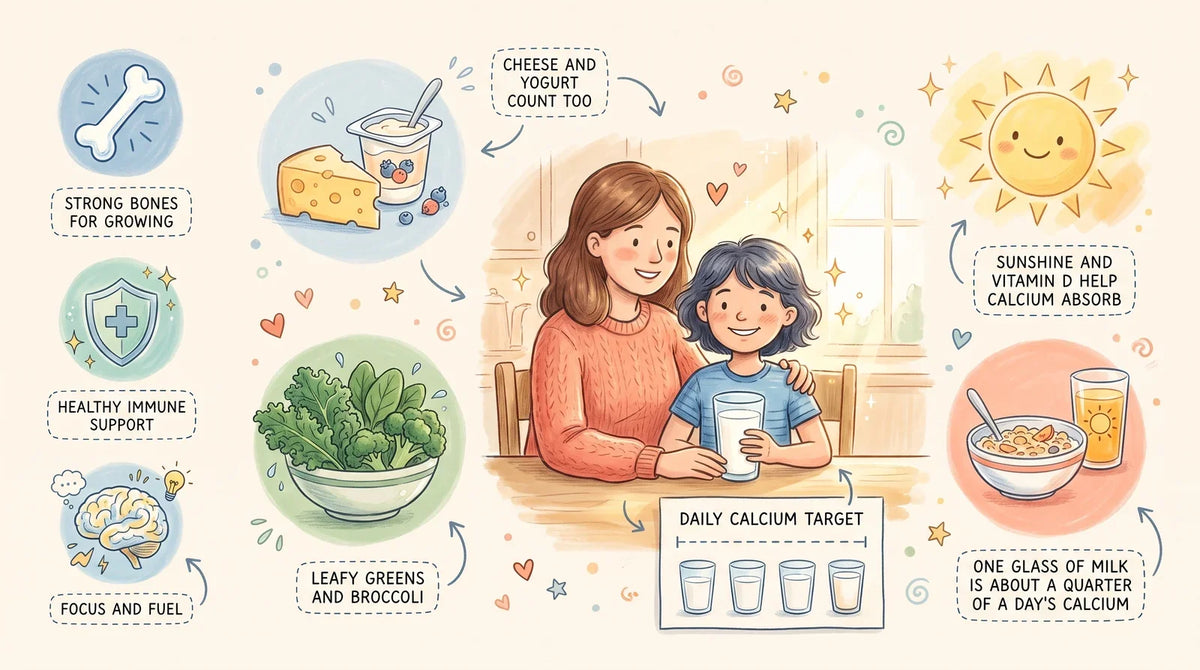
Run the numbers. To hit 1,300 mg on nonfat milk alone, a nine-year-old would need about 4.3 cups a day. On whole milk, closer to 4.7 cups. Two glasses of nonfat milk, which is a perfectly normal day for a milk-drinking child, delivers 598 mg. That is 46 percent of the target.
So even a child who drinks milk twice a day is getting under half their calcium from milk. The rest has to come from somewhere. This is why the NIH lists "children and teens age 4 to 18 years" among the US groups getting less than recommended amounts of calcium. It is not that these kids refuse milk. It is that milk alone was never going to cover it. For the full picture of where the other half comes from, see our guide to calcium for growing kids.
Why more milk is not better
If a little helps, the instinct is to pour more. The DeBoer study is the reason to resist that instinct.
In that same cohort of 8,950 preschoolers, children drinking 3 or more servings daily had higher odds of being overweight or obese, with an adjusted odds ratio of 1.16 and a 95 percent confidence interval of 1.02 to 1.32. The paper's own conclusion supports the American Academy of Pediatrics recommendation that preschool children consume 2 milk servings daily. The authors found the height benefit and the weight risk in the same dataset, and still landed on a cap.
There is also a ceiling on calcium itself. The NIH sets an Upper Limit of 2,500 mg a day for ages 1 to 8 and 3,000 mg for ages 9 to 18, counting all sources. And calcium is absorbed best in doses of 500 mg or less at one time, which means four glasses at breakfast is worse arithmetic than one glass at four points in the day.
Milk is also filling. A child who drinks a litre of it has less appetite for the iron, zinc and vegetables they also need. That trade-off is real, and it is the same displacement problem we covered in whether coffee stunts your growth, just running in the opposite direction.
What to do if your child will not drink milk
Plenty of children cannot or will not. Lactose intolerance, milk allergy, a vegan household, or simple refusal. The NIH treats this as a solvable problem, not a crisis, and lists the alternatives directly.
Some of them beat milk on paper. Fortified orange juice carries 349 mg per cup and fortified soy milk 299 mg per cup, both at or above cow's milk. Firm tofu made with calcium sulfate gives 253 mg per half cup. Canned pink salmon with the bones in gives 181 mg per 3 ounces.
One caution worth knowing. Absorption from dairy and fortified foods runs about 30 percent, but absorption from spinach is only 5 percent compared with 27 percent for milk, because oxalic acid binds the calcium into salts the body cannot use. So the 123 mg on a spinach label is not 123 mg your child keeps. Low-oxalate greens like broccoli, kale and bok choy absorb about as well as milk, they just carry less per serving. We worked through the whole ranked list in non-dairy calcium foods for kids.
Vitamin D matters here too, since it is what lets the body absorb calcium in the first place. A child hitting their calcium target with poor vitamin D status is not getting the benefit they think they are.
What milk cannot do
Milk cannot extend the growth window. Growth plates close on their own schedule, typically ages 13 to 16 in girls and 15 to 19 in boys, and once they have closed no food or supplement changes final height. If you want the timeline for your own child, we mapped it in when do growth plates close.
Milk also cannot beat the genetic estimate. If you have run the mid-parental height formula and want to know how much of the result is fixed, how tall will my daughter be walks through what the number does and does not predict. The short version: the formula describes the middle of a range your child was born into, and nothing on a grocery shelf moves that range.
And milk is not a protein strategy. Dairy protein was the active ingredient in Berkey's models, but the amounts involved come from ordinary food, not supplements. Most children in Western countries already get two to three times the protein they need, as we covered in protein for growing kids.
When to talk to your pediatrician
The question worth asking is not whether your child is as tall as their classmates. It is whether they are still growing at a normal rate. A growth curve that was tracking normally and has recently flattened is what warrants a conversation, tracked over several months rather than judged in a single visit.
A pediatrician can confirm whether a real deficiency exists before you change anything. Blood work answers in a week what guesswork never answers at all. That is also the right moment to raise lactose intolerance, a restrictive diet, or an absorption condition like celiac or Crohn's, all of which change the calcium maths considerably.
Where a supplement fits, honestly
If milk covers under half a teenager's calcium and your child drinks little or none of it, the gap is arithmetic, not opinion. Food should close it first. Yogurt, cheese, fortified juice, tofu, canned fish with bones, and low-oxalate greens all count.
A gummy multivitamin is a gap-filler for the days food does not get there, which for a picky eater is most days. Tallori Growth Gummies carries 300 mg of calcium per 2-gummy serving, which is roughly one glass of milk, alongside vitamin D3 at 25 mcg and vitamin K2 in the MK-7 form at 100 mcg. The K2 form matters more than most labels admit, and we explained why in vitamin K2 for kids.
Being straight about what that means: 300 mg is not a replacement for a diet. It is about 23 percent of a nine-year-old's daily target, the same share a glass of milk provides. Tallori is designed to sit alongside food, not instead of it. It will not make a child taller, and any brand telling you otherwise is selling you something the research does not support. What it can do is stop a preventable shortfall from being the thing that holds a child below their own range. If you want the broader view of how these formulas are built, start with natural height growth supplements, and for where the gaps usually hide, hidden nutrition gaps in kids.

Try Tallori Growth Gummies
Zero sugar. All 7 vitamin and mineral doses printed on the label. 60-day money-back guarantee. Ages 5 to 18.
Shop NowRelated Reading
Frequently Asked Questions
Does drinking milk make you taller?
Not on its own. A 2012 meta-analysis of 12 controlled trials found the most likely effect of dairy supplementation is about 0.4 cm per year of additional growth per roughly 245 ml of milk daily. That is a real but small effect, and it is largest in children who were already short for their age. Genetics accounts for roughly 60 to 80 percent of final height, and no food changes that ceiling.
How many glasses of milk a day should a child drink?
The 2014 ECLS-B study of 8,950 preschoolers supports the American Academy of Pediatrics recommendation that preschool children have 2 milk servings daily. In that same cohort, children drinking 3 or more servings a day had higher odds of being overweight or obese. More milk is not automatically better, and the rest of a child's calcium is meant to come from other foods.
How much calcium is in a glass of milk?
Per the NIH Office of Dietary Supplements, one cup of nonfat milk has 299 mg of calcium and one cup of whole milk has 276 mg. Children aged 9 to 18 need 1,300 mg a day, so a single glass covers about 23 percent of the target and two glasses cover about 46 percent.
Is it the milk itself or the nutrients in it?
The nutrients. In the 2009 Growing Up Today Study of 5,101 girls, once dairy protein was added to the statistical model, milk itself was no longer significant. Yogurt predicted height growth at least as well as milk. The authors concluded dairy protein had the strongest association with height growth of the foods and nutrients they studied.
What if my child will not or cannot drink milk?
There are alternatives that match or beat milk per serving. NIH figures put fortified orange juice at 349 mg per cup, fortified soy milk at 299 mg per cup, firm tofu made with calcium sulfate at 253 mg per half cup, and canned pink salmon with bones at 181 mg per 3 ounces. Yogurt at 415 mg per 8 ounces is higher than milk. Lactose intolerance or a dairy-free diet is a solvable planning problem, not a lost cause.
Does spinach count as a good calcium source?
Less than the label suggests. NIH notes that calcium absorption from spinach is only about 5 percent compared with 27 percent for milk, because oxalic acid binds calcium into indigestible salts. Low-oxalate greens like broccoli, kale and bok choy absorb about as well as milk, though they carry less calcium per serving.
Can drinking more milk during puberty add extra inches?
No. The largest observed effects are fractions of a centimetre per year, and they concentrate in children who were undernourished to begin with. Growth plates close on their own schedule, typically ages 13 to 16 in girls and 15 to 19 in boys, and once they close no food or supplement changes final height.
Does Tallori replace milk?
No. Tallori Growth Gummies provides 300 mg of calcium per 2-gummy serving, which is roughly one glass of milk and about 23 percent of a nine-year-old's daily target. It is designed to fill gaps alongside food, not to replace dairy or any other food group. It does not make children taller. Tallori is zero sugar, sweetened with monk fruit and xylitol, prints all 7 vitamin and mineral doses on the panel alongside a 112.4mg Clean Growth Blend of botanicals, and is designed for ages 5 to 18.
This article is for informational purposes and is not medical advice. Talk to your child's pediatrician about any nutrition or growth concerns.