Hidden Nutrition Gaps in Kids: What Even Balanced Diets Miss
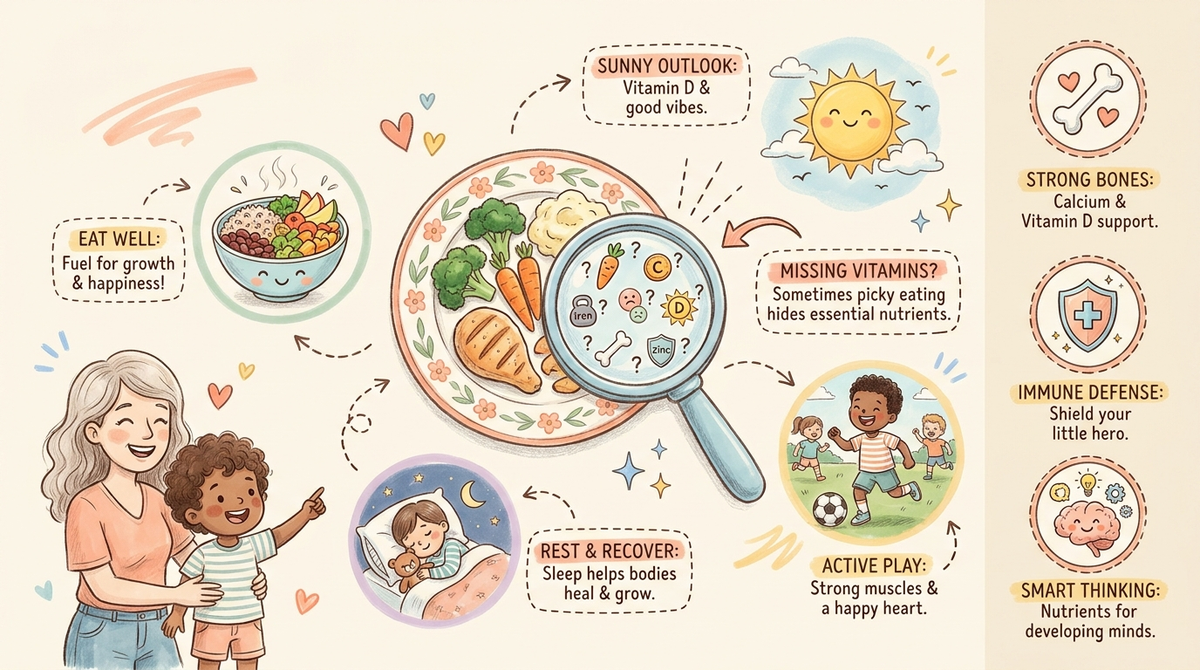
Your child finishes dinner every night. Sometimes goes back for seconds. And yet U.S. National Health and Nutrition Examination Survey data consistently identifies 5 specific nutrients that fall short in the diets of most American children ages 4 to 18. Not in malnourished children. In normal, well-fed kids.
This post is about those 5 nutrients. Where the gap comes from. Why picky eaters face a compounding risk. And what to check on a supplement label before you try to fill the gap with something that may not fully deliver.
Why Even Balanced Diets Leave Gaps
Modern produce contains fewer vitamins and minerals than it did 50 years ago. Soil depletion and commercial farming have measurably reduced the nutrient density of many fruits and vegetables. Your child could be eating more servings of vegetables than you did growing up and still getting less of certain minerals.
Picky eating adds another layer. A child who consistently avoids leafy greens, fatty fish, nuts, and legumes is bypassing the primary food sources for zinc, omega-3 DHA, magnesium, and vitamin K2. That is not a parenting failure. It is a developmental pattern that affects most children between ages 5 and 10.
The result is a gap that does not show up at the dinner table. It appears over months and years, in immune resilience, sleep quality, ability to concentrate, and bone development.
The 5 Nutrients US Kids Most Commonly Miss
Zinc
Zinc supports cell division, immune response, and protein synthesis. It is one of the nutrients most directly connected to healthy development during the growing years.
The National Institutes of Health recommends 5 milligrams of zinc per day for ages 4 to 8, and 8 to 11 milligrams for ages 9 to 18. Reaching that consistently requires regular consumption of red meat, shellfish, or legumes. Children who avoid those foods often fall short without any visible sign of it.
What makes zinc gaps harder to spot: low zinc intake can reduce appetite and worsen picky eating. A child who already has narrow food preferences and consistently low zinc intake may be caught in a cycle that is difficult to identify from the outside.
Magnesium
Magnesium supports more than 300 enzymatic processes in the body. Bone formation, muscle function, and the nervous system regulation that controls sleep quality all depend on it.
The NIH recommends 130 milligrams per day for children ages 4 to 8, and 240 milligrams for ages 9 to 13. The primary food sources are dark leafy greens, nuts, seeds, and whole grains. These are among the foods most consistently refused by picky eaters.
A child who struggles to fall asleep, wakes frequently, or seems wired before bedtime may have lower magnesium intake than their body needs. The connection between magnesium and sleep quality in children is supported by pediatric nutrition research, though it is rarely the first thing a parent is told to check. A calm bedtime routine, including consistent screen time limits before bed, matters alongside the nutrition side of the equation.
The form matters when choosing a supplement. Magnesium glycinate is absorbed significantly better than magnesium oxide. Many low-cost children's vitamins use magnesium oxide because it is cheaper to manufacture.
Vitamin K2
This is the gap most parents have never heard of, and it may be the most important one for bone development.
Calcium is the well-known bone nutrient. But calcium alone does not build bone. It needs to be actively directed to the right place. Vitamin K2 does that. It activates the proteins that guide calcium into bone tissue rather than leaving it circulating in soft tissue.
The problem is that K2 is found almost exclusively in natto (fermented soybeans), aged cheeses, and certain animal organ meats. The realistic probability of a 7-year-old eating natto regularly is essentially zero. Most children's diets contain almost no K2.
The form used in a supplement also matters. Research suggests K2 in MK-7 form has a half-life of approximately 72 hours, meaning it stays active in the body far longer than K2 MK-4, which clears within a few hours. Many budget supplements use MK-4 because it is less expensive.
Omega-3 DHA
DHA is the omega-3 fatty acid most critical for brain function and nervous system development during childhood. The body cannot synthesize adequate amounts on its own. It must come from food or a supplement.
DHA is hard to get from a picky eater's plate. Many parents try to supplement with flaxseed oil, but flaxseed provides ALA, which the body then attempts to convert to DHA. That conversion is inefficient, especially in young children.
Low DHA intake has been associated with difficulty concentrating and inconsistent sleep in school-age children. For a picky eater, this is one of the hardest nutrient gaps to close through diet alone.
Vitamin D
Vitamin D is the most widely discussed childhood nutrition gap. It is also still widely missed.
The body produces vitamin D through sun exposure. Most US children spend the majority of their daylight hours indoors at school, and many use sunscreen during outdoor time. The NIH recommends 600 IU per day for children ages 1 and older.
Vitamin D is required for calcium absorption. A child with insufficient vitamin D may absorb calcium poorly regardless of how much calcium is in their food. Calcium, K2, and vitamin D work as a delivery system. All three need to be present for any one of them to function as intended.
Why Picky Eaters Face a Compounding Risk
A child who eats a wide variety of foods has a reasonable chance of picking up some of these nutrients through diet, even inconsistently. A picky eater has almost no reliable food-based route to adequate K2, DHA, or sufficient magnesium and zinc.
This is the piece that most nutrition advice skips. It is not one isolated gap. It is the same 3 to 5 gaps appearing together, in the same children, across multiple years. And because these nutrients work together, each gap reduces the effectiveness of the others.
Jennifer has a 7-year-old who eats pasta, chicken nuggets, apples, and refuses most vegetables. She is doing everything right by the conventional measure. She is also likely looking at low zinc, low magnesium, nearly zero K2, low DHA, and potentially low vitamin D. Not because she is failing. Because those nutrients do not exist in the foods her son will accept.
Genetics sets a ceiling for how tall a child can grow. Nutrition sets the floor for how close they get to that ceiling. Research suggests that nutrition, sleep, and overall health influence somewhere between 20 and 40% of a child's final height outcome. Growth plates typically remain open until approximately ages 14 to 16 in girls and 16 to 19 in boys. The window is real, and it is not permanent.
The Problem with Most Supplement Solutions
Here is where the picture gets more complicated.
Most children's gummies on the market contain 3 to 5 grams of sugar per serving. That sounds minor. But sugar triggers an insulin response. And elevated insulin can interfere with the absorption of fat-soluble vitamins, including K2 and vitamin D.
The result is a supplement that lists K2 and calcium on the label but partially works against their delivery through the same formula. A complete ingredient list on a high-sugar gummy is not the same as a complete formula with effective absorption.
Zero sugar changes this. Without a sugar-driven insulin spike, fat-soluble nutrients have a cleaner absorption pathway. This is why the sweetener matters as much as the ingredient list.
Monk fruit is FDA GRAS-certified (Generally Recognized As Safe). It produces no insulin response and no blood sugar spike. Tallori uses monk fruit alongside xylitol, and neither one adds sugar.
What to Check on Any Supplement Label
Four questions take under two minutes at the store or on the brand website.
Are the vitamin and mineral doses listed? If the label shows a "growth blend" or "proprietary formula" without milligrams for each vitamin and mineral, you cannot verify what you are actually giving your child. Transparency on dosing is a minimum standard.
What form is the K2? Look for MK-7 specifically. A label that says "Vitamin K2" without identifying the form is most likely using the shorter-acting MK-4.
What is the DHA source? Algae-sourced DHA delivers directly. Flaxseed-derived omega-3 requires a conversion step that children's bodies do not perform efficiently.
What is the sugar content? A sugar-sweetened gummy with a strong ingredient list is not the same as a zero-sugar formula with the same ingredients. The delivery mechanism affects what your child absorbs.
These four questions separate a well-formulated supplement from a well-marketed one.
How Tallori Supports These Specific Gaps
Tallori was designed around these 5 gaps. It contains K2 in MK-7 form, DHA from algae oil, magnesium glycinate, vitamin D3, zinc, and calcium. All 7 vitamin and mineral doses are printed on the label. The botanicals sit in a 112.4mg Tallori Clean Growth Blend, and those single doses are not printed.
It is sweetened with monk fruit and xylitol. Zero added sugar. Two gummies per day. Ages 5 to 18. Strawberry flavor, pectin-based (no gelatin).
Made in an FDA-registered, GMP-certified facility.
Kids ask for them by name. Consistency matters more than any single ingredient. The most complete formula does not help a child who refuses to take it.
Tallori comes with a 60-day money-back guarantee.