Best Multivitamin for Kids in 2026: 7 Brands Compared
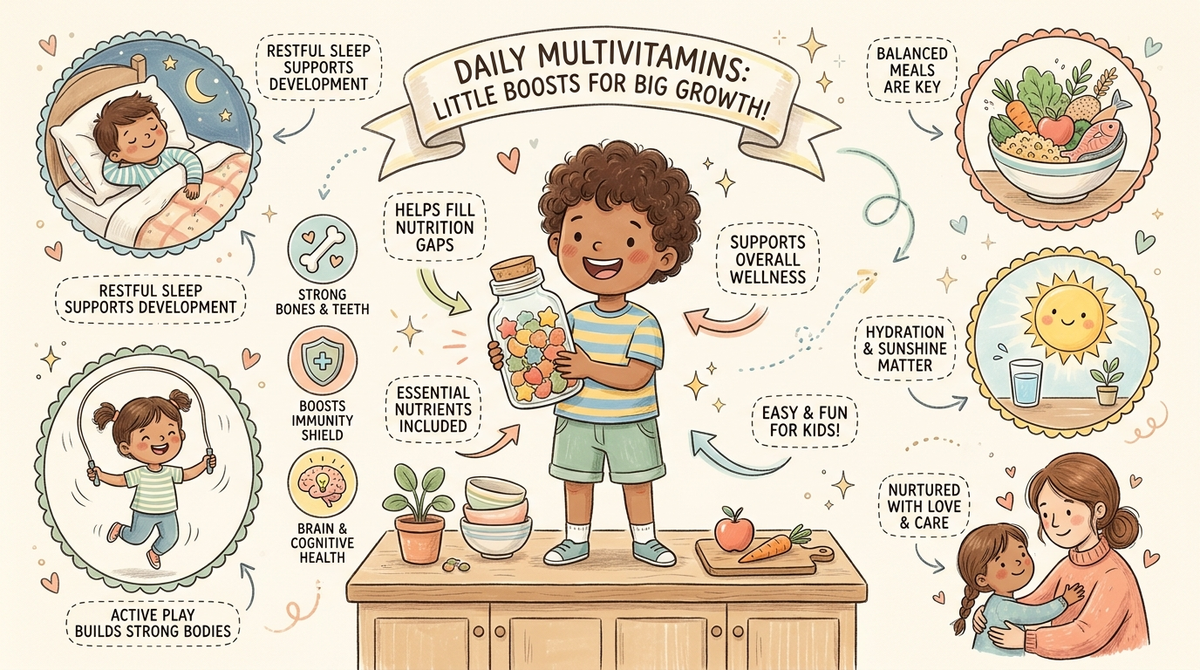
Many parents buy the most popular kids' gummy on the shelf and never read the label closely. The vitamins are real. So is the added sugar. One is helping. The other is not.
The best multivitamin for kids in 2026 is not the one with the best commercial or the most colorful packaging. It is the one that actually delivers nutrients during the years when growing bodies need them most.
Quick answer: What is the best multivitamin for kids in 2026?
The best multivitamin for kids covers bones (calcium, vitamin D3, vitamin K2 in MK-7 form), brain (omega-3 DHA from algae, not flaxseed), immunity (zinc, vitamin C), and daily nutrition gaps from picky eating (magnesium, spinach, ashwagandha for stress and sleep). It should have zero or very low added sugar, a label that prints the individual vitamin and mineral doses, GMP-certified manufacturing, and a format children will actually take daily. For most parents of picky eaters ages 5 to 18, Tallori Growth Gummies meets all five criteria in a single daily gummy.
Why most kids' multivitamins do not deliver what parents expect
Most reviews of kids' vitamins rank products by taste, gummy texture, and whether the packaging looks fun. Those things matter for daily compliance. They are not why growth outcomes differ between kids on different formulas.
Two things on the label predict whether a vitamin will work. Most parents never check either one.
The first is sugar. Gummy vitamins need something to hold them together and make them taste good. Most brands choose sugar or glucose syrup. A single serving of several leading kids' gummies contains between 2 and 5 grams of added sugar. According to the American Heart Association, children ages 2 to 18 should consume no more than 25 grams of added sugar per day. A daily gummy that contributes 3 to 5 grams of that budget before breakfast is not a neutral choice.
The second is vitamin K2. K2 activates the proteins that direct calcium toward bone tissue instead of soft tissue. The form that stays active long enough to do that job is MK-7, which has a half-life of roughly 3 days. The cheaper form, K1, is cleared from the bloodstream in hours. A label that says "Vitamin K" without specifying the form almost always means K1. Parents searching for a multivitamin to support bone development during the growth years should check for K2 MK-7 specifically.
The 4-point label check every parent should run
Before comparing brands, run these four checks on any label you are considering. They take 90 seconds and immediately eliminate about half the products on most shelves.
1. How much sugar per serving?
Look at the Supplement Facts panel, not the marketing copy. Any amount over 2 grams of added sugar per serving is worth questioning, especially if the vitamin also contains nutrients like K2 that work best in a low-sugar environment. Zero added sugar formulas sweetened with monk fruit or stevia exist. They are not harder to find. They are just less commonly marketed as aggressively as the candy-flavored alternatives.
2. Does it say K2 MK-7 specifically?
A multivitamin that lists "Vitamin K" without the form is hiding the form because the form is K1. This is one of the single biggest formula differentiators most parents do not know to ask about. MK-7 is the only K2 form with a meaningful half-life for bone support in a once-daily gummy. If the label says K1 or says nothing, look for another option.
3. Where does the omega-3 come from?
Several kids' multivitamins include omega-3 fatty acids, which is worth having for brain and focus support. The source matters. Flaxseed oil provides ALA, which the body must convert to DHA. That conversion rate in children is low. Algae-sourced DHA delivers the active form directly, with no conversion step required. Look for "algae DHA" or "DHA from algae" on the label.
4. Are the ingredient doses listed individually?
If the label says "proprietary growth blend: 400mg" without breaking down the individual amounts of each ingredient, that is not formula privacy. That is hiding the math. A trustworthy brand publishes the exact milligram amount of every vitamin and mineral. It is how you confirm the formula actually covers the daily requirements your child needs, not just the minimum needed to put an ingredient name on the label.
7 multivitamins for kids compared in 2026
Here is how seven leading options compare across the four criteria above. Always confirm competitor details with current product labels before purchasing.
| Brand | Added Sugar | K2 Form | Omega-3 Source | Label Transparency | Best For |
|---|---|---|---|---|---|
| Tallori | 0g (monk fruit and xylitol) | K2 MK-7 ✅ | Algae DHA ✅ | All 7 vitamin and mineral doses printed ✅ | Picky eaters 5–18, bone + brain + immunity complete |
| Hiya Kids | 0g added sugar | Check current label | None listed | Individual doses listed | Parents wanting zero-sugar basics without omega-3 |
| First Day Kids | 0g added sugar | Check current label | Check current label | Individual doses, triple-tested | Parents who prioritize safety testing above all |
| SmartyPants Kids | Check current label | Check current label | Flaxseed ALA (conversion required) | Individual doses listed | Parents wanting omega-3 included who are OK with ALA conversion |
| Olly Kids Multi | Check current label | Check current label | None | Individual doses listed | Parents focused on basic coverage at lower price |
| NuBest Tall Kids | Check current label | Check current label | Check current label | Check label for blend transparency | Parents already in the NuBest ecosystem |
| Flintstones Kids | Contains added sugar | Check current label | None | Individual doses listed | Familiarity and pharmacy availability |
What makes a multivitamin work for picky eaters specifically
Most multivitamins were formulated for kids who eat balanced diets. The nutrient gaps left by a picky eater are different. They are deeper.
A child who refuses fish is almost certainly low on DHA. A child who avoids dairy misses calcium and D3 daily. A child who eats fewer than 10 different foods across a week is likely low on zinc, magnesium, and the whole-food micronutrients that do not appear on most supplement labels.
Emma built Tallori specifically for this gap. Not a height gummy, not a calcium tablet, not a general daily vitamin. A complete daily formula for the kid who wins the negotiation at dinner. Calcium (300mg per serving), vitamin D3 (25mcg), K2 MK-7, magnesium, zinc, algae DHA, vitamin C, spinach powder, ashwagandha, L-arginine and glutamine, astragalus, monk fruit, and xylitol. Zero added sugar. Strawberry flavor. Pectin-based, which means non-sticky and dentist-friendly.
Compliance is the ingredient most multivitamin reviews leave off the comparison table.
How long before you notice a difference?
The honest timeline is 8 to 12 weeks for early signals. Appetite, energy, and sleep quality sometimes shift first. Visible changes in growth are a longer-term outcome. They require consistent daily use across months, not days.
According to research cited in peer-reviewed pediatric nutrition literature, supplementation in children who are deficient in key nutrients like zinc can show measurable impact on growth over 6 months of consistent use. Supplementation in children who are already nutritionally sufficient does not add growth. The supplement fills a gap. It does not override genetics.
Genetics accounts for roughly 60 to 80 percent of final height. Nutrition during the growth window influences the rest. Growth plates are typically open in girls through ages 13 to 16 and in boys through ages 15 to 19. After that, the window closes permanently. The supplement question is not "will this make my child taller." The question is "is my child reaching the top of their own genetic range, or are preventable nutrition gaps leaving potential on the table."
Is it safe to give your child a daily multivitamin?
For most healthy children, a daily multivitamin at age-appropriate doses is safe. The American Academy of Pediatrics notes that children who eat varied diets generally do not need supplementation. Picky eaters, children on restricted diets (vegan, dairy-free, gluten-free), and children with documented deficiencies benefit most.
Fat-soluble vitamins (A, D, E, K) can accumulate in the body, so doses matter. A well-formulated children's supplement stays within safe daily limits by design. Look for products that list individual doses and stay within the NIH Office of Dietary Supplements reference ranges for each nutrient. Tallori's vitamin D3 dose of 25mcg (1,000 IU) sits comfortably within the 600 IU RDA with margin below the 3,000 IU upper limit for children ages 4 to 8 per NIH ODS guidance.
Always consult your pediatrician before starting any supplement, particularly if your child has a diagnosed condition or takes prescription medication.
The bottom line: what to look for in 2026
Most parents do not have time to study supplement labels for 45 minutes. Here is the short version.
Check sugar first. Check K2 form second. Ask where the omega-3 comes from. Confirm every vitamin and mineral dose is on the label individually. If all four pass, you have a formula worth considering.
For picky eaters ages 5 to 18 who need bone, brain, and daily nutrition support in one daily gummy, Tallori is built to cover all of it without added sugar. GMP-certified. 60-day money-back guarantee.
Try Tallori Growth Gummies
Zero sugar. 7-in-1 nutrients. 60-day money-back guarantee. Ages 5 to 18.
Shop NowRelated reading
Frequently Asked Questions
What is the best multivitamin for kids in 2026?
Do kids actually need a multivitamin?
What is the difference between a multivitamin and a growth gummy?
Why does sugar in a kids' vitamin matter?
What is vitamin K2 MK-7 and why does the form matter for kids?
How long does it take for a kids' multivitamin to show results?
Is a daily multivitamin safe for my child?
What makes Tallori different from other kids' gummy vitamins?