How Tall Will My Daughter Be? The Formula Pediatricians Use
Last updated: September 5, 2026
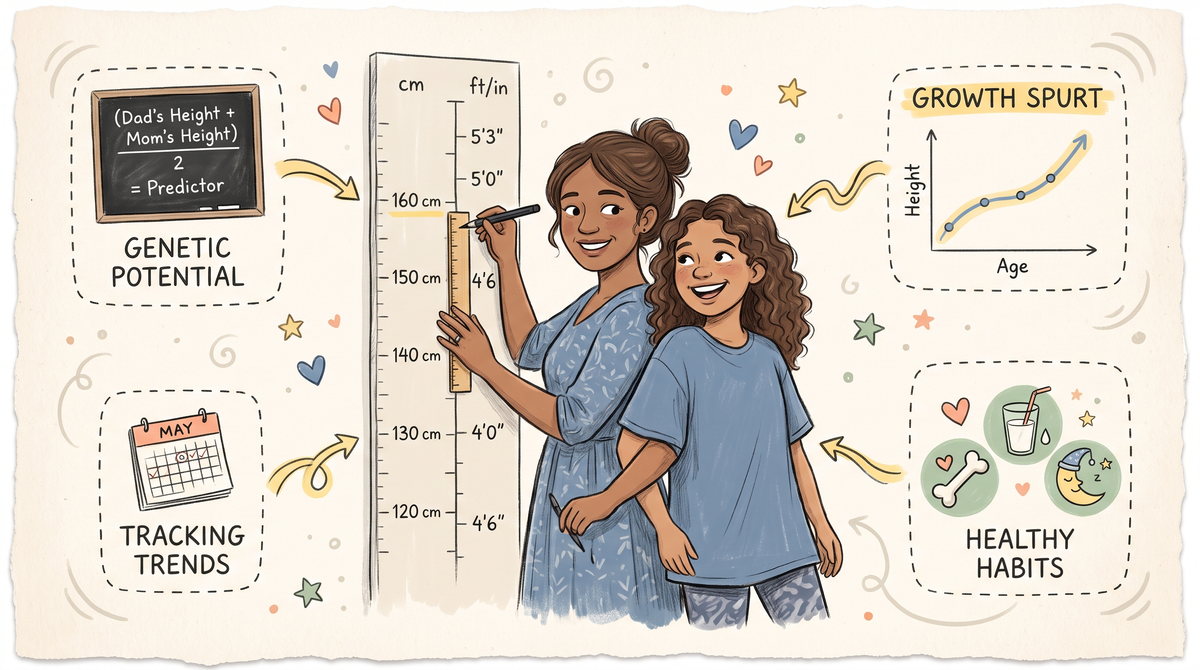
The most common way to estimate how tall your daughter will be is the mid-parental height formula: add both parents' heights together, subtract 5 inches (13 centimeters), then divide by 2. Mayo Clinic publishes this method and is blunt about its limits. In their words, "There's no sure way to tell what a child's adult height will be." The number the formula gives you is not a prediction. It is the middle of the genetic range your daughter was born into, and where she lands inside that range depends on the years you are living through right now.
This guide walks through the formula step by step with worked examples, explains what the answer does and does not mean, covers when girls actually stop growing, and separates the things that genuinely influence where a girl finishes from the things that sell well and do nothing.
The mid-parental height formula, step by step
Mayo Clinic describes the calculation in three steps. Use inches or centimeters, but do not mix them.
- Add the mother's height to the father's height.
- Subtract 5 inches (13 centimeters) for a girl. For a boy you add 5 inches instead.
- Divide by 2.
That is the whole thing. The 5 inch adjustment exists because adult men are on average taller than adult women, so the formula corrects the parental average toward the child's own sex before splitting the difference.
| Child | Formula (inches) | Formula (centimeters) |
|---|---|---|
| Daughter | (mother's height + father's height, minus 5) ÷ 2 | (mother's height + father's height, minus 13) ÷ 2 |
| Son | (mother's height + father's height, plus 5) ÷ 2 | (mother's height + father's height, plus 13) ÷ 2 |
Source: Mayo Clinic, Child growth: Can you predict adult height? One caution before you run the numbers. Measure both parents properly rather than using the height on a driver's licence. Shoes off, heels against a wall, eyes level, a flat book on the head. A single inch of optimism from each parent moves the answer by a full inch.
Worked examples with real numbers
Numbers make this concrete. Three households, all daughters.
Example one. Mom is 5 feet 4 inches (64 inches). Dad is 5 feet 10 inches (70 inches). Add them: 134. Subtract 5: 129. Divide by 2: 64.5 inches, or about 5 feet 4 and a half.
Example two. Mom is 5 feet 1 inch (61 inches). Dad is 5 feet 7 inches (67 inches). Add them: 128. Subtract 5: 123. Divide by 2: 61.5 inches, or about 5 feet 1 and a half.
Example three. Mom is 5 feet 8 inches (68 inches). Dad is 6 feet 1 inch (73 inches). Add them: 141. Subtract 5: 136. Divide by 2: 68 inches, or 5 feet 8.
Notice what the three examples have in common. In every case the daughter's estimate lands close to her mother's height, nudged up or down by her father's. That is the formula working exactly as designed, and it is also why the answer rarely surprises anyone who already knows the family.
How much should you trust the number?
Treat it as a midpoint, not a forecast. Mayo Clinic is direct that there is no sure way to tell a child's adult height, and the same page notes that children grow at different rates, with some starting their growth phases early and others later. Two sisters with identical parents can finish inches apart.
The formula does not tell you how tall your daughter will be. It tells you the middle of the range she was born into. The only job worth doing over the next few years is making sure nothing preventable keeps her from reaching that range.
This is the same position we take on nutrition generally. Genetics accounts for roughly 60 to 80 percent of final height, with the remainder influenced by nutrition, sleep and overall health. Genetics sets the ceiling. Daily habits set the floor. A calculator can describe the ceiling. Nothing you buy will raise it.
When do girls stop growing?
This is the question most parents are really asking, because it decides how much time is left. Nemours KidsHealth lays out the sequence for girls, and it is more predictable than most parents expect.
| Milestone | Typical timing for girls |
|---|---|
| Sexual development begins | Ages 8 to 13, average about 12 |
| Growth spurt | Between ages 10 and 14 |
| Peak rate of growth in height | About 2 years after puberty begins |
| First period | Average age 12.5, almost always after the peak growth rate |
| Final adult height reached | About age 14 or 15, earlier or later depending on when puberty began |
Source: Nemours KidsHealth, Growth and Your 13 to 18 Year Old. The line that lands hardest for most parents is this one: once girls start to menstruate, they usually grow about 1 or 2 more inches. If your daughter has had her first period, the remaining runway is short, and it is measured in inches rather than feet.
Boys run roughly two years behind. They grow most quickly between ages 12 and 15, and by age 16 most boys have stopped growing. Our companion guide on when boys stop growing covers that timeline in the same detail, and our guide to when growth plates close explains the skeletal side of it. Growth plates typically close between 13 and 16 in girls and 15 to 19 in boys. Once they close, that chapter is finished, which is the whole reason the timing question matters more than the formula does.
The other prediction methods, and what they are worth
The mid-parental formula is the one pediatricians reach for, but it is not the only method floating around.
- Doubling an early height. Mayo Clinic mentions doubling a girl's height at 18 months, or a boy's at age 2. It is a rough guess and Mayo presents it as exactly that. If your daughter is already 11, this method is a museum piece.
- Online height calculators. Most of them run the same mid-parental arithmetic you just did by hand, sometimes dressed up with a regression model. A calculator that asks only for two parent heights is the formula with a nicer interface.
- Percentile tracking. The most useful of the lot, and the one your pediatrician actually uses. A child who has tracked steadily along the same percentile line for years is telling you more than any one-off calculation can.
What your pediatrician does that a calculator cannot
Mayo Clinic describes the clinical version of this question. Your healthcare professional records your child's height, weight and body mass index, plus head circumference in younger children, and plots them on a growth chart that compares your child with other children of the same age and sex. That chart carries information a one-line formula never will, because it shows the trajectory rather than a single point.
The signal doctors care about is a change in that trajectory. A child who has always tracked low but tracked steadily is usually fine. A child whose growth rate was normal and has recently flattened is the one worth investigating, and a doctor may track measurements over several months before deciding whether it reflects a health issue or simply a variation of normal. If you are worried, that is the appointment to make. Do not let a formula on a blog, ours included, replace it.
What actually influences where a girl lands in her range
Here is the honest hierarchy, strongest first.
Nutrition, but only where there is a real gap. This is the part supplement marketing gets backwards. Research in children who are genuinely deficient does show measurable differences. A study in Thai children found the zinc-supplemented group grew 5.6cm versus 4.7cm for placebo over six months. But the reverse also holds, and it is the finding brands never quote: a large JAMA Pediatrics trial in Mongolia, with 8,851 children over three years, found vitamin D supplementation added no height in children who were already sufficient. Correcting a deficiency helps. Topping up a child who is fine does nothing.
Sleep and daily routine. Growing bodies need the hours. Our guides on screen time before bed and exercise and height cover both sides of that, including the uncomfortable finding that activity outrunning a child's nutrition can work against growth rather than for it.
Not skipping meals during the spurt. Girls in a growth spurt can grow several inches in a year, and appetite usually spikes to match. Our guide to the signs of a growth spurt covers what to watch for. A teenage girl who starts skipping breakfast during the exact 2 to 3 year window when her body needs the most is the scenario worth heading off.
The specific nutrients that build bone. Calcium requirements jump to 1,300mg a day for ages 9 to 18, which is more than most American teenagers get. Our calcium guide for growing kids has the numbers by age, and hidden nutrition gaps in kids covers where the shortfalls usually sit. If your daughter is a selective eater, vitamins for picky eaters is the more relevant read, and supporting height during puberty pulls the whole window together. For the broader picture of what belongs in a children's formula, see our science-backed parent guide to kids growth supplements.
What does not change the number
Stretching, hanging from bars and posture exercises do not lengthen bone. Any temporary gain from spinal decompression reverses within hours. No supplement, ours included, makes a child taller than her genetics allow, and any product promising guaranteed inches is making a claim it cannot support. There is no such thing as a growth gummy that beats the formula.
Our position has not changed and will not: expect early signs like appetite, energy and focus over weeks, and treat anything framed as guaranteed inches as a reason to close the tab.
Where Tallori fits, and where it does not
Tallori Growth Gummies will not change your daughter's mid-parental estimate. Nothing will. What a daily formula does is close the ordinary gaps in an ordinary diet during the years when the gaps cost the most, so that nutrition is not the reason she lands at the bottom of her own range instead of the middle of it.
Each serving of 2 gummies carries all 7 vitamin and mineral doses printed on the panel where you can check them against NIH guidance: vitamin C, D3, K2 in the MK-7 form, calcium at 300mg, magnesium, zinc, and omega-3 DHA from algae oil, never fish. The botanicals sit inside a 112.4mg Clean Growth Blend, the same structure most brands in this category use, and we say so rather than pretending otherwise. Zero added sugar, sweetened with monk fruit and xylitol. Pectin based. Designed for ages 5 to 18, which is the same window this entire article is about.

Try Tallori Growth Gummies
Zero sugar. All 7 vitamin and mineral doses printed on the panel. Calcium, D3, K2 as MK-7 and algae DHA. 60-day money-back guarantee. Ages 5 to 18.
Shop NowRelated Reading
- When Do Boys Stop Growing? The Window That Doesn't Repeat
- When Do Growth Plates Close? Boys vs Girls Timeline
- Signs of a Growth Spurt in Kids: What to Watch For
- Average Height for a 13 Year Old Girl: What's Normal
- Average Height for a 14 Year Old Girl: What's Normal
- Support Height During Puberty: The Critical Window
- How Much Calcium Do Growing Kids Need?
Frequently Asked Questions
How do I calculate how tall my daughter will be?
Add the mother's height to the father's height, subtract 5 inches (13 centimeters) because she is a girl, then divide by 2. Mayo Clinic publishes this method and notes there is no sure way to tell a child's adult height, so treat the result as the middle of her genetic range rather than a prediction.
At what age do girls stop growing?
Most girls reach their final adult height around age 14 or 15, earlier or later depending on when puberty began, per Nemours KidsHealth. Growth plates in girls typically close between ages 13 and 16. Girls have their growth spurt between 10 and 14, with the peak rate arriving about 2 years after puberty starts.
How much do girls grow after their first period?
Usually about 1 or 2 more inches, per Nemours KidsHealth. A first period, average age 12.5, almost always arrives after the peak growth rate has already passed, so it is a signal that most of the growing is behind her rather than ahead.
Do girls get their height from their mother or their father?
Both. The mid-parental formula uses both parents equally and then adjusts for the child's sex, which is why a daughter's estimate usually lands near her mother's height but shifts up or down with her father's. Genetics accounts for roughly 60 to 80 percent of final height overall.
How accurate is the mid-parental height formula?
It is an estimate, not a measurement. Mayo Clinic states plainly that there is no sure way to tell what a child's adult height will be, and notes that children grow at different rates, with some entering their growth phases early and others late. Two siblings with the same parents can finish inches apart.
Can a supplement make my daughter taller than the formula predicts?
No. No supplement, including ours, raises a child's genetic ceiling, and any product promising guaranteed inches is making a claim it cannot support. What nutrition can do is prevent a deficiency from keeping a child at the low end of her own range. A JAMA Pediatrics trial of 8,851 children found vitamin D added no height in children who were already sufficient.
When should I take my daughter to a doctor about her height?
The signal worth acting on is a change in trajectory, not a low number by itself. A child who has always tracked low but tracked steadily is usually fine. A child whose growth rate was normal and has recently flattened is worth a visit, and a doctor may track measurements over several months before deciding what it means.
Does the formula work the same way for a son?
Almost. For a boy you add 5 inches (13 centimeters) to the combined parent heights instead of subtracting, then divide by 2. Boys also run about 2 years behind girls on timing: they grow most quickly between ages 12 and 15, and most have stopped growing by age 16.
This article is for informational purposes and is not medical advice. Talk to your child's pediatrician about any growth, puberty or nutrition concerns.