Signs of a Growth Spurt in Kids: What to Watch For (2026)
Last updated: August 30, 2026
A growth spurt is a short period of rapid increase in a child's height and weight. Most children experience several between birth and late adolescence. The largest ones arrive during puberty, when the body's demand for nutrients rises sharply and almost everything physical changes at once. Knowing the signs helps parents respond with the right support at the right time.
What is a growth spurt, exactly?
A growth spurt happens when a child's body grows faster than its usual steady pace. Bones lengthen from specialized growth centers called growth plates. During a spurt, those plates activate intensely. The body draws on calories, protein, and micronutrients at a higher rate than normal.
Growth spurts happen throughout childhood, but two periods stand out. The first is infancy, when babies can grow roughly 10 inches in their first year alone. The second, and largest, is puberty. Most parents notice the puberty spurt most clearly because the child is old enough to express how different they feel.
According to the Cleveland Clinic, adolescents can grow an average of 3 to 4 inches per year during their peak growth spurt.
What are the most common signs your child is having a growth spurt?
Not every child shows every sign. But if several of the following appear at once, your child's body is likely in an active growth phase.
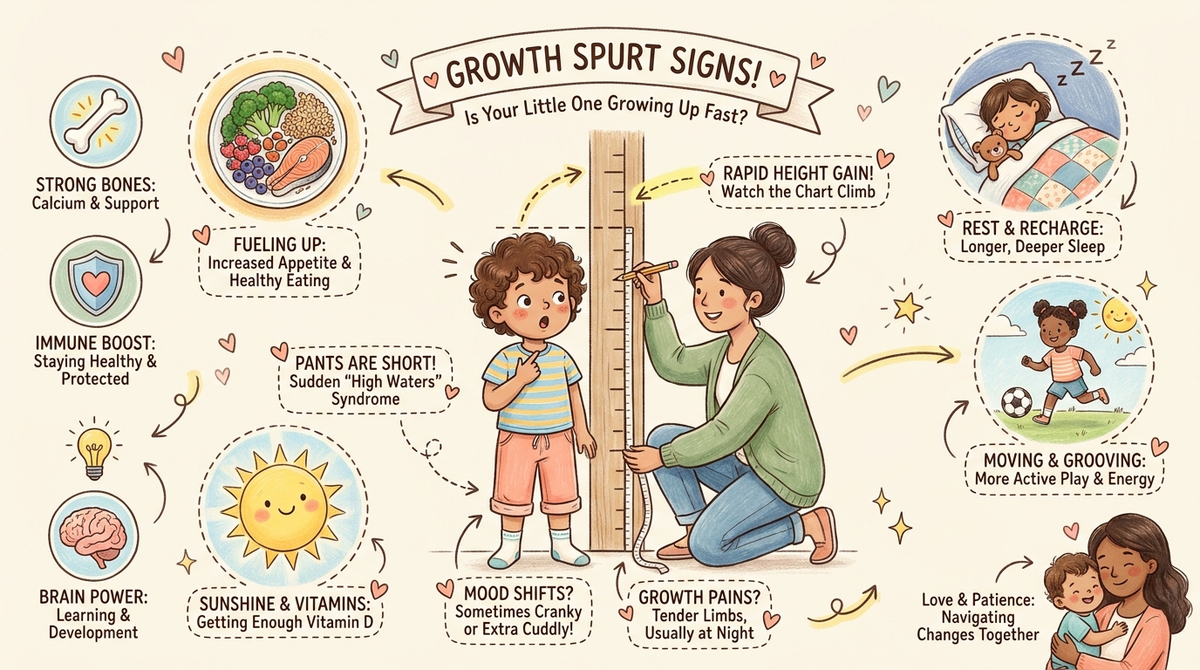
- Clothes and shoes stop fitting overnight. Leg length tends to grow before torso length in most kids, so pants go short first. Shoe sizes can jump half a size in a matter of weeks.
- Hunger that feels unusual. Your child finishes dinner and asks for more within the hour. The body is burning fuel for bone and muscle production at a faster rate. This is not a phase to cut short with empty snacks.
- More sleep than normal. Growth hormone releases primarily during deep sleep. Children in an active growth phase often sleep longer and still wake feeling sluggish. The sleep is doing real work. Let it happen.
- Aching legs at night. Growing pains appear in the calves, shins, or behind the knees. They are more common in children ages 3 to 12 and typically peak at night. They are not dangerous, but they are real.
- Mood shifts and emotional outbursts. Hormonal changes, fatigue, and hunger combine during growth spurts. A normally steady child may suddenly seem irritable or overwhelmed. This is biology, not a behavior problem.
- Temporary clumsiness. When legs grow rapidly, the center of gravity shifts. Coordination takes time to catch up. More bumping into door frames and spilled glasses is normal.
- Visible height changes in photos. Looking at photos from two to three months ago, the child looks noticeably different. Family members who see the child occasionally often comment on this before you do.
- Stretch marks on hips or shoulders. Rapid skin stretching can leave light pink or silvery marks. These are harmless and fade over time. They signal that the body is growing faster than the skin expected.
You do not need all eight. Three or four appearing together, especially the hunger, sleep, and mood cluster, is a reliable indicator that a growth phase is active.
At what age do most kids have their biggest growth spurt?
According to Nemours KidsHealth, girls typically experience their peak growth spurt between ages 10 and 14. Boys tend to hit theirs between ages 12 and 16. Girls often start and finish earlier. Boys often grow for longer.
This matters because the growth window is not infinite. Girls' growth plates typically close between ages 13 and 16. Boys' close between 15 and 19. After that point, no supplement, no stretching routine, and no amount of extra sleep changes the outcome. The biology is real. The window closes.
Treating the growth years as the period where nutrition decisions compound most is not alarmist. It is accurate.
For detailed timelines by age: What Age Do Kids Stop Growing? Real Timelines, Not Averages.
How long does a growth spurt last in kids?
Short-cycle growth spurts in younger children can last just a few days. The larger adolescent growth phase, sometimes called peak height velocity, typically spans one to three years.
During that multi-year window, growth is not constant. It moves in waves. Some months your child grows visibly. Others stay flat. The spurts themselves feel sudden because the gaps between them are quiet.
The implication is practical: consistent daily nutrition across the entire growth window matters more than any single intervention during a spurt.
Why does my child sleep so much during a growth spurt?
Growth hormone does not release evenly throughout the day. Most of it pulses during deep, slow-wave sleep. When the body is in an active growth phase, it needs more sleep to do more work. More hormone means more plate activity means longer, deeper sleep.
The National Sleep Foundation recommends 9 to 11 hours per night for children ages 6 to 13, and 8 to 10 hours for teens ages 14 to 17. During a growth spurt, a child may need the upper end of that range. Cutting sleep short during this period is one of the more overlooked ways that growth support gets undermined, not by a bad formula, but by a bad schedule.
If your child is sleeping significantly more and you are also seeing the hunger and mood signs, the sleep is useful. Protect it. Daytime activity is the other half of that picture, and it is worth knowing what it can and cannot do: see does exercise make kids taller.
Why is my child so hungry during a growth spurt?
The body is building bone and muscle at an accelerated rate. Calcium for bone matrix. Protein for muscle tissue. Magnesium for muscle recovery. Zinc for protein synthesis and immune defense. These demands all spike simultaneously during a growth phase.
The hunger is not random. It is a signal that the body's micronutrient demand has increased. The problem is that extra calories from snacks and processed foods do not automatically deliver the micronutrients that bone and muscle construction actually need.
A child who already avoids vegetables, dairy, and fish is likely running low on zinc, magnesium, and omega-3 DHA under normal circumstances. During a growth spurt, those gaps widen. Hunger goes up. But if the additional food is crackers and pasta, the calories arrive without the cofactors. The body keeps asking. The gaps stay open.
What nutrients support healthy growth during a growth spurt?
Calcium gets most of the attention. But during a growth spurt, calcium alone is a 30 percent solution. Here is what the body actually needs and why each piece matters.
| Nutrient | Role During Growth | RDA (Ages 9–13) | Common Gap? |
|---|---|---|---|
| Calcium | Bone matrix formation | 1,300 mg | Yes, especially in dairy-avoiders |
| Vitamin D3 | Helps the body absorb calcium from food | 600 IU | Yes, especially in low-sunlight regions |
| Vitamin K2 (MK-7) | Directs calcium to bone, not soft tissue | No established pediatric RDA | Yes, most kids get near zero from diet |
| Magnesium | Muscle recovery, sleep quality, activates K2 | 240 mg | Yes, found mainly in nuts and leafy greens |
| Zinc | Protein synthesis, immune defense | 8 mg | Yes, especially in picky eaters |
| Omega-3 DHA | Brain development and focus during school-age growth years | No established pediatric RDA | Yes, hard to get from a picky eater's plate |
Sources: NIH Office of Dietary Supplements, Calcium, Vitamin D, Zinc, Magnesium.
The table above is not a product list. It is the actual nutrient demand profile of a body in an active growth phase.
Genetics determines roughly 60 to 80 percent of your child's final height. The remaining 20 to 40 percent is influenced by nutrition, sleep, and activity during the growth window. No supplement overrides genetics. But a child who is consistently short on zinc, magnesium, and K2 during their peak growth years is not reaching the upper end of the range that their own genes allow. That is the gap that nutrition during a growth spurt is actually meant to close.
Tallori supports the full nutrient stack during peak growth years: K2 in MK-7 form, algae-sourced omega-3 DHA, calcium, D3, magnesium, and zinc. Zero sugar, sweetened with monk fruit and xylitol. All 7 vitamin and mineral doses are printed on the panel, with the botanicals held in a 112.4mg Clean Growth Blend, the same structure most brands in this category use. Designed for ages 5 to 18. See the full formula here.
When should I be concerned about my child's growth?
Growth spurts are normal. They are not a cause for alarm. But some patterns are worth a conversation with your child's pediatrician.
Talk to a doctor if:
- Your child's growth has stalled for more than 12 months with no visible changes in height or shoe size
- Your child is significantly below expected height for their age on a CDC growth chart
- Growing pains are severe, persistent, or present during the day rather than only at night
- You notice signs of early puberty before age 8 in girls or age 9 in boys
A pediatric endocrinologist can rule out conditions that affect growth, including thyroid dysfunction, celiac disease, or growth hormone deficiency. Tallori supports healthy nutrition during the growth window. It does not replace a medical evaluation.
Related Reading
Supporting the Growth Window While It's Open
Tallori is a sugar-free daily growth gummy with the complete nutrient stack for kids ages 5 to 18. 60-day money-back guarantee.
See the Full Formula