What Age Do Kids Stop Growing? Real Timelines, Not Averages
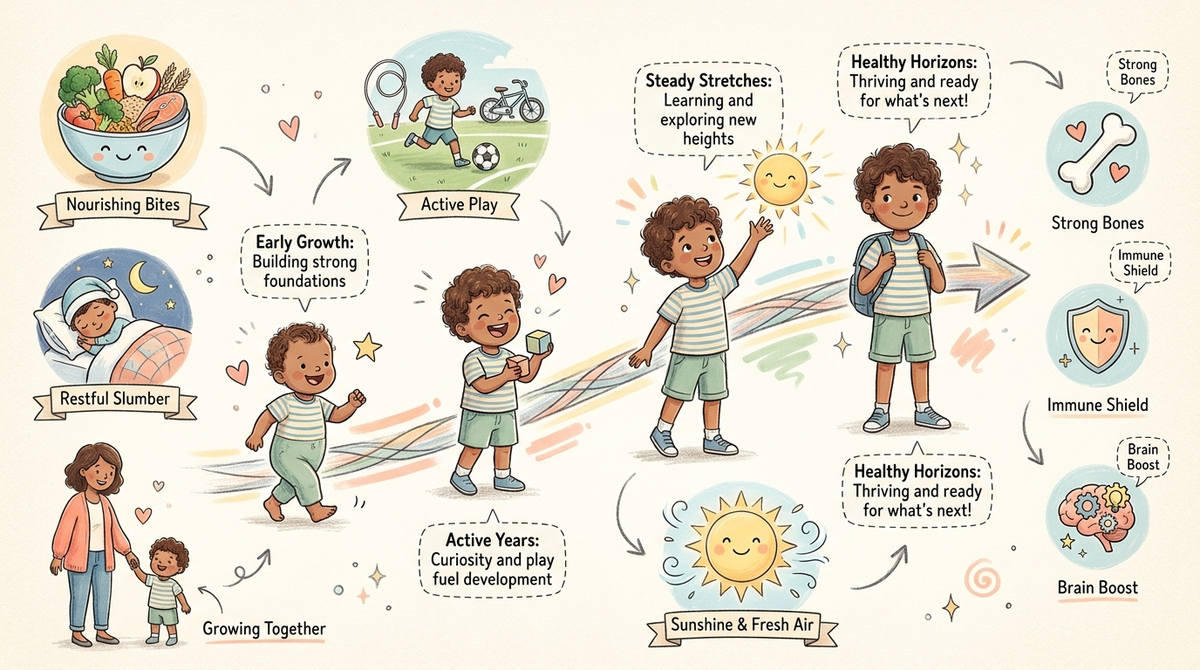
Most girls stop growing in height between ages 14 and 16. Most boys stop between 16 and 18. The mechanism is growth plate closure. When the cartilage zones at the ends of the long bones harden into solid bone, height gain ends. That window is open during childhood. It does not stay open forever.
This guide covers the real timelines for both girls and boys, what drives those differences, and what parents can do while the window is still open.
What Age Do Girls Stop Growing?
Girls typically reach their final height between ages 14 and 16. Their fastest growth period runs from roughly ages 10 to 13, during the early puberty years. Growth plates in girls generally close between ages 13 and 16, according to pediatric endocrinology references from Nemours KidsHealth.
The starting point matters. A girl who enters puberty early, at 8 or 9, may complete her growth window by 14. A girl who begins at 12 may still be adding height at 16. These are ranges, not fixed cutoffs. The average is a useful anchor, but each child moves through it on her own schedule.
After the major puberty milestones are complete, height gains slow to near zero. Changes in the mid-to-late teen years tend to be postural and muscular rather than skeletal.
What Age Do Boys Stop Growing?
Boys typically reach their final height between ages 16 and 18. Their fastest growth phase runs from ages 12 to 16. Growth plates in boys close between ages 15 and 19, roughly two years later than in girls, based on pediatric references from Nemours KidsHealth and the National Institutes of Health Office of Dietary Supplements.
Late development is common among boys and is rarely cause for alarm. A boy who has not started puberty at 14 is not automatically behind. His window may open and close on a later schedule than peers. Some boys gain a final inch or two between ages 18 and 20, though that represents the tail of the distribution rather than the norm.
The main growth period for boys is firmly within the teen years. By 18, the large majority have reached their final adult height.
What Is the Growth Plate and Why Does It Matter?
The growth plate, also called the epiphyseal plate, is a layer of cartilage near the end of a long bone. It sits in the legs, arms, and spine. While the growth plate is active, the body can lengthen the bone. When puberty ends, estrogen and testosterone signal the body to harden that cartilage into solid bone. Once that hardening completes, height gain is finished.
Growth plates do not close uniformly across the body. Smaller bones close earlier. The long bones of the legs close last. These are the bones that account for the majority of a child's standing height.
Pediatricians use wrist X-rays to assess "bone age." The closure pattern in the smaller wrist and hand bones predicts how much of the growth window remains in the larger leg bones. This is why bone age can differ from calendar age, and why two children the same chronological age can be at very different stages of the growth process.
What Causes Kids to Stop Growing at Different Ages?
Genetics sets the ceiling. Roughly 60–80% of a child's final height is determined by what their parents and grandparents passed down, based on twin study data cited in pediatric growth research. The other 20–40% is influenced by nutrition, sleep, physical activity, and overall health during the active growth years.
Timing of puberty is the single biggest variable within that 20–40%. Earlier puberty means earlier growth plate closure. A child who enters puberty at 8 or 9 gets a head start on height gains but finishes the window sooner. A late-developing boy may grow for longer than his peers and end up taller as a result.
Medical conditions can narrow or disrupt the window: thyroid disorders, growth hormone deficiency, and conditions affecting nutrient absorption such as celiac disease. These require clinical evaluation, not nutritional management.
Nutritional gaps are a separate, manageable factor. A child who is consistently low in calcium, vitamin D3, zinc, or magnesium during the active growth years may not reach the height their genetics would otherwise allow. The research on nutrient-deficient populations is clear on this point.
Can You Tell If Your Child's Growth Plates Are Still Open?
There is no reliable at-home test. But there are practical signals parents can track.
A pediatrician can assess bone age through a wrist X-ray, comparing the closure pattern to standard references for the child's age and sex. If bone age matches calendar age and puberty milestones appear complete, the growth window is likely near its end.
Observable signs that the window may be closing: shoe size has not changed in 12 months, height measurements have plateaued over the same period, and the major puberty milestones are complete. For girls, the growth window typically closes roughly 2–3 years after the first period. For boys, the reliable markers are voice change that has stabilized and facial hair that is well established.
These are signals. Pediatric assessment with a bone age X-ray is the only way to confirm closure.
Boys vs. Girls: Side-by-Side Growth Timeline
| Growth Stage | Girls | Boys |
|---|---|---|
| Puberty begins (average range) | Ages 8–13 | Ages 9–14 |
| Fastest height growth | Ages 10–13 | Ages 12–16 |
| Growth plates close | Ages 13–16 | Ages 15–19 |
| Final height typically reached | Ages 14–16 | Ages 16–18 |
| Late developers (common?) | Less common | More common |
Sources: Nemours KidsHealth (2026 updated), NIH Office of Dietary Supplements.
The key difference is timing, not duration. Both girls and boys have roughly 4–6 active growth years during puberty. Girls simply start and finish earlier. This is why boys and girls who are the same age can look like they are at completely different developmental stages during middle school.
Does Nutrition Affect How Tall My Child Will Be?
Genetics sets the ceiling. Nutrition determines how close to that ceiling a child actually gets.
Children who are deficient in key growth-related nutrients can show measurable height differences compared to peers with adequate levels. A Thai study of 140 children found the zinc-supplemented group gained 5.6 cm over six months versus 4.7 cm in the placebo group, in a population with documented zinc deficiency.
One clarification that matters: supplementing in a child who already has adequate nutrient levels does not add height beyond what genetics allows. A major JAMA Pediatrics trial in Mongolia (n=8,851, three years) confirmed this clearly. Supplements support children who have gaps. They do not override the genetic ceiling.
The nutrients most commonly low in children with limited or picky diets: calcium, vitamin D3, vitamin K2, zinc, magnesium, and omega-3 DHA. Each plays a specific role in bone development and overall growth during the active years.
For a detailed breakdown of what the research actually shows, see our science-backed parent guide to kids' growth supplements.
When Should You Talk to a Pediatrician About Growth?
Most variation in the growth timeline is normal. Some patterns are worth raising at the next well-child visit.
Consider flagging it if: your child has not grown in height at all over a 12-month period before puberty is complete; your child is consistently tracking below the 3rd percentile on the CDC growth chart; puberty has not started by age 13 in a girl or age 14 in a boy; you notice asymmetric growth in one limb; or your child has a condition known to affect nutrient absorption, such as celiac disease or inflammatory bowel disease.
Pediatricians track growth at every well-child visit. If a concern exists, a single height-velocity calculation between two visits will often clarify whether further investigation is needed. Most of the time, it is not.
What Can Parents Do While the Window Is Still Open?
The growth window closes between the mid-teens and late teens. The best time to support it is before that point.
Three evidence-backed factors support healthy growth during the active years.
Sleep. Human growth hormone is released in pulses during deep sleep. The American Academy of Pediatrics recommends 9–12 hours of sleep per night for ages 6–12 and 8–10 hours for teens. Consistent sleep habits during these years support the hormonal environment of the growth window.
Nutrition. The NIH Office of Dietary Supplements confirms the recommended daily intakes: calcium 1,000 mg/day for ages 4–8 and 1,300 mg/day for ages 9–18; vitamin D3 600 IU/day; zinc 5 mg/day for ages 4–8 and 8–11 mg/day for ages 9–18; magnesium 130 mg/day for ages 4–8 and 240 mg/day for ages 9–13. Most picky eaters fall short on at least one of these consistently.
Weight-bearing activity. Running, jumping, and sports provide the mechanical stimulus that signals bone to maintain development during the growth years.
When diet alone leaves gaps, a daily multivitamin formulated for growing children can support nutritional completeness. What to look for: full ingredient transparency, no proprietary blends, vitamin K2 in MK-7 form (the longer-acting form, with a half-life of roughly three days versus hours for K1), and zero added sugar. Every gram of added sugar in a daily gummy is a daily nutritional tradeoff with no benefit for growing bones.
Tallori Growth Gummies are formulated for ages 5–18 with 0g added sugar, K2 MK-7, vitamin D3, calcium, zinc, magnesium, and algae-sourced omega-3 DHA. Every ingredient has a clear role. Every dose is listed on the label. Available with a 60-day money-back guarantee.
For parents comparing growth gummy options, see do height growth gummies actually work for kids.
Frequently Asked Questions
Try Tallori Growth Gummies
Zero sugar. 12 targeted ingredients. 60-day money-back guarantee. Ages 5 to 18.
Shop NowFrequently Asked Questions
What age do most kids stop growing?
Do boys stop growing later than girls?
Can a child still grow after their growth plates close?
How can I tell if my child's growth plates are still open?
Does nutrition affect how tall my child will be?
What nutrients matter most during the growing years?
Is it too late to support my 13-year-old's growth?