Screen Time Before Bed: What It Really Does to Your Child's Sleep
Last updated: September 4, 2026
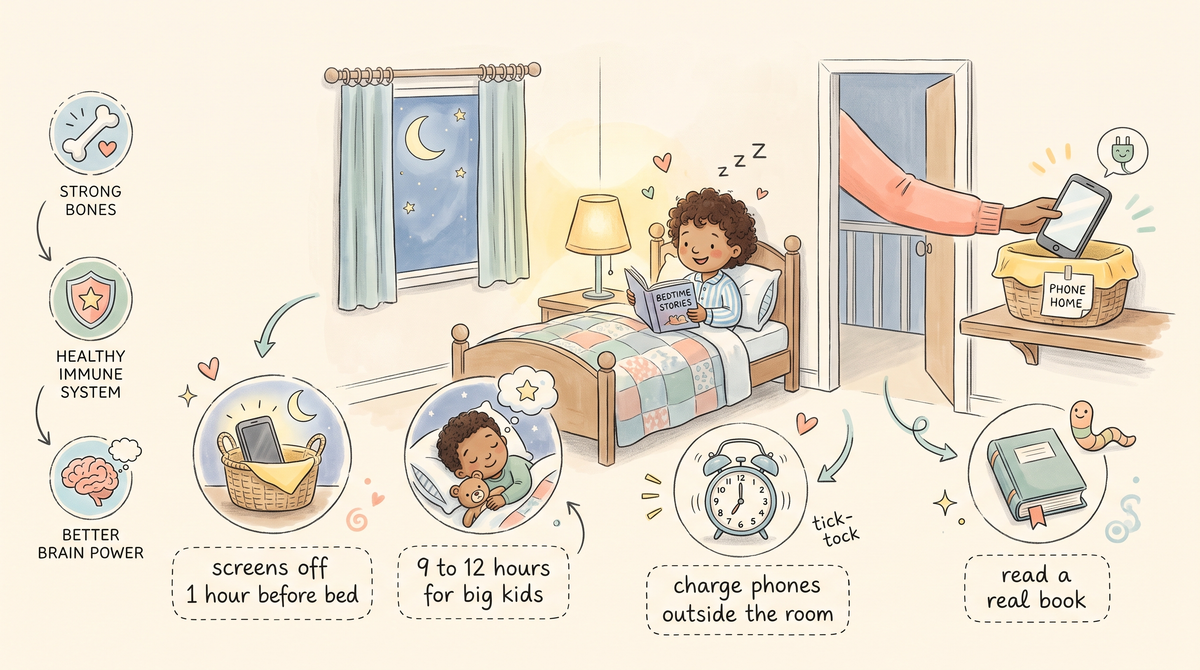
Screen time before bed is linked to kids falling asleep later, and the newest objective research shows the biggest sleep losses come from screens used in bed, especially gaming and app-switching, rather than from any screen use earlier in the evening. The American Academy of Pediatrics recommends turning off all screens at least one hour before bedtime and keeping devices out of children's bedrooms at night. A school-age child needs 9 to 12 hours of sleep per night and a teen needs 8 to 10, per CDC guidance, and evening screens are one of the most common reasons kids miss those targets.
If bedtime at your house ends with a phone glowing under a blanket, you are living the most common sleep fight in modern parenting. This guide covers what the research actually measured, which screen habits cost the most sleep, why the answer is more forgiving than "no screens after dinner," and a realistic plan most families can hold.
How much sleep does your child actually need?
Start with the target before worrying about what steals from it. The CDC publishes recommended daily sleep amounts based on American Academy of Sleep Medicine consensus. Note that the numbers stay high right through the teen years, the same years kids get their first phones.
| Age group | Recommended sleep per day |
|---|---|
| Preschool, 3 to 5 years | 10 to 13 hours (including naps) |
| School age, 6 to 12 years | 9 to 12 hours |
| Teens, 13 to 17 years | 8 to 10 hours |
Source: CDC, About Sleep. Do the math backward from the school alarm. A 10 year old who wakes at 7am needs to be asleep between 7pm and 10pm. A phone that pushes sleep past 10:30 puts that child under the range on a school night, every school night.
What the official advice says about screens at night
The American Academy of Pediatrics recommends keeping all screens, meaning TVs, computers, laptops, tablets and phones, out of children's bedrooms, especially at night, and turning off all screens at least 60 minutes before bedtime. The AAP also encourages families to write down a Family Media Use Plan so the rules exist before the argument does. The CDC's general sleep guidance is slightly softer: turn off electronic devices at least 30 minutes before bedtime.
That is the standard advice, and it is good advice. But most parents already know it and still lose the nightly fight. What helps more is knowing which part of the screen habit actually costs sleep, because the newest research says it is not the part most families fight about.
What happened when researchers filmed real bedtimes
Most screen-and-sleep research relies on kids or parents reporting their own screen use, which is about as reliable as it sounds. A 2024 study in JAMA Pediatrics did something better. Researchers gave 79 healthy kids ages 11 to 14 wearable and bedroom cameras for four nights, coded every minute of screen use in the two hours before sleep, and measured actual sleep with wrist accelerometers.
The results split the problem in two:
Screen use in the two hours before bed had no association with most measures of that night's sleep. Watching a show on the couch after dinner did not shorten sleep. Every type of screen use did push sleep onset later, though, with interactive use delaying it by about 10 minutes for every extra 10 minutes of use.
Screen use in bed was a different story. Every 10 minutes of screen time in bed was associated with 3 fewer minutes of total sleep. Interactive use in bed cost about 9 minutes per 10 minutes of use. Gaming was the worst single activity, at 17 minutes of lost sleep per 10 minutes of play. And on nights when kids multitasked across apps in bed, they slept about 35 minutes less than on nights they did not.
The phone in the bed is the problem, not the phone in the house. Move the fight from "no screens tonight" to "no screens in the bed" and you are fighting the battle that actually costs sleep.
The study's authors said it themselves: recommendations to restrict all screen time before bed "seem neither achievable nor appropriate." The realistic target is the bed, not the evening.
The two worst offenders: gaming and multitasking
Ranked by measured sleep cost in that study, from screen time happening in bed:
| In-bed screen activity | Measured sleep cost |
|---|---|
| Gaming | About 17 minutes less sleep per 10 minutes of play |
| Multitasking across apps | About 35 minutes less sleep on nights it happened |
| Interactive use (texting, social media) | About 9 minutes less sleep per 10 minutes of use |
| Passive use (watching video) | About 4 minutes less sleep per 10 minutes of use |
Source: Brosnan et al., JAMA Pediatrics 2024. Notice the ladder. The more a screen activity demands back from your child, the more sleep it takes. A show your kid watches costs less than a game your kid plays, and a game costs less than a game plus a group chat plus a video running at once. If you can only enforce one rule, make it this one: the console and the group chat do not come to bed.
Why sleep matters more during the growing years
For an adult, a short night costs a bad morning. For a child, the stakes are higher because the growing years do not repeat. Ages 5 to 18 map to the window when growth plates are still open, and once they close, that chapter is finished. Our guide to when growth plates close walks through that timeline by age and sex.
Sleep sits inside that picture as one of the levers parents actually control. A 2023 review on stress and growth in children (Mousikou and colleagues, Hormone Research in Paediatrics) notes that a stressor may impact growth directly or indirectly through other factors, naming diet, sleep, behavior and overall health. In plain terms, the researchers place sleep on the short list of everyday factors connected to how a child grows. We cover the sleep side of that research in our guide to how sleep affects height growth, and the stress side in does stress stunt growth in kids.
The AAP's list of what regular sleep deprivation brings is blunt: irritability, difficulty concentrating, high blood pressure, obesity, headaches and depression. Children who get enough sleep, per the same AAP guidance, have a healthier immune system and better school performance, behavior, memory and mental health. None of that is a height claim. It is a childhood-quality claim, and it is enough.
Our honest position, the same one we hold on nutrition: genetics sets the ceiling and daily habits set the floor. No bedtime routine makes a child taller than their genes allow. What consistent sleep, decent food and daily movement do is protect the child's own range. Sleep is simply the cheapest of the three, because it costs nothing but the argument.
A screen plan that survives real family life
Built from the AAP guidance plus what the camera study showed actually matters:
- Charge every device outside the bedroom. This is the single highest-value rule in this article. A phone that sleeps in the kitchen cannot be used in bed, and in-bed use is where the measured sleep losses live. A cheap analog alarm clock removes the "but it's my alarm" defense.
- Screens off 30 to 60 minutes before bed. CDC says at least 30 minutes, AAP says 60. Pick the number your house can actually hold and defend it. A held 30 beats an abandoned 60.
- End gaming earliest. It carried the biggest measured sleep cost. Move it to after school or right after dinner, not last before bed.
- Trade down, not off. If your child will not accept a hard stop, move them down the ladder: from gaming to watching, from the bedroom to the living room. The study found passive, out-of-bed viewing barely moved the needle.
- Write the plan down. The AAP's Family Media Use Plan exists because rules made at 9:45pm in a doorway do not hold. Rules written on the fridge on a Sunday afternoon do better.
- Model it. The AAP is direct that parents are the role model. A parent scrolling in bed is teaching the exact habit this article is about.
- Keep wake time fixed. Per AAP, the same wake time on weekdays and weekends does more for a child's rhythm than a perfect bedtime. It also quietly caps how late a Saturday night can drift.
Teens are wired to stay up later, so plan for it
If your teenager cannot fall asleep at 9:30pm, that is not defiance. Per the AAP, sleep-wake cycles shift up to two hours later at the start of puberty. The biology moves bedtime later at exactly the age school moves mornings earlier, which is why the AAP has advocated for middle and high schools to start at 8:30am or later.
For parents, this changes the job. You cannot force a 15 year old's brain to feel sleepy at 9pm. What you can do is stop screens from stretching a natural 10:30pm bedtime into a 12:30am one, because a teen still needs 8 to 10 hours. The charge-outside-the-room rule matters most in the teen years, and it holds best when it started years earlier, when the first phone arrived.
Where the evening meal and nutrition fit in
A calm evening is a routine, and food sits inside it. The same kids who take screens to bed are often the same kids running on beige dinners, and the two problems meet at bedtime: a wound-up child with a nutrition gap. Our guides to hidden nutrition gaps in kids and vitamins for picky eaters cover what those gaps usually are.
Two honest notes here. First, no vitamin, mineral or gummy is a sleep aid, ours included, and any supplement marketed as one for children deserves your skepticism. Second, nutrients still matter to the same growing body that sleep serves. Roughly 50 to 60 percent of the body's magnesium is stored in bone, per NIH, and our magnesium guide for kids covers what that nutrient actually does and does not do. Daytime activity earns its place in the routine too, and our guide on exercise and height gives that topic the same honest treatment. For the full picture of what belongs in a kids' formula, see our science-backed parent guide to kids growth supplements.
Where Tallori fits a calm evening routine
Tallori Growth Gummies are a daily multivitamin, not a sleep product, and we will never tell you otherwise. Where they fit this article is the routine itself. A consistent evening rhythm, dinner, gummies, screens off, reading, lights out, is the structure the AAP guidance describes, and a two-gummy step that kids do not fight makes the rest of the routine easier to hold.
Each serving carries all 7 vitamin and mineral doses printed on the panel where you can check them: vitamin C, D3, K2 in the MK-7 form, calcium at 300mg, magnesium, zinc and omega-3 DHA from algae oil, not fish. The botanicals sit in a 112.4mg Clean Growth Blend, the same structure most brands in this category use. Zero added sugar, sweetened with monk fruit and xylitol, which also means no sugar hit as the last taste of the day. Pectin based, designed for ages 5 to 18, the same window this whole article is about.

Try Tallori Growth Gummies
Zero sugar. All 7 vitamin and mineral doses printed on the panel. Algae DHA, pectin based, no sugar hit before bed. 60-day money-back guarantee. Ages 5 to 18.
Shop NowRelated Reading
- How Sleep Affects Height Growth: A Parent's Guide
- Does Stress Stunt Growth in Kids? What the Research Says
- Does Exercise Make Kids Taller? The Honest Answer
- Hidden Nutrition Gaps in Kids: What Even Balanced Diets Miss
- When Do Growth Plates Close? Boys vs Girls Timeline
- Magnesium for Kids: What It Does and How Much They Need
- Kids Growth Supplements: A Science-Backed Parent Guide
Frequently Asked Questions
Does screen time before bed really affect kids' sleep?
Yes, but the effect is specific. A 2024 JAMA Pediatrics study using cameras and sleep trackers found evening screen use mainly delayed when kids fell asleep, while screen use in bed shortened actual sleep, by about 3 minutes per 10 minutes of use and much more for gaming and multitasking. The bed is where the real losses happen.
How long before bed should kids stop using screens?
The American Academy of Pediatrics recommends turning off all screens at least 60 minutes before bedtime, and the CDC's general guidance says at least 30 minutes. Pick the number your family can consistently hold. A 30-minute rule you enforce every night beats a 60-minute rule you abandon by Thursday.
Is watching TV before bed as bad as using a phone in bed?
No. In the 2024 camera-based study, screen use before getting into bed had no association with most measures of that night's sleep, while in-bed use cost real sleep, especially interactive use. Passive watching in bed cost about 4 minutes per 10 minutes, versus about 17 minutes per 10 minutes for gaming.
Do screens or lost sleep stunt a child's growth?
No study shows screens change a child's height, and genetics accounts for roughly 60 to 80 percent of final height. Research on childhood stress and growth does name sleep among the everyday factors connected to how a child grows, alongside diet and overall health. Sleep is worth protecting for your child's mood, focus, immunity and development, not out of fear about inches.
What is the best way to get a phone out of my child's bedroom?
Make the charger live somewhere else. A family charging spot in the kitchen or hallway, plus a basic analog alarm clock for the bedroom, removes both the temptation and the "it's my alarm" argument. The AAP recommends keeping all screens out of children's bedrooms at night, and the rule holds best when it applies to the whole family.
How much sleep does a child need by age?
Per CDC guidance based on American Academy of Sleep Medicine consensus: preschoolers ages 3 to 5 need 10 to 13 hours including naps, school-age kids 6 to 12 need 9 to 12 hours, and teens 13 to 17 need 8 to 10 hours per day.
Why does my teenager stay up so late?
Biology, mostly. Per the AAP, sleep-wake cycles shift up to two hours later at the start of puberty, so a teen's brain genuinely does not feel sleepy at a 9 year old's bedtime. Teens still need 8 to 10 hours, so the practical job is stopping screens from stretching a naturally later bedtime even further into the night.
Do Tallori gummies help kids sleep?
No, and we will not claim they do. Tallori Growth Gummies are a zero sugar daily multivitamin for ages 5 to 18, not a sleep aid. They fit the evening as a consistent step in a calm routine, with all 7 vitamin and mineral doses printed on the panel, sweetened with monk fruit and xylitol, and no sugar hit before bed.
This article is for informational purposes and is not medical advice. Talk to your child's pediatrician about any sleep, nutrition or growth concerns.