Non Dairy Calcium Foods for Kids: The Real Numbers Parents Need
Last updated: September 3, 2026
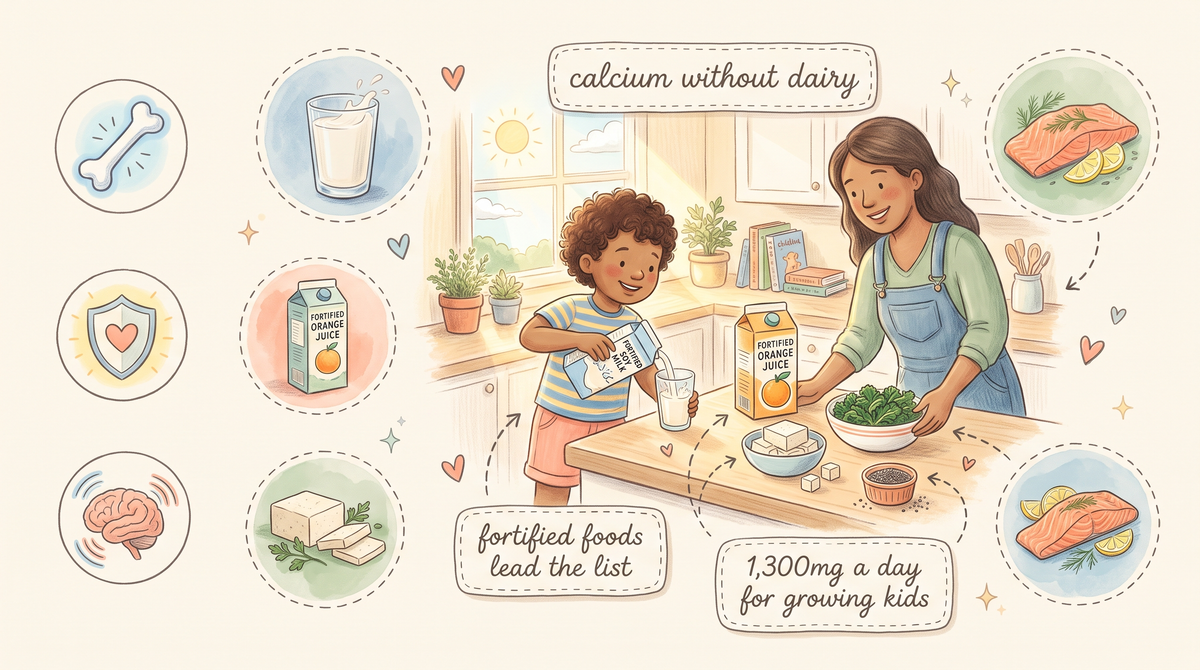
Non dairy calcium foods for kids include calcium-fortified orange juice (349mg per cup), fortified soy milk (299mg per cup), firm calcium-set tofu (253mg per half cup), canned salmon with bones (181mg per 3 ounces), fortified breakfast cereal, kale, bok choy, chia seeds, and white and pinto beans. A child ages 4 to 8 needs 1,000mg of calcium a day and a child or teen ages 9 to 18 needs 1,300mg, per NIH guidance. That target is reachable without milk, but it takes planning, because the highest non dairy sources are fortified foods, not vegetables.
If your child is lactose intolerant, allergic to milk, vegan, or simply refuses anything dairy, you are not dealing with a rare problem. The NIH lists people who avoid dairy among the groups most likely to fall short on calcium. It also names children and teens ages 4 to 18 among the US groups getting less than recommended amounts overall. Dairy-avoiding kids sit in both groups at once.
This guide covers the real numbers per serving, the absorption differences most food lists skip, and the honest math of getting a growing child to 1,300mg a day without a glass of milk in sight.
How much calcium does a child actually need per day?
The NIH Office of Dietary Supplements sets the recommended daily amounts by age. Note the jump at age 9. The 9 to 18 window carries the highest calcium requirement of any life stage, higher than an adult's, because that is when the skeleton does most of its building. We break down what those numbers mean for each age in our guide to how much calcium growing kids need.
| Age | Recommended daily amount | Daily upper limit (all sources) |
|---|---|---|
| Children 1 to 3 years | 700 mg | 2,500 mg |
| Children 4 to 8 years | 1,000 mg | 2,500 mg |
| Children 9 to 13 years | 1,300 mg | 3,000 mg |
| Teens 14 to 18 years | 1,300 mg | 3,000 mg |
Source: NIH Office of Dietary Supplements, Calcium fact sheet. The upper limit covers everything combined: food, drinks, and supplements.
The best non dairy calcium foods, ranked by real numbers
Most lists of dairy-free calcium foods name the same ten items and skip the milligrams. The milligrams are the whole story. Here is the NIH food table, non dairy entries only, ranked from strongest to weakest.
| Food | Serving | Calcium (mg) |
|---|---|---|
| Orange juice, calcium fortified | 1 cup | 349 |
| Soy milk, calcium fortified | 1 cup | 299 |
| Tofu, firm, made with calcium sulfate | Half cup | 253 |
| Salmon, pink, canned, with bones | 3 ounces | 181 |
| Tofu, soft, made with calcium sulfate | Half cup | 138 |
| Breakfast cereal, calcium fortified (10% DV) | 1 serving | 130 |
| Turnip greens, boiled | Half cup | 99 |
| Kale, cooked | 1 cup | 94 |
| Chia seeds | 1 tablespoon | 76 |
| Bok choy, raw, shredded | 1 cup | 74 |
| Pinto beans, canned | Half cup | 54 |
| Corn tortilla | One, 6 inch | 46 |
| Whole wheat bread | 1 slice | 30 |
| Broccoli, raw | Half cup | 21 |
Source: NIH Office of Dietary Supplements, Calcium Health Professional fact sheet. Notice the pattern. The top three non dairy sources are all fortified or calcium-set foods. The vegetables everyone recommends sit near the bottom of the list.
The absorption problem most food lists skip
Milligrams on a chart are not milligrams in your child's bones. Absorption varies sharply by food, and the NIH numbers here surprise most parents.
Calcium absorption from dairy products and fortified foods runs about 30 percent. Spinach, which looks impressive on paper at 123mg per half cup boiled, gives up only about 5 percent of its calcium, versus 27 percent for milk. The reason is oxalic acid, a natural compound in spinach that binds calcium into salts the body cannot digest. Collard greens, sweet potatoes, rhubarb, and beans carry high oxalate levels too.
The good news: low-oxalate greens like broccoli, kale, and bok choy absorb about as well as milk does. Their weakness is quantity, not quality. A cup of raw kale holds 24mg. Your child would need to eat kale by the mixing bowl to move the needle.
One important caveat, straight from the NIH: when kids eat a varied diet, these oxalate interactions probably have little or no nutritional consequence. The point is not to fear spinach. The point is not to count spinach as a calcium source when you do the daily math.
The honest math: what 1,300mg looks like without dairy
Here is a realistic non dairy day for a 12 year old who needs 1,300mg:
- Fortified cereal with a cup of fortified soy milk at breakfast: about 429mg
- A cup of fortified orange juice with lunch: 349mg
- Half a cup of firm calcium-set tofu in a stir fry at dinner: 253mg
- Cooked kale on the side: 94mg
- A tablespoon of chia seeds in a smoothie or yogurt alternative: 76mg
That adds up to roughly 1,201mg, just under target, and it assumes your child willingly eats tofu, kale, and chia seeds in the same day. Every parent reading that list knows exactly where it falls apart. Fortified foods carry the load in a dairy-free diet, and the plan only works on the days the plan actually happens.
Why picky eaters make this twice as hard
A dairy-free diet plus a picky eater is the toughest calcium scenario there is. The strongest non dairy sources, tofu, canned fish with bones, and leafy greens, sit near the top of most kids' refusal list. What picky kids will eat, plain pasta, bread, crackers, and fruit, sits at the bottom of the calcium table.
A dairy-free picky eater is not missing one nutrient. Milk was quietly carrying calcium, vitamin D, and protein at once, and whatever replaced it usually carries none of them.
That is the real reason we tell parents that calcium alone is a 30 percent solution. A kid who won't touch dairy, fish, or vegetables is usually also short on vitamin D, zinc, and magnesium at the same time. Our guides to vitamins for picky eaters and hidden nutrition gaps in kids cover the full picture.
Are fortified foods as good as natural calcium?
For absorption purposes, yes. The NIH puts absorption from fortified foods in the same 30 percent range as dairy. Fortified orange juice, fortified soy or almond milk, calcium-set tofu, and fortified cereals are the workhorses of a dairy-free diet precisely because they deliver dairy-level doses with dairy-level absorption.
Two label habits worth building. First, check that the milk substitute actually says calcium on the label, because not every carton is fortified. Second, shake the carton. Added calcium settles at the bottom, and an unshaken cup can deliver less than the label promises.
Calcium does not work alone: the D3 and K2 part
Getting calcium in is half the job. The body also has to absorb it and route it to bone, and two other nutrients control that.
Vitamin D helps the body absorb calcium in the first place, per NIH. A dairy-free child loses a fortified vitamin D source along with the milk, so the two gaps usually travel together. Our vitamin D3 dosage guide for kids covers the right amounts by age.
Vitamin K2 handles the routing. K2 activates osteocalcin, a protein that directs calcium into bone tissue rather than letting it circulate in soft tissue. The form matters: MK-7 stays active in the body for roughly three days, while K1, the plant form, clears in hours. A label that just says Vitamin K without naming the form is hiding the form, and the form it is hiding is usually K1. All of this matters most while growth plates are still open, which is why timing counts. Our guide on when growth plates close explains that window.
Signs your child may be falling short
Calcium shortfall in kids is quiet. There is no obvious daily symptom, which is why NIH flags it by group rather than by warning sign. Over time, getting too little calcium can contribute to soft, weak bones, per NIH. If your child avoids dairy and their diet does not include the fortified foods above most days, assume a gap rather than waiting for evidence of one, and raise it at the next pediatrician visit. A pediatrician can also rule out the bigger causes of growth concerns, from sleep to chronic stress, that no food list fixes.
Where a supplement honestly fits
Food first. That is the federal Dietary Guidelines position and it is ours. Fortified foods and supplements exist for the situations where food alone does not get there, and a dairy-free picky eater is exactly that situation.
Two rules for supplementing calcium in kids. First, a supplement fills a gap, it does not replace the food plan. Second, the body absorbs calcium best at 500mg or less at a time, per NIH, so a moderate daily dose beats a megadose. A supplement that supplies a few hundred milligrams alongside the vitamin D3 that absorbs it and the K2 that routes it does more useful work than a giant calcium pill taken alone.
For the wider picture of what belongs in a kids' formula and why, see our science-backed parent guide to kids growth supplements.
What makes Tallori different for dairy-free kids
Tallori Growth Gummies were built for exactly the gap this article describes. Each serving supplies 300mg of calcium, a meaningful share of the daily target sized within the NIH absorption sweet spot, plus the two nutrients a dairy-free diet loses alongside it: vitamin D3 at 25mcg and vitamin K2 in the MK-7 form at 100mcg. The formula is pectin based, not gelatin, and the omega-3 DHA comes from algae oil, not fish, so it fits vegetarian and dairy-free households as-is.
All 7 vitamin and mineral doses, vitamin C, D3, K2, calcium, magnesium, zinc, and omega-3 DHA, are printed on the panel where you can check them against the NIH numbers in this guide. The botanicals sit in a 112.4mg Clean Growth Blend, the same structure most brands in this category use. Zero added sugar, sweetened with monk fruit and xylitol, designed for ages 5 to 18.

Try Tallori Growth Gummies
Zero sugar. 300mg calcium with the D3 and K2 that make it count. Dairy free, pectin based, algae DHA. 60-day money-back guarantee. Ages 5 to 18.
Shop NowRelated Reading
- Does Drinking Milk Make You Taller? What the Research Actually Shows
- How Much Calcium Do Growing Kids Need? Ages 5 to 18 Breakdown
- Vitamin D3 Dosage for Kids: The Right Amount by Age
- Vitamin K2 for Kids: Why the Form Matters More Than the Dose
- Best Vitamins for Picky Eaters: What Actually Works
- Hidden Nutrition Gaps in Kids: What Even Balanced Diets Miss
- When Do Growth Plates Close? Boys vs Girls Timeline
- Kids Growth Supplements: A Science-Backed Parent Guide
Frequently Asked Questions
What non dairy food is highest in calcium for kids?
Calcium-fortified orange juice leads the NIH food table at 349mg per cup, followed by fortified soy milk at 299mg per cup and firm calcium-set tofu at 253mg per half cup. The strongest non dairy sources are fortified foods, not vegetables.
How can my child get 1,300mg of calcium without dairy?
Build the day around fortified foods: fortified cereal with fortified soy milk at breakfast, fortified orange juice at lunch, and calcium-set tofu at dinner covers roughly 1,000mg. Greens, chia seeds, and beans fill the rest. It is doable but takes daily planning, which is where many families add a supplement.
Is spinach a good calcium source for kids?
Not really. Spinach holds 123mg per half cup boiled, but per NIH only about 5 percent of it absorbs, versus 27 percent for milk, because oxalic acid binds the calcium. Spinach is still a healthy food. Just do not count it toward the calcium target.
Do kids with lactose intolerance need a calcium supplement?
Not automatically. NIH lists dairy avoiders among the groups more likely to fall short, and its suggested fixes include fortified juices and milk substitutes, canned fish with bones, low-oxalate greens, and supplements. If your child reliably eats the fortified foods, food can cover it. If not, a supplement fills the gap. Your pediatrician can help you judge which camp your child is in.
Are fortified plant milks as good as cow's milk for calcium?
For calcium, largely yes. Fortified soy milk carries 299mg per cup, matching nonfat cow's milk, and NIH puts absorption from fortified foods in the same range as dairy. Check the label to confirm the milk is actually fortified, and shake the carton, since added calcium settles at the bottom.
What happens if a child does not get enough calcium?
Per NIH, getting too little calcium over time can contribute to soft, weak bones in children. The shortfall is usually silent day to day, which is why NIH flags at-risk groups, including dairy avoiders and kids and teens ages 4 to 18 generally, rather than warning signs. Talk to your pediatrician if you suspect a gap.
Why do calcium supplements for kids include vitamin D3 and K2?
Vitamin D helps the body absorb calcium, per NIH, and vitamin K2 activates osteocalcin, the protein that directs calcium into bone tissue. The MK-7 form of K2 stays active for roughly three days, while K1 clears in hours. Calcium without its support nutrients does less of its job.
Can my child get too much calcium?
Yes, there is an upper limit: 2,500mg a day for ages 1 to 8 and 3,000mg for ages 9 to 18, covering food, drinks, and supplements combined, per NIH. A dairy-free child eating normal portions is far from that ceiling. NIH also notes calcium absorbs best at 500mg or less at a time, so spreading intake across the day beats one large dose.
Is Tallori dairy free?
Yes. Tallori Growth Gummies are pectin based with no dairy ingredients, and the omega-3 DHA comes from algae oil rather than fish. Each serving supplies 300mg of calcium alongside vitamin D3 and vitamin K2 in the MK-7 form, with zero added sugar, sweetened with monk fruit and xylitol, for ages 5 to 18.
This article is for informational purposes and is not medical advice. Talk to your child's pediatrician about any nutrition or growth concerns.