Support Height During Puberty: The Critical Window
Last updated: July 13, 2026
Supporting height during puberty means closing real nutrition gaps while the growth plates are still open. Puberty is the body's last major growth window. Girls' plates typically close between 13 and 16. Boys' close between 15 and 19. After that, no amount of sleep, protein, or supplementation adds height. The window is real, and it's finite.
You've watched the growth chart. You've heard "he'll catch up" more times than you can count. Puberty is the stretch where that phrase either becomes true or stops mattering. Here's what actually moves the needle during it, and what's just noise. Most of what parents Google during this stretch splits into two buckets: biology questions (when does this actually happen, and how much growth is left) and action questions (what do I feed him, does sleep matter, is a supplement worth it). This post covers both, in order, with sources for every number.
What Actually Happens to Height During Puberty?
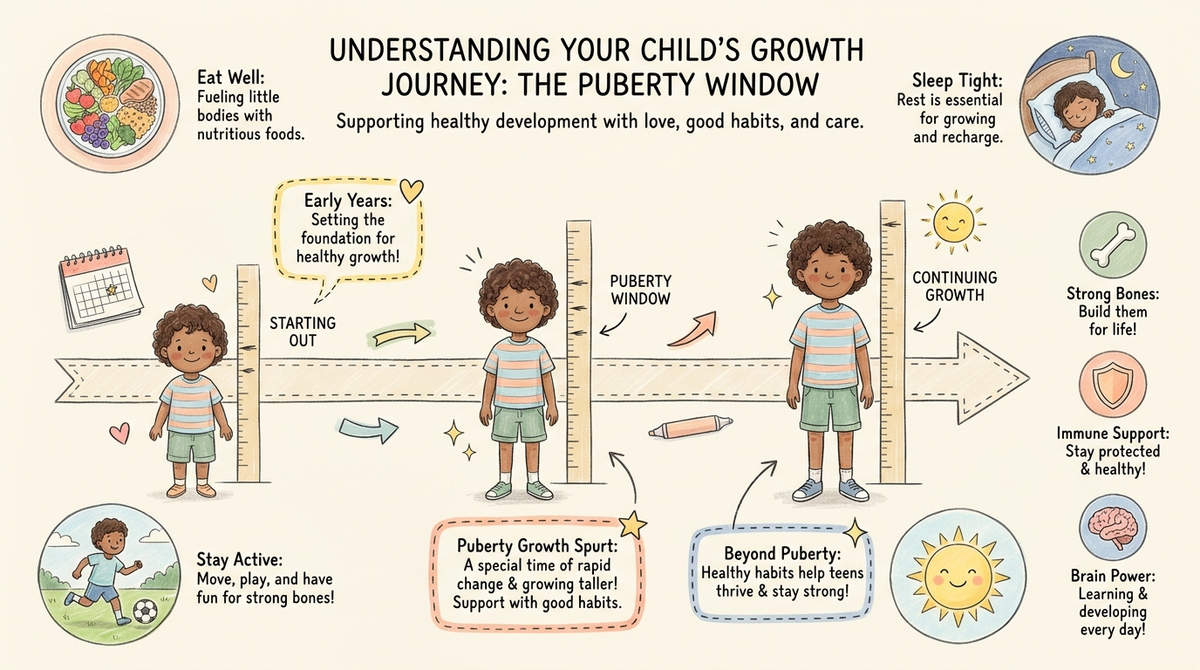
Puberty triggers peak height velocity, the fastest growth phase since infancy. Girls typically hit it between ages 10 and 14. Boys hit it between 12 and 16. During that one-to-three year stretch, kids can gain 3 to 4 inches a year, according to Cleveland Clinic. Nutrition determines whether they reach the top or bottom of that range.
When Does the Growth Window Close for Good?
Growth plates are the soft cartilage at the ends of long bones. Once they fuse to solid bone, height gains stop. Girls' plates typically close between ages 13 and 16. Boys' close later, between 15 and 19. This isn't a marketing range. It's biology. You don't get the window back.
How Many Inches Can a Kid Grow During a Growth Spurt?
Cleveland Clinic and Abbott Nutrition both cite 3 to 4 inches per year during peak height velocity, which typically lasts one to three years. That's the single fastest stretch of growth your child will experience during puberty. Missed nutrients during this window are the hardest to make up later.
What Nutrients Matter Most During the Puberty Growth Window?
Six nutrients do most of the work: calcium and vitamin D for bone mineralization, vitamin K2 (MK-7 form) to direct that calcium to bone instead of soft tissue, zinc for cell growth and collagen synthesis, magnesium (50 to 60% of it is stored in bone, per NIH ODS), and omega-3 DHA for the brain development happening alongside the physical growth.
Why Isn't Calcium Alone Enough During Puberty?
Calcium builds bone. It doesn't decide where that bone-building happens without help. Vitamin K2 activates a protein called osteocalcin that directs calcium to the skeleton. Without enough K2, calcium can end up in soft tissue instead of bone. A gummy with calcium and nothing else is a 30 percent solution.
Does Sugar in Growth Supplements Undermine the Nutrients?
Zero sugar isn't a taste preference. High-sugar formulas are less likely to be built as a complete nutrient stack in the first place, and added sugar during a growth window a child depends on daily is working against the goal, not toward it. That's the whole case for a zero-sugar formula.
Does Sleep Affect Height During Puberty?
Yes. Growth hormone release is tied to deep sleep cycles, which is one reason pediatricians push consistent bedtimes hard during the teen years. Puberty itself makes this harder. Later chronotypes, school schedules, and screens all compete with the bedtime a growing body actually needs. Nutrition and sleep work together during puberty. A perfect formula can't compensate for a kid who's chronically short on rest, and a perfect bedtime can't compensate for a diet missing zinc, magnesium, and calcium.
Is Zinc Deficiency a Real Risk During Puberty?
It's more common than most parents assume, especially in picky eaters. A Thai study of 140 children found that zinc-supplemented kids grew 5.6 cm over six months versus 4.7 cm in the placebo group. The RDA climbs from 8 mg (ages 9-13) to 11 mg for boys and 9 mg for girls (14-18), per NIH ODS. Zinc deficiency in older kids can also show up as hair loss and frequent infections, which is often the first sign a pediatrician catches before a parent connects it to diet.
Should Picky Eaters Get Extra Attention During Puberty?
Yes, and this is where most families lose ground without realizing it. Puberty raises nutrient needs across the board right as many kids get pickier, not less picky. A picky eater covering calcium and vitamin D from milk alone is still missing zinc, magnesium, and omega-3, which is a 30 percent solution dressed up as a complete one. A growth gummy that only covers bones is a bone gummy with a marketing problem.
What Role Does Stress Play During the Puberty Growth Window?
Puberty is stressful for kids in ways that don't always show up as obvious anxiety. A 2026 randomized, double-blind trial in Frontiers in Nutrition gave 85 children ages 6 to 12 a standardized ashwagandha root extract, 300 mg daily for 8 weeks, and found improved cognitive performance and sleep quality compared to placebo. The fatigue improvement didn't reach statistical significance, so that specific claim stays honest, not inflated. Ashwagandha should be used carefully, or avoided, in kids with thyroid disease, autoimmune conditions, upcoming surgery, or certain medications. Check with a pediatrician first if any of those apply.
Can a Daily Supplement Support Height During Puberty?
A supplement can't override genetics, and it can't add height a child wasn't going to reach anyway. What it can do is close nutrition gaps a picky-eater diet leaves behind, so a kid actually hits their genetic ceiling instead of falling short of it from preventable deficiencies. That's the honest scope.
What Should Parents Avoid During the Growth Window?
Skip anything promising results in 30 days. Nutrient supplementation works cumulatively, not overnight. Skip "proprietary blend" labels that hide individual doses. If a brand won't publish the exact milligrams of each ingredient, that's not formula privacy. That's hiding the math. And skip any product that claims to boost or increase growth hormone directly. No supplement is cleared to make that claim, and a brand willing to make it is a brand willing to overstate everything else on the label too.
Is It Too Late to Support Height Once Puberty Has Already Started?
No. Genetics sets the ceiling, roughly 60 to 80% of final height. Nutrition during the growth window influences the rest. Starting mid-puberty still matters, because the plates haven't closed yet.
"I worried we'd missed the window. He was already 13. But within two months he was eating bigger meals and finally hungry at breakfast."
Amanda Chen, Tallori parent
What Does a Complete Puberty-Support Formula Actually Look Like?
The table below breaks down the nutrients that matter most during the puberty growth window, the RDA by age, and their specific role. No competitor brand is named. This is a criteria checklist for reading any label, including Tallori's.
| Nutrient | RDA (ages 9-13) | RDA (ages 14-18) | Role During Puberty | In Tallori |
|---|---|---|---|---|
| Calcium | 1,300 mg | 1,300 mg | Bone mineralization | Yes |
| Vitamin D3 | 600 IU | 600 IU | Calcium absorption | Yes |
| Vitamin K2 (MK-7) | 60 mcg (AI) | 75 mcg (AI) | Directs calcium to bone, not soft tissue | Yes, MK-7 form specifically |
| Zinc | 8 mg | 11 mg (boys) / 9 mg (girls) | Cell growth, collagen synthesis | Yes |
| Magnesium | 240 mg | 410 mg (boys) / 360 mg (girls) | 50-60% stored in bone | Yes |
| Omega-3 DHA | No pediatric DHA-specific AI (ALA-based) | No pediatric DHA-specific AI (ALA-based) | Brain development alongside physical growth | Yes, algae-sourced (no ALA conversion step) |
Genetics sets the ceiling. Nutrition sets the floor. No supplement changes that math, and any brand that implies otherwise is selling a promise it can't keep.

Support the Growth Window While It's Still Open
Tallori is zero sugar, K2 MK-7, and 60-day guaranteed. Built for the years that actually count.
Shop Tallori Growth GummiesRelated Reading
Frequently Asked Questions
What age does puberty growth start?
Girls typically start their peak growth phase between ages 10 and 14. Boys start later, between ages 12 and 16. The exact timing varies by child, genetics, and overall health, but these ranges cover most kids according to Cleveland Clinic's pediatric growth references.
How much does a teenager grow during puberty?
During peak height velocity, kids can grow 3 to 4 inches a year for one to three years, per Cleveland Clinic and Abbott Nutrition. That's the fastest stretch of growth since infancy. Nutrition during this window determines whether a child reaches the top or bottom of their genetic range.
What vitamins support height growth during puberty?
Calcium, vitamin D3, vitamin K2 in the MK-7 form, zinc, and magnesium are the core nutrients. Calcium and D3 build bone. K2 directs that calcium to the skeleton instead of soft tissue. Zinc and magnesium support cell growth and are largely stored in bone tissue itself.
Can a supplement make my child taller?
No supplement overrides genetics, which accounts for roughly 60 to 80% of final height. What a complete formula can do is close nutrition gaps, especially in picky eaters, so a child reaches the top of their own genetic range instead of falling short from preventable deficiencies.
Does sugar in growth gummies matter?
Yes. A growth gummy loaded with added sugar is working against the nutrient stack it's supposed to deliver. Tallori uses monk fruit, an FDA GRAS-recognized sweetener, so the formula stays zero sugar without sacrificing the flavor kids actually ask for daily.
Is zinc deficiency common in teens?
It's more common than most parents realize, especially with picky eaters who avoid meat and seafood. A Thai clinical study found zinc-supplemented children grew 5.6 cm over six months versus 4.7 cm in the placebo group. The RDA is 8 mg for ages 9-13, rising to 11 mg (boys) or 9 mg (girls) at 14-18.
How long does it take to see results from a growth supplement?
Nutrient supplementation works cumulatively, not overnight. Parents typically notice early signs like appetite and energy within 6 to 8 weeks, with visible changes building over months of consistent daily use. Any brand promising results in 30 days is setting an expectation nutrition science doesn't support.
Is it too late to start a growth supplement once puberty has begun?
No. As long as growth plates haven't closed (typically 13-16 in girls, 15-19 in boys), nutrition still matters. Starting mid-puberty still gives a child's body the raw materials it needs for the growth phases still ahead, even if a few months were missed.
This statement has not been evaluated by the Food and Drug Administration. This product is not intended to diagnose, treat, cure, or prevent any disease. Results vary by child. Consult a healthcare professional before starting any supplement, especially for children under 5 or with medical conditions.