Protein for Growing Kids: How Much They Need and Where It Comes From
Last updated: August 29, 2026
Protein for growing kids is the nutrient that builds and repairs the tissue a child adds during the growth years, and the amount they need is set by the National Institutes of Health at 19 grams a day for ages 4 to 8, 34 grams for ages 9 to 13, and 46 to 52 grams for teens depending on sex. Those numbers are smaller than most parents expect, and the great majority of children in the United States already clear them from ordinary meals without any supplement, powder or shake.
That is the short answer. The longer answer is the useful one, because "your kid is probably fine" is not what a parent wants to hear when their child is the smallest one on the team, refuses meat, or lives on beige food. So this guide covers the real numbers by age, what protein does during the growth window, which children genuinely fall short, what too much protein looks like, and the nutrients that are far more likely to be missing than protein is.
How much protein does a growing child actually need?
The Institute of Medicine's Dietary Reference Intake tables, hosted by the National Institutes of Health, set the Recommended Dietary Allowance for protein by age and, from age 14, by sex. Here are the figures.
| Age | Protein RDA (grams per day) | What that looks like in food |
|---|---|---|
| 1 to 3 years | 13g | A cup of milk plus one egg plus a spoon of peanut butter |
| 4 to 8 years | 19g | A cup of milk, an egg, and a small serving of chicken |
| Boys 9 to 13 | 34g | Greek yogurt, two eggs, and a chicken thigh across a day |
| Girls 9 to 13 | 34g | Same as above |
| Girls 14 to 18 | 46g | Yogurt at breakfast, a turkey sandwich, fish at dinner |
| Boys 14 to 18 | 52g | Same pattern with slightly larger portions |
One point matters more than the numbers themselves. The Institute of Medicine notes directly on that table that these are average values calculated from reference body weights, and that they are not meant to be an exact protein prescription based on age. A tall, heavy, athletic 12 year old sits above the average the number was built on. A small 12 year old sits below it. Treat the figures as a sanity check, not a target to hit to the gram.
Why protein matters during the growth window
Protein is the raw material for tissue. Muscle, skin, organs, enzymes and the collagen framework that bone mineralizes onto are all built from amino acids the body pulls out of dietary protein. During a growth spurt, when a child can add several inches in a year, the demand for that raw material rises alongside everything else.
What protein does not do is act as a growth lever you can pull. Adding protein on top of a diet that already meets the RDA does not produce more growth, more height or more muscle. It produces surplus, which the body treats as surplus. That distinction sits at the center of nearly every marketing claim in the kids' protein aisle.
The growth window itself is what makes the timing feel urgent to parents, and fairly so. Growth plates stay open through childhood and close permanently at the end of adolescence, typically between 13 and 16 for girls and 15 and 19 for boys. If you want the full picture of that timeline, our guide to growth plates in children walks through what opens, what closes, and when. Nutrition matters most while that window is open. It just does not follow that more of any single nutrient is better.
Most American kids are already getting enough
This is the finding that surprises parents most, and it comes from the clinicians who see children every day rather than from anyone selling something.
Cleveland Clinic pediatric sports nutrition specialist Diana Schnee, RD, LD, puts it plainly: "In most Western countries, children already get two to three times the protein they need daily. It's uncommon for a child to need extra."
Protein is the nutrient parents worry about most and the one American children are least likely to be short on. The gaps are almost always somewhere else on the plate.
Two to three times the requirement is a wide margin. A child eating a bowl of cereal with milk, a cheese sandwich, and chicken with rice has cleared the RDA for a 9 to 13 year old before snacks. That is why pediatric dietitians rarely start with protein when a family raises a nutrition concern, and why the honest version of this article cannot end with a recommendation to buy more protein.
Where protein actually comes from
Both animal and plant foods supply protein, and a mixed diet covers the requirement easily. Reliable sources include:
- Animal sources: chicken, turkey, lean beef, pork, fish, eggs, milk, cheese, Greek yogurt
- Plant sources: beans, lentils, chickpeas, tofu and soy foods, nuts and nut butters, seeds, whole grains
Greek yogurt, eggs and milk deserve a particular mention for picky eaters, because they arrive in formats children tend to accept when meat is being refused. A single cup of Greek yogurt can carry 15 to 20 grams, which is most of a day's requirement for a young child in one bowl.
Plant proteins work too. They are less concentrated per serving than meat, so a vegetarian or vegan child needs a wider spread of beans, soy, grains and nuts across the day rather than one hero food. That is a planning question, not a supplement question.
Which kids genuinely need more protein
There is a real minority of children who fall short, and it is worth knowing whether your child is in it before you change anything. Cleveland Clinic names three groups:
- Children who are not growing as expected, or who have been diagnosed with growth faltering by a pediatrician
- Children on vegan or vegetarian diets, especially when the diet is restrictive as well as meat free
- Children with absorption conditions such as inflammatory bowel disease, malabsorption syndrome, celiac disease or similar
Notice what is not on that list. Being short is not on it. Being a fussy eater is not automatically on it either. If your child sits low on the growth chart and you are worried, the first step is a pediatrician visit to check the growth curve and rule out causes, not a protein purchase. Even in the three groups above, the clinical advice is whole food first.
Can a child get too much protein?
Yes, and this is the part the protein aisle does not advertise. The Institute of Medicine has never set a Tolerable Upper Intake Level for protein, which some brands read as permission. It is not. It means the data was not sufficient to set a number, not that any amount is safe.
Cleveland Clinic lists the effects of excessive protein intake in children as added strain on the kidneys and liver, increased risk of dehydration, kidney stones, digestive upset (especially from powders), unwanted weight gain when it lands on top of an already complete diet, and excessive satiety.
That last one is the sneaky one, and it matters most for exactly the child a parent is usually worried about. A kid with a small appetite who fills up on a protein shake has less room for the food that carries calcium, zinc, magnesium and vitamins. You can crowd out the nutrients a growing body is actually short on by over-supplying the one it is not. That is the same crowding-out pattern we describe in our piece on hidden nutrition gaps in kids.
Do kids need protein powder or protein shakes?
For the overwhelming majority, no. Cleveland Clinic's guidance is that the focus should be on adequate whole food intake rather than supplements, and that whole protein sources bring a package of other nutrients that an isolated powder does not.
Two specific cautions are worth repeating. First, concentration. A protein shake can carry around 30 grams per bottle, roughly a whole grilled chicken breast, but it is far less filling than the chicken, so it is easy for a child to take in more protein and more calories than they would ever eat. Second, formulation. Adult protein powders are formulated for adult bodies and can carry nutrient levels that are not appropriate for a child, which is a straightforward reason not to share a tub with a 10 year old.
If a pediatrician or pediatric dietitian recommends a protein supplement for a specific child, that is a different situation and worth following. It is simply not the default.
What about picky eaters?
Picky eating is the reason most parents land on this question, so it deserves a direct answer. A picky eater who drinks milk, eats yogurt or cheese, tolerates eggs, or eats peanut butter is very likely fine on protein even if they refuse every vegetable in the house.
The nutrients that go missing when a child eats a narrow diet are usually the ones tied to the foods they refuse. Skip vegetables and greens, and magnesium and vitamin K drop. Skip fish, and omega-3 DHA drops. Skip dairy, and calcium and vitamin D drop. Skip variety generally, and zinc drops. Protein is the resilient one, because it hides in the foods picky eaters do accept.
That is the practical reframe: if you are worried about a fussy eater, audit the vitamins and minerals before you audit the protein. Our guide to vitamins for picky eaters covers which gaps actually open up and in what order.
Protein is not the only nutrient a growing body is short on
Height is built on bone, and bone is a mineral structure laid down on a protein scaffold. The protein part is rarely the bottleneck. The mineral part often is.
Calcium supplies the mineral itself, at an RDA of 1,000mg for ages 4 to 8 and 1,300mg for ages 9 to 18. Vitamin D3 governs how much of that calcium gets absorbed in the first place. Vitamin K2, specifically in the MK-7 form, activates osteocalcin, which is the protein that directs calcium into bone tissue rather than leaving it circulating. Magnesium matters because roughly 50 to 60 percent of the body's magnesium is stored in bone. And zinc is the one with the clearest link to growth in deficient children: a Thai study of 140 children found 5.6cm of growth over six months in the supplemented group against 4.7cm in the placebo group.
Note the pattern in that last figure. The gain shows up in children who were deficient. A JAMA Pediatrics trial of 8,851 children in Mongolia found that vitamin D supplementation in kids who were already sufficient did not add height at all. Nutrition moves the needle by fixing a shortfall, never by piling more onto a diet that is already adequate. That is as true for protein as it is for vitamin D. Genetics sets roughly 60 to 80 percent of final height, and nutrition influences where inside that range a child lands. For the full version of that argument, see our science-backed guide to kids' growth supplements.
Where Tallori fits, and where it does not
We should be direct about this, because a supplement brand writing about protein has an obvious incentive to blur it.
Tallori Growth Gummies is not a protein supplement and does not supply meaningful protein. Protein needs are measured in tens of grams per day. A gummy is measured in milligrams. The formats do not meet. Our Clean Growth Blend does contain the free amino acids L-arginine, L-glutamine and L-carnitine, but amino acids in a 112.4mg blend are not a protein source and nobody should read them as one. If your child genuinely needs more protein, that comes from food, and from a pediatrician's plan if the shortfall is real.
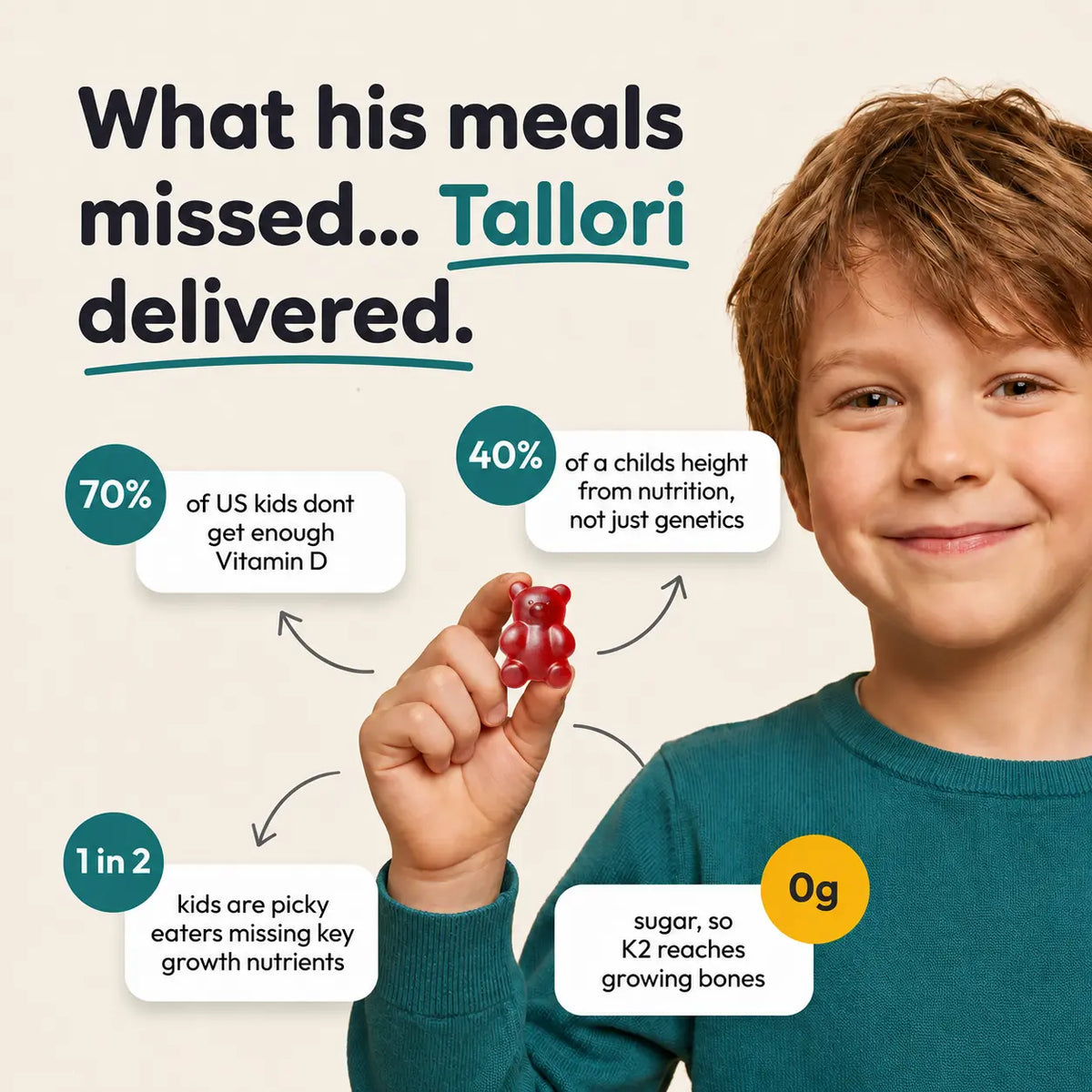
What Tallori is built to do is the other half of the plate: the vitamins and minerals a growing child is far more likely to be short on. It is a zero sugar, pectin based gummy multivitamin for ages 5 to 18, sweetened with monk fruit and xylitol. The panel prints all seven vitamin and mineral doses individually: vitamin C 25mg, vitamin D3 25mcg, vitamin K2 as MK-7 100mcg, calcium 300mg, magnesium as glycinate 50mg, zinc as citrate 6mg, and omega-3 DHA 50mg from algae oil rather than fish, so it is vegetarian and has no fishy aftertaste. The botanicals sit in a 112.4mg Clean Growth Blend, the same structure most brands in this category use, and we do not print the individual doses inside it.
The zero sugar part is not a marketing line. Sugar triggers an insulin response that interferes with how efficiently vitamin K2 does its job of directing calcium to bone. A growth gummy carrying three grams of added sugar per serving is working against its own ingredient list.

Try Tallori Growth Gummies
Zero sugar. All 7 vitamin and mineral doses printed on the label. 60-day money-back guarantee. Ages 5 to 18.
Shop NowRelated Reading
- Calcium for Growing Kids: How Much They Actually Need
- Iron for Growing Kids: What Parents Should Know
- Zinc Deficiency in Children: Symptoms to Watch For
- Signs of a Growth Spurt in Kids: What to Watch For
- Hidden Nutrition Gaps in Kids: What Even Balanced Diets Miss
- Best Vitamins for Picky Eaters
- Kids Growth Supplements: A Science-Backed Parent Guide
Frequently Asked Questions
How much protein does a 10 year old need per day?
The NIH Recommended Dietary Allowance for ages 9 to 13 is 34 grams per day, the same for boys and girls. That figure is an average based on a reference body weight, so a larger or more active child sits above it and a smaller child sits below it.
Does more protein make a child grow taller?
No. Protein supplies the raw material for tissue, but adding protein on top of a diet that already meets the requirement does not produce extra growth. Nutrition helps by correcting a shortfall, not by supplying a surplus, and genetics accounts for roughly 60 to 80 percent of final height.
Is my picky eater getting enough protein?
Very likely yes, if they drink milk or eat yogurt, cheese, eggs or peanut butter. Protein hides in the foods picky eaters tend to accept. The nutrients that actually go missing on a narrow diet are usually magnesium, zinc, calcium, vitamin K and omega-3 DHA, which are tied to the vegetables, fish and variety being refused.
Can kids have too much protein?
Yes. No Tolerable Upper Intake Level has been set for protein, but Cleveland Clinic lists added strain on the kidneys and liver, dehydration risk, kidney stones, digestive upset from powders, unwanted weight gain, and excessive fullness that crowds out other nutrient-dense food as effects of excessive intake in children.
Should my child take protein powder?
For most children, no. Cleveland Clinic advises whole foods over supplements, since whole protein sources bring other nutrients an isolated powder does not. A shake can carry around 30 grams per bottle, comparable to a whole chicken breast but far less filling, and adult powders are formulated for adult bodies. If a pediatrician recommends one for a specific child, follow that advice.
Which children actually need extra protein?
Cleveland Clinic names three groups: children who are not growing as expected or have been diagnosed with growth faltering, children on vegan or vegetarian diets, and children with absorption conditions such as inflammatory bowel disease or malabsorption syndrome. Even for these groups, whole food is the recommended first route.
What are the best protein foods for kids?
Chicken, turkey, lean beef, pork, fish, eggs, milk, cheese and Greek yogurt on the animal side. Beans, lentils, chickpeas, tofu and soy foods, nuts, nut butters, seeds and whole grains on the plant side. Greek yogurt, eggs and peanut butter are usually the easiest wins with a fussy eater.
Does Tallori contain protein?
No. Tallori Growth Gummies is not a protein supplement and does not supply meaningful protein. Protein needs are measured in tens of grams per day and a gummy is measured in milligrams. Our 112.4mg Clean Growth Blend includes the free amino acids L-arginine, L-glutamine and L-carnitine, which are not a protein source. Tallori covers the vitamins and minerals alongside protein, with all 7 vitamin and mineral doses printed on the panel.
This article is for informational purposes and is not medical advice. Talk to your child's pediatrician about any nutrition or growth concerns.