Does Lifting Weights Stunt Your Growth? A Parent's Guide for Young Athletes
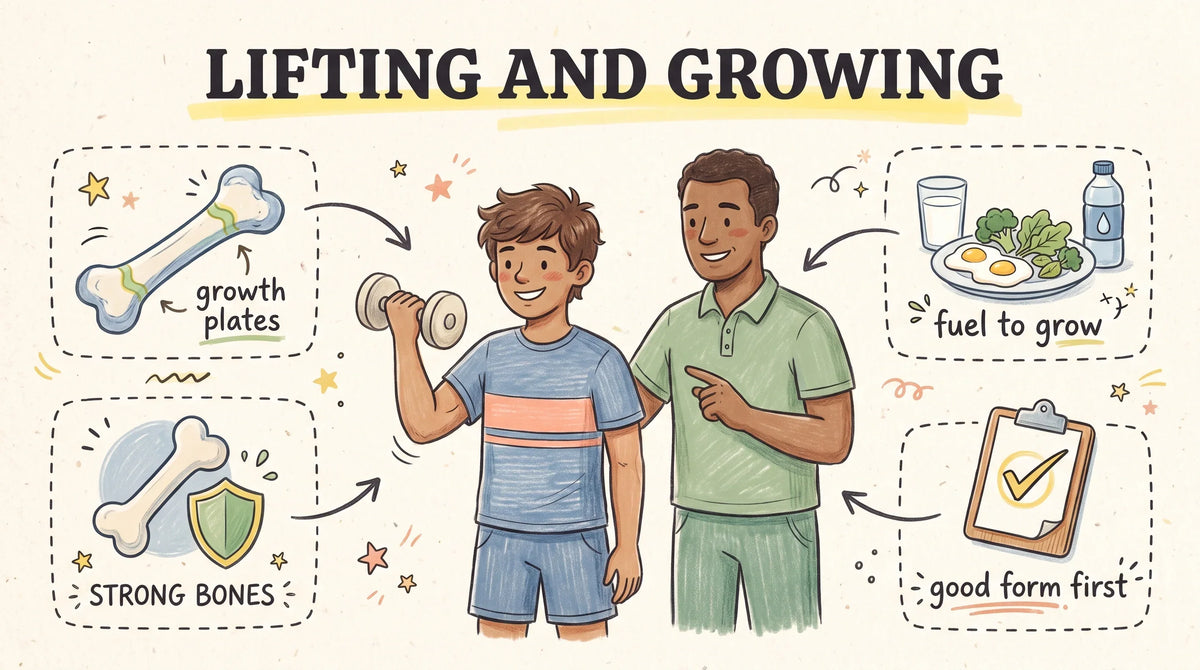
Last updated: September 12, 2026
Does lifting weights stunt your growth? No. Properly supervised strength training does not make children or teenagers shorter, and there is no study showing that it does. The largest evidence review on the question looked at 22 resistance training programs in pre and early pubertal youth and found that they "did not influence growth in height and weight." The myth is about growth plates, and the thing that actually threatens a growth plate is a serious fracture, which happens far more often in football, basketball, gymnastics and skateboarding than in a supervised gym session.
This is one of the most stubborn myths in youth sports, and it costs kids something real. Parents pull 12 year olds out of strength programs. Coaches tell 14 year olds to wait until they stop growing. Meanwhile the actual risks to a young athlete's growth get almost no attention, because they are less dramatic than a snapped growth plate and harder to put in a headline.
So here is the full picture: where the myth came from, what the research measured, the one genuine risk and why it points at different sports than people think, the line between strength training and max lifting, and the risk that almost nobody writing about this topic mentions.
The short answer, with the evidence behind it
The most cited review on this exact question is Robert Malina's 2006 evidence-based review in the Clinical Journal of Sport Medicine, "Weight training in youth: growth, maturation, and safety" (PMID 17119361). It reviewed 22 reports of experimental resistance training programs in pre and early pubertal children.
Three findings matter here.
First, the programs worked. They produced "significant improvements in muscular strength during childhood and early adolescence." Second, those strength gains were lost during detraining, which tells you the gains were real and trainable rather than a measurement artifact. Third, and this is the answer to the question: "Experimental resistance training programs did not influence growth in height and weight of pre- and early-adolescent youth, and changes in estimates of body composition were variable and quite small."
The review's own conclusion is worth quoting in full, because it contains the conditions that people drop when they repeat it: "Experimental training protocols with weights and resistance machines and with supervision and low instructor/participant ratios are relatively safe and do not negatively impact growth and maturation of pre- and early-pubertal youth."
Supervision and low instructor to participant ratios are not decorative. They are part of the finding. The research says supervised training is safe. It does not say a 12 year old alone in a garage with a loaded barbell is safe.
University Hospitals Rainbow Babies and Children's Hospital puts the same conclusion in one line in its pediatric sports medicine weight training fact sheet: "Strength training does not stunt growth."
The injury numbers nobody publishes
Almost every article on this topic says supervised lifting is "safe" and stops there. The Malina review actually counted.
Of the 22 studies, only 10 systematically monitored injuries. Across those 10 studies, three injuries were reported in total. The estimated injury rates in the programs that tracked them were 0.176, 0.053 and 0.055 injuries per 100 participant-hours.
Read that as a parent rather than a statistician. At the highest of those three rates, you would expect roughly one injury for every 568 hours a child spends training. A kid lifting three hours a week would take nearly four years to accumulate that much time. And the review is honest that only 10 of 22 studies monitored injuries at all, so the counting is incomplete rather than exhaustive.
That is the number to hold next to the mental image of a growth plate shattering under a barbell.
Where the myth actually came from
The fear is anatomical and it is not stupid. Growth plates are areas of cartilage near the ends of long bones, and as the American Academy of Orthopaedic Surgeons explains in its growth plate fracture guide, "because they are the last portion of a child's bones to harden, growth plates are particularly vulnerable to injury." The growth plate "helps determine the future length and shape of the mature bone," and a badly treated fracture "could result in a limb that is crooked or unequal in length when compared to its opposite limb."
So the mechanism people are worried about is real. Cartilage is softer than bone. Load goes through bone. The leap is assuming that a dumbbell is where that load becomes dangerous.
Two other things fed the myth. Historically, child labour involving heavy manual work was associated with shorter adults, but those children were also chronically underfed, working long hours and often ill, which is a different situation entirely. And observationally, sports that select for small bodies, like gymnastics and competitive diving, are full of short athletes, which looks like causation and is mostly selection.
The sports where growth plate fractures actually happen
Here is the part that reframes the whole question. The AAOS lists the situations where growth plate fractures genuinely occur:
"Growth plate fractures often occur during participation in competitive sports such as football, basketball, or gymnastics. Many growth plate fractures occur during participation in recreational activities such as biking, sledding, skiing, or skateboarding."
Weightlifting is not on that list. Football, basketball and gymnastics are. So are biking and skateboarding.
The AAOS also notes that most growth plate fractures happen in the long bones of the fingers, and are common in the forearm and the lower leg bones, which are injury patterns consistent with falls and impacts rather than controlled vertical loading. They occur twice as often in boys as in girls, because girls finish growing earlier, and the incidence peaks in adolescence.
This is the honest version of the risk conversation. Growth plate injuries are worth taking seriously, they can affect a limb's growth, and a persistent limp or a deformed looking limb after an injury needs a doctor quickly. But the activity most parents are anxious about is not the one where they cluster. The kid being kept out of the weight room is usually still playing the sport where the real risk lives.
Worth adding: the AAOS also says growth plate injuries "can also occur gradually as a result of repetitive stress on the bone, which may occur when a child overtrains in a sports activity." Overtraining is the recurring theme, and it applies to pitching, running and gymnastics as much as to lifting.
Strength training and weightlifting are not the same thing
Mayo Clinic draws the line that most of this debate is missing. In its guidance on strength training for kids, it says plainly: "Don't confuse strength training with weightlifting, bodybuilding or powerlifting. Trying to build big muscles can put too much strain on young muscles, tendons and areas of cartilage that haven't yet turned to bone, called growth plates."
That single paragraph explains why the answer to "does lifting weights stunt your growth" is both no and it depends what you mean by lifting.
Strength training means light loads, controlled movement and good form, using body weight, resistance tubing, free weights, machines or medicine balls. Competitive weightlifting, powerlifting and bodybuilding mean maximal or near maximal loads, often with form breaking down under fatigue, which is where the genuine strain sits.
University Hospitals sets the same boundary from the other direction: "maximal lifting (highest weight amount you can lift one to three times) may put you at more risk for injury to the growing areas of a child's body. Therefore, max lifting should be discouraged until after puberty." Its list of max lifts to avoid before puberty is specific: bench press, clean and jerks, snatches, and squats, performed as a one rep maximum.
So the real line is not weights versus no weights. It is submaximal training versus one rep maxes.
What age can a child start strength training
The two pediatric sources give nearly the same answer. Mayo Clinic says strength training "can become a part of a fitness plan as early as age 7 or 8." University Hospitals says "kids should be at least 8 years old before starting weight training. This allows them time to develop the crucial balance skills necessary for proper form."
Mayo adds the real gate, which is behavioural rather than chronological: "To strength train, children should be able to follow directions and practice proper form." A child who cannot yet hold a position on request is not ready, whatever the birthday says.
Mayo also recommends checking with your child's healthcare professional before starting, and says that check is essential if the child has a known or suspected condition such as a heart condition, high blood pressure or seizures.
For context on how this sits inside a child's overall activity, the Department of Health and Human Services guidance Mayo cites asks for 60 minutes or more of daily activity for school-age children, with muscle and bone strengthening exercise on at least three days a week. Strength work is not an optional extra bolted onto the guidelines. It is part of them.
What your child will and will not get out of it
This is the expectation-setting most parents never receive, and it defuses a lot of the anxiety on its own.
University Hospitals is blunt about it: "Kids will not gain muscle bulk / mass from weight training until after puberty. Instead, they gain neuromuscular coordination which essentially means that THEY CAN GET STRONGER as their body learns to fire more neurons to each muscle and increase the contraction, but, they WILL NOT GAIN MUSCLE BULK."
A pre-pubertal child who trains gets stronger without getting bigger. The strength is nervous system adaptation, not muscle growth. Which means a parent watching a 10 year old start a strength program should expect better coordination, better body control and fewer awkward falls, and should not expect visible muscle.
Mayo lists what the research does support for kids who train properly: increased muscle strength, protection for muscles and joints against sports injuries, better performance in nearly any sport, and learned proper form. For children who are not athletes at all, it adds stronger bones, healthier blood pressure and cholesterol, healthy weight maintenance, better self-esteem and more overall physical activity.
Stronger bones is the one worth underlining here, because it flips the myth completely. Weight-bearing exercise is one of the established inputs to bone strength during childhood, which is the same window when the calcium that builds bone matters most.
What a safe program actually looks like
Combining the Mayo Clinic and University Hospitals guidance, here is what both sources agree on.
| Element | What the pediatric guidance says | Why it matters |
|---|---|---|
| Starting age | Age 7 to 8 at the earliest, and only if the child can follow directions and hold proper form | Balance and instruction-following are the real prerequisites, not age |
| Supervision | Always supervised by a qualified adult. Most injuries occur in unsupervised settings | This is the single condition attached to every safety finding in the research |
| Learning sequence | Learn form with no weight first. Only add load once the movement is mastered | Form breakdown under load is where injuries come from |
| Load and reps | Mayo: one or two sets of 8 to 12 reps. UH: start light enough to lift 12 to 15 times, advance to three sets, then increase weight slowly | If a child cannot complete 10 reps with good form, the weight is too heavy |
| Max lifting | Discouraged until after puberty. No one rep max bench press, squat, clean and jerk or snatch | This is the actual boundary the growth plate concern belongs to |
| Equipment fit | Machines must fully adjust to the child's height, or use free weights. Adult equipment is often too large | Poorly fitted machines force bad joint angles |
| Warm up and cool down | 5 to 10 minutes of light aerobic work before. 10 to 15 minutes of light aerobic work and gentle stretching after | Prepares muscle for load and supports recovery blood flow |
| Rest | At least one full day between working each major muscle group | Adaptation happens during recovery, not during the session |
| Cardio and core | UH: cardio at least 30 minutes, five days a week. Core strengthening alongside the visible muscle groups | Trunk strength protects the spine and hips under load |
The risk almost nobody writes about
Here is the part that gets left out of every "myth busted" article on this topic, and it is the one that actually deserves a parent's attention.
A 1995 review in Sports Medicine by Katarina Borer (PMID 8614759) makes a point that has nothing to do with growth plates: "Exercise can transiently block the expression of statural growth by competitively removing the necessary nutritional support for growth. Statural growth retardation can be corrected by catch-up growth, but stunting may also be permanent (depending on the timing and magnitude of the energy drain)."
In plain language: a growing body has to pay for growth out of the same energy budget it pays for training out of. When training demand rises and food intake does not rise with it, growth is the thing that gets squeezed. The review calls it an energy drain, and it is a nutrition problem wearing an exercise costume.
The same review is equally clear that exercise itself is a positive input, describing it as providing "the mechanical stress needed for growth and remodelling of the musculoskeletal system." Borer also flags the honest caveat that studying this is difficult, because children are not randomly assigned into organised sports and exercise-induced energy drain usually goes unmeasured.
Notably, the pediatric sports medicine fact sheet lands in exactly the same place without citing the research. University Hospitals writes: "If you are taking the time to make your body stronger, it is also important to consider feeding your body the fuel that it needs to grow. This means it is very important to eat healthy, avoid junk food, and hydrate with water."
So the risk to a hard-training 14 year old is not the barbell. It is the 14 year old who added five training sessions a week and did not add a single meal. That pattern is common in youth sport, it is invisible on a growth chart until months later, and it is the only mechanism in this entire article with a plausible route to affecting height.
If you want the wider version of this list, we sorted every real and mythical cause in what stunts your growth, and looked at the opposite question in does exercise make kids taller.
Myth versus evidence, side by side
| The claim | What the evidence says | Source |
|---|---|---|
| Lifting weights compresses growth plates and makes kids shorter | Resistance training programs "did not influence growth in height and weight" in pre and early adolescent youth | Malina 2006, PMID 17119361 |
| Supervised youth lifting is dangerous | Three injuries reported across the 10 studies that monitored them, at rates of 0.176, 0.053 and 0.055 per 100 participant-hours | Malina 2006 |
| Growth plate injuries come from the weight room | They cluster in football, basketball, gymnastics, biking, sledding, skiing and skateboarding | AAOS OrthoInfo |
| Kids should wait until they stop growing | Strength training can start as early as age 7 or 8 if the child can follow directions and hold form | Mayo Clinic |
| All lifting is equally risky | Max lifting specifically should be discouraged until after puberty. Submaximal training is the safe form | University Hospitals Rainbow |
| Training is the threat to a young athlete's growth | The plausible threat is training that outpaces nutrition, described as an energy drain | Borer 1995, PMID 8614759 |
Where nutrition fits, and where it does not
Genetics sets the ceiling. Nutrition sets the floor. That is the honest frame for every conversation about height, and it applies here too. Roughly 60 to 80 percent of a child's final height is genetic. Nothing in a training program or a supplement moves that range. What good nutrition does is protect a child's ability to reach the upper end of the range they already have, instead of losing ground to a preventable gap.
For a young athlete, the practical version is simpler than it sounds. Training raises the demand for energy, protein, calcium and the minerals that go into bone. If intake does not rise to meet it, that is the real problem, and the fix is food first. Protein comes from meals, not supplements, and most US children already get two to three times what they need. Calcium is the one that more often falls short, and the NIH names children and teens ages 4 to 18 among the US groups getting less calcium than recommended. We covered the practical sources in calcium for growing kids.
Tallori Growth Gummies is a zero sugar daily multivitamin for ages 5 to 18, designed to help fill nutrition gaps during the growing years. It supplies 300mg of calcium, which is roughly the calcium in one glass of milk and about 23 percent of the 1,300mg a 9 to 18 year old needs, alongside vitamin D3, vitamin K2 as MK-7, magnesium, zinc, vitamin C and omega-3 DHA from algae oil. All 7 vitamin and mineral doses are printed on the panel, and the botanicals sit in a 112.4mg Tallori Clean Growth Blend whose individual doses are not printed, which is standard across this category. It is sweetened with monk fruit and xylitol.
What it does not do is worth saying just as plainly. It does not make children taller. It does not offset a training load that outstrips a child's eating. It does not replace meals, and it is not a protein supplement. A gummy is the wrong format for a nutrient measured in tens of grams a day. If a young athlete has ramped up training, the answer is more food, not more supplements.

Try Tallori Growth Gummies
Zero sugar. All 7 vitamin and mineral doses printed on the label. 60-day money-back guarantee. Ages 5 to 18.
Shop NowRelated Reading
Frequently Asked Questions
Does lifting weights stunt your growth?
No. A 2006 evidence-based review of 22 resistance training studies in pre and early pubertal youth found that the programs "did not influence growth in height and weight." University Hospitals Rainbow Babies and Children's Hospital states plainly that strength training does not stunt growth. The condition attached to every safety finding is supervision, with low instructor to participant ratios and submaximal loads.
Can lifting weights damage a child's growth plates?
A serious growth plate fracture can affect how a bone grows, and the American Academy of Orthopaedic Surgeons says an untreated one could leave a limb crooked or unequal in length. But the AAOS lists football, basketball, gymnastics, biking, sledding, skiing and skateboarding as where growth plate fractures actually occur. Weightlifting is not on that list. Most growth plate fractures happen in the fingers, forearm and lower leg bones, which are impact and fall patterns.
At what age can a child start strength training?
Mayo Clinic says strength training can become part of a fitness plan as early as age 7 or 8. University Hospitals says at least 8 years old, so the child has time to develop the balance skills needed for proper form. The real gate is behavioural rather than chronological: Mayo says children should be able to follow directions and practice proper form before they start. Check with your child's healthcare professional first, and definitely check if your child has a heart condition, high blood pressure or seizures.
What is the difference between strength training and weightlifting for kids?
Mayo Clinic warns not to confuse strength training with weightlifting, bodybuilding or powerlifting, because trying to build big muscles can put too much strain on young muscles, tendons and growth plates. Strength training means light loads and controlled movement with body weight, resistance tubing, free weights, machines or medicine balls. Competitive lifting means maximal loads. University Hospitals adds that max lifting, meaning the heaviest weight liftable one to three times, should be discouraged until after puberty, including bench press, clean and jerks, snatches and squats performed as a one rep max.
How risky is supervised youth weight training?
In the 2006 review, only 10 of the 22 studies systematically monitored injuries, and across those 10 studies just three injuries were reported. Estimated injury rates were 0.176, 0.053 and 0.055 per 100 participant-hours. The review notes the injury monitoring was incomplete, so treat these as indicative rather than exhaustive. Its conclusion was that supervised protocols with low instructor to participant ratios are relatively safe.
Will my child build muscle from lifting before puberty?
No. University Hospitals is explicit that kids will not gain muscle bulk or mass from weight training until after puberty. What they gain is neuromuscular coordination, meaning the body learns to fire more neurons to each muscle and increase the contraction. A pre-pubertal child gets measurably stronger without getting visibly bigger. Expect better coordination and body control, not visible muscle.
Can too much training affect a child's growth?
This is the one real mechanism, and it is about food rather than load. A 1995 Sports Medicine review states that exercise "can transiently block the expression of statural growth by competitively removing the necessary nutritional support for growth," and that the retardation can be corrected by catch-up growth but may also be permanent depending on the timing and magnitude of the energy drain. The practical version is a young athlete who added training sessions without adding meals. The pediatric sports medicine guidance makes the same point, telling young lifters to feed the body the fuel it needs to grow.
How many reps and sets should a child do?
Mayo Clinic suggests one or two sets of 8 to 12 repetitions with good form, and says that if a child cannot do 10 repetitions the weight is too heavy. University Hospitals suggests learning the movement with no weight first, then starting with a weight light enough to lift 12 to 15 times, advancing to three sets as tolerated, and only then increasing the weight slowly. Both recommend at least one full rest day between working the same major muscle group.
Does Tallori help a young athlete grow taller?
No. Tallori is a zero sugar daily multivitamin for ages 5 to 18 that helps fill nutrition gaps during the growing years. It does not make children taller, it does not offset a training load that outstrips a child's eating, and it is not a protein supplement or a replacement for meals. Roughly 60 to 80 percent of final height is genetic. If a young athlete has increased their training, the answer is more food first, and a pediatrician if their growth curve has flattened.
This article is for informational purposes and is not medical advice. Talk to your child's pediatrician about any nutrition, training or growth concerns.