Average Height for a 12-Year-Old (2026): Boys and Girls, and What Supports Growth
Last updated 5 July 2026
The average height for a 12-year-old is about 4 feet 11 inches (149 cm) for boys and just under 5 feet (151 cm) for girls, according to CDC growth chart data. Those are the 50th percentiles, the middle of the pack. Yes, you read that right. At 12, the average girl is slightly taller than the average boy, and that is completely normal. The range at this age is wide, and most 12-year-olds are nowhere near done growing.
How tall is the average 12-year-old?
At the 50th percentile on the CDC chart, the average 12-year-old boy is about 4 feet 11 inches (149 cm) and the average 12-year-old girl is just under 5 feet (151 cm). Half of kids each age are taller, half are shorter. Age 12 is a turning point. Many girls are mid-growth-spurt while many boys have not started theirs yet.
Why is the average 12-year-old girl taller than the boy?
Because girls start puberty about two years earlier. Girls usually hit their fastest growth between 10 and 12, while boys typically peak around 13 to 15. So at 12, a lot of girls are surging ahead and a lot of boys are standing still by comparison. It looks dramatic in a classroom. It is also temporary. Most boys catch up and pass the girls over the next few years.
What is the normal height range for a 12-year-old?
Pediatricians read height as a percentile, not a single number. Here is roughly where 12-year-olds land on the CDC stature-for-age chart. Treat the decimals as approximate and confirm with your pediatrician.
| 12-year-old | 5th percentile | 50th percentile (average) | 95th percentile |
|---|---|---|---|
| Boys | 4 ft 7 in (139 cm) | 4 ft 11 in (149 cm) | 5 ft 4 in (162 cm) |
| Girls | 4 ft 8 in (142 cm) | 4 ft 11 in (151 cm) | 5 ft 4 in (163 cm) |
Source: CDC clinical growth charts, stature-for-age. Values rounded. A late developer can sit low on this chart and still finish tall.
How does height change around age 12?
Fast, and on different schedules for boys and girls. The table below shows the 50th-percentile height across the ages on either side of 12, so you can see your child's trajectory rather than one snapshot.
| Age | Average boy (50th) | Average girl (50th) |
|---|---|---|
| 10 years | 4 ft 6 in (138 cm) | 4 ft 6 in (138 cm) |
| 11 years | 4 ft 8 in (143 cm) | 4 ft 8 in (144 cm) |
| 12 years | 4 ft 11 in (149 cm) | 4 ft 11 in (151 cm) |
| 13 years | 5 ft 1 in (156 cm) | 5 ft 2 in (157 cm) |
| 14 years | 5 ft 4 in (164 cm) | 5 ft 3 in (161 cm) |
Source: CDC clinical growth charts. Values rounded. Notice how girls lead at 12 and boys pull ahead by 14.
Is a 12-year-old still growing?
Almost certainly, with most of the growth still ahead. Age 12 sits early in the growth window for boys and mid-spurt for many girls. According to Nemours KidsHealth, girls typically grow until their plates close around 13 to 16 and boys keep growing until 15 to 19. A 12-year-old has years of growth left. Steady progress along their own curve matters far more than the number today.
Is my 12-year-old short, or just a late developer?
Often it is timing, not a ceiling. A 12-year-old who sits low on the chart but is growing steadily along their own line is usually a late bloomer, and a late bloomer can finish tall. The thing pediatricians watch is not a single low number. It is a child who falls off their own curve or stops growing. If your child is tracking steadily, that is reassuring. If the curve flattens, that is the conversation to have with the doctor.
What decides how tall a 12-year-old will be?
Four levers, and they are not equal. Genetics is the biggest. Twin and family studies suggest genetics accounts for roughly 60 to 80 percent of final height (Cleveland Clinic). The rest is influenced by nutrition, sleep, and overall health during the growth window.
Here is the honest version. Genetics sets the ceiling. Nutrition, sleep, and activity set the floor. No food and no supplement will make a short kid tall. What good nutrition can do is help a child reach the upper end of their own genetic range instead of leaving height on the table from preventable nutrition gaps.
Can nutrition still support growth at 12?
It can, and 12 is a great age to get it right because so much growth is still ahead. Severe deficiency in nutrients like zinc, vitamin D, or calcium can measurably slow growth. One Thai trial found zinc-supplemented children grew 5.6 cm versus 4.7 cm in the placebo group over six months. But the reverse is not magic. A JAMA Pediatrics trial in Mongolia (8,851 children, three years) found that adding vitamin D to kids who were already sufficient did not add height. The lesson is balance. Fixing a real gap supports growth. Megadosing a kid who is already covered does not.
What about the sugar in most growth gummies?
This is the part most parents miss. Many growth gummies carry 3 to 5 grams of added sugar per serving. That is a problem for two reasons. Sugar is the opposite of what you want in a daily routine for a growing tween, and the brands leaning on sugar to taste good are often the same ones using a vague proprietary blend that hides how much of each nutrient you get.
Tallori was built sugar-free for exactly this reason. Zero added sugar, sweetened with monk fruit and xylitol. All 7 vitamin and mineral doses are printed on the label, including calcium, vitamin D3, and vitamin K2 in the MK-7 form. The botanicals sit in a 112.4mg Tallori Clean Growth Blend, and those single doses are not printed. A growth gummy that is mostly sugar is a candy with a vitamin label. That is our opinion, and we will stand behind it.
How can parents support a growing 12-year-old?
Most of it is not exotic. It is the basics done consistently during the years they matter.
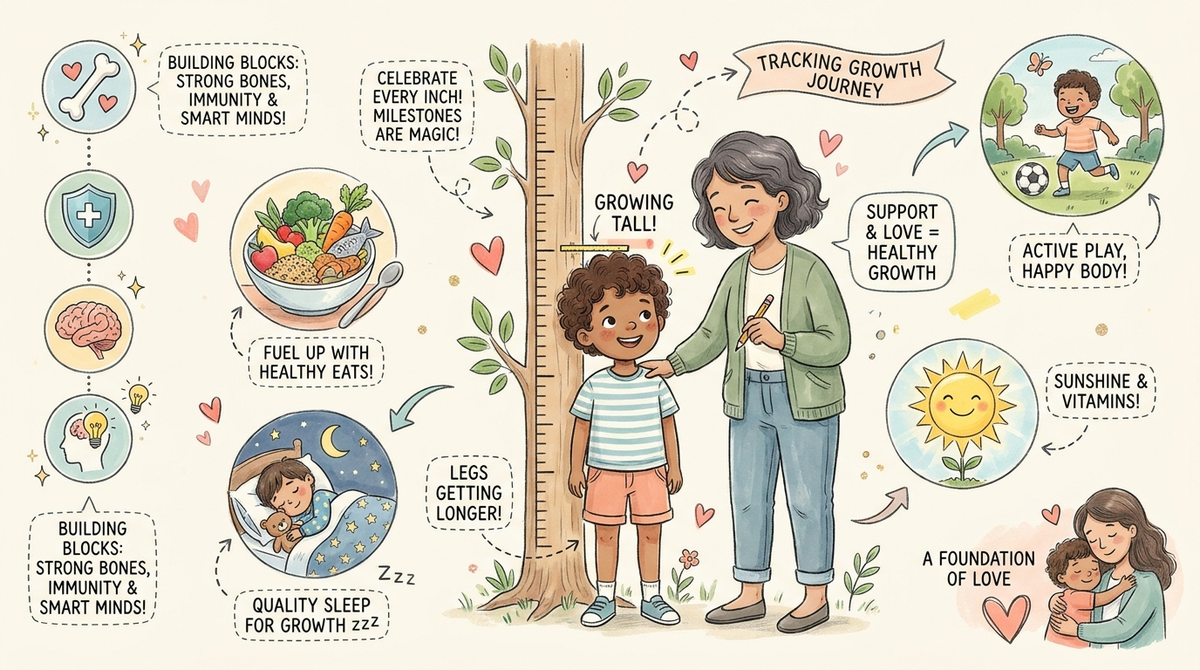
- Sleep. Most growth hormone is released during deep sleep. A 12-year-old needs about 9 to 12 hours. Phones out of the room help more than any pill.
- Protein and calcium daily. Bone is being built fast. Calcium needs jump to about 1,300 mg a day starting at age 9 (NIH Office of Dietary Supplements).
- Fill the real gaps. Tweens who skip vegetables, fish, or dairy are often short on zinc, magnesium, vitamin D, and omega-3 DHA. That is where a complete, sugar-free supplement earns its place.
- Movement. Weight-bearing activity and sport support bone development. It will not add inches on demand, but it supports the system that does the growing.
What should parents look for in a growth supplement for a 12-year-old?
If you do add a supplement during the window, the label tells you almost everything. Here is the checklist we use, with Tallori as the example that meets it.
| What to check | Why it matters | Tallori |
|---|---|---|
| Added sugar | Daily sugar is the opposite of a health habit for tweens | 0 g added sugar, sweetened with monk fruit and xylitol |
| Vitamin and mineral doses printed | A "proprietary blend" hides how much of each nutrient you actually get | All 7 vitamin and mineral doses printed |
| Vitamin K2 form | MK-7 stays in the body for days; K1 clears in hours | K2 as MK-7 |
| More than calcium | Picky tweens also miss zinc, magnesium, and omega-3 | Calcium 300 mg, D3 25 mcg, K2, plus zinc, magnesium, algae DHA |
| Honest claims | No supplement guarantees inches; be skeptical of anything that does | Supports growing years, never promises a number |
The honest timeline
No supplement works on a deadline. Nutrition supports growth cumulatively, over months of consistent use, not in a single dramatic week. If your 12-year-old is growing along their curve and eating reasonably well, they may not need anything extra at all. If there are real gaps, fill them, stay consistent for 8 to 12 weeks, and keep the expectations honest. Supporting their growth is the goal. Guaranteeing a number is not something anyone can promise.
Worried your 12-year-old is missing the nutrients their growth window needs?
Tallori is a sugar-free daily growth gummy for ages 5 to 18. Zero added sugar, 7-in-1 nutrients (vitamin C, D3, K2, calcium, magnesium, zinc, and algae DHA) with all 7 doses printed on the label, made to support bones, immunity, and focus during the growing years. Backed by a money-back guarantee.
This article is for general information and is not medical advice. Tallori is a dietary supplement and is not intended to diagnose, treat, cure, or prevent any disease. Talk to your pediatrician about your child's growth and before starting any supplement.
Keep reading
- Kids Growth Supplements: A Science-Backed Parent Guide
- What Age Do Kids Stop Growing? Real Timelines, Not Averages
- Average Height for a 14-Year-Old Boy
- Average Height for a 12-Year-Old Girl
- Best Vitamins for Picky Eaters (Ages 5 to 18)
- Average Height for a 13-Year-Old Boy (2026)
- Average Height for a 13-Year-Old Girl (2026)
- Average Height for a 15-Year-Old Boy (2026)