Average Height for a 14-Year-Old Boy: Is Your Son On Track?
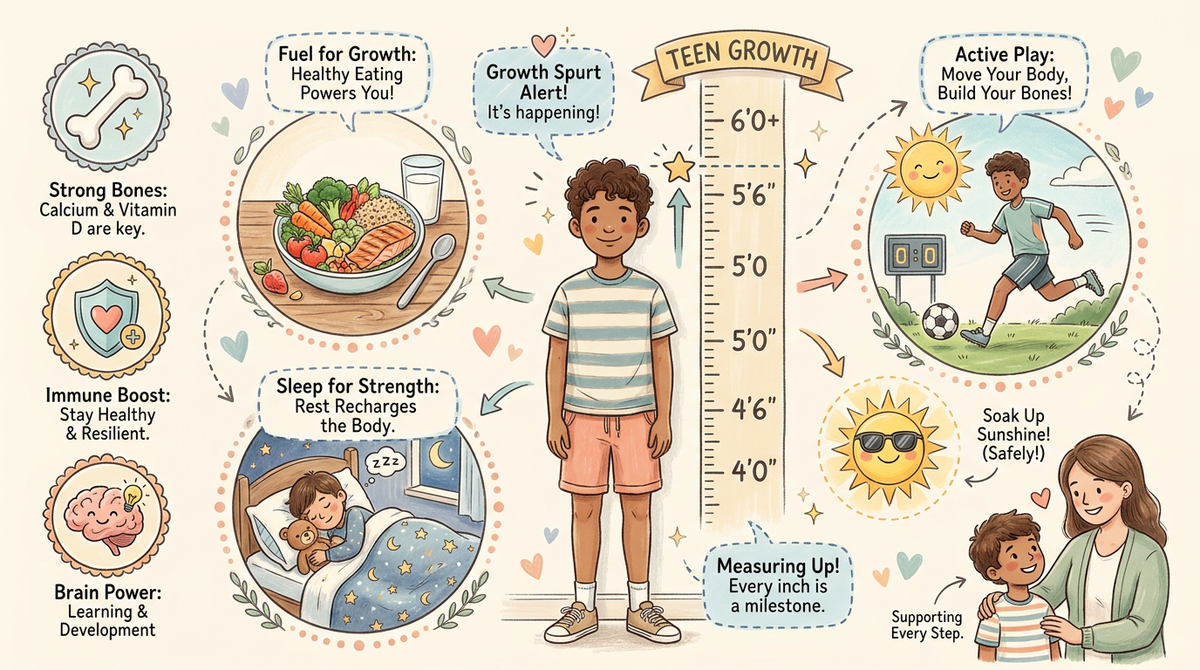
The average height for a 14-year-old boy in the US is approximately 5'4" (162 cm). Most 14-year-old boys fall somewhere between 5'2" and 5'7" depending on when puberty started. The growth window is still open. Boys typically keep growing until ages 15 to 19, when growth plates close. The number on the wall today is not the number on the wall in two years.
You measured your son this morning and the number on the wall didn't match his age. The doctor said "genetics" like that ended the conversation. This guide gives you the honest 2026 percentile data, what it actually means, and what daily nutrition can still do during the years that don't repeat.
Quick verdict in 60 words
The average height for a 14-year-old boy is approximately 5'4" (162 cm) at the 50th percentile. Half of boys are taller. Half are shorter. The growth window stays open until ages 15 to 19. A boy at 5'1" at 14 is well within the normal range and likely has years of growth runway left. Daily nutrition during the window is the largest controllable factor.
His growth window is still open. Give it the nutrition to work with.
Shop Tallori Growth GummiesAverage height for a 14-year-old boy by percentile
According to CDC growth charts, here is the approximate range for boys at age 14.
| Percentile | Height (inches) | Height (cm) |
|---|---|---|
| 3rd | 5'0" | 152 cm |
| 10th | 5'2" | 157 cm |
| 25th | 5'3" | 160 cm |
| 50th (average) | 5'4" | 162 cm |
| 75th | 5'6" | 168 cm |
| 90th | 5'8" | 172 cm |
| 97th | 5'10" | 178 cm |
This is a range. Not a target. Pediatricians watch the growth curve more than the single number. A boy who has been steady at the 30th percentile his whole life is on his own track. That track is more important than a single number on a wall today.
Average height by age for boys 11 to 17
Here is the 50th percentile, the simple average, by age for boys, per CDC growth charts.
| Age | Average height (inches) | Average height (cm) |
|---|---|---|
| 11 | 4'10" | 147 cm |
| 12 | 5'0" | 152 cm |
| 13 | 5'2" | 156 cm |
| 14 | 5'4" | 162 cm |
| 15 | 5'6" | 168 cm |
| 16 | 5'8" | 173 cm |
| 17 | 5'9" | 175 cm |
Notice the steepest jump happens between ages 13 and 15. According to Nemours KidsHealth, this is the peak height velocity for most boys. Some boys gain 3 to 4 inches in a single year during this window.
What does "average" actually mean?
The 50th percentile is the simple average. Half of all 14-year-old boys are taller. Half are shorter. A boy at the 25th percentile is shorter than 75 percent of boys his age. He is still within the normal range. He is not behind. He is on his own track.
Pediatricians watch consistency more than the percentile number. A boy who has been steady at the 20th percentile since age 5 is following his own genetic trajectory. A boy who suddenly drops from the 50th to the 10th percentile in a year is the one to investigate.
Is your son on track?
The pediatrician answer is yes if all of these are true:
- His growth curve is consistent year over year (not a sudden drop)
- His percentile is within the broad normal range (3rd to 97th)
- His weight and height are growing in parallel
- He is hitting other developmental milestones (voice change, body hair)
- Both biological parents are within average height ranges for adults
The pediatrician answer is "let's investigate" if any of these are true:
- His percentile has dropped significantly in the last 12 to 18 months
- His weight is normal but his height is well below the 3rd percentile
- He has shown no signs of puberty by age 14
- One or both biological parents reached final height much later than peers (a clue, not a diagnosis)
For most boys, the answer is the first list. Reassuring, but the worry rarely listens to reassurance. Most parents reading this are not looking for permission to stop worrying. They are looking for something to do.
The honest pain behind the search
One Reddit dad in r/Parenting put words to the silent worry most teen dads carry:
"It hurts my heart my son is small for his age. I don't know what to say when he tells me he's sad about it."
That worry is what most parents are actually Googling when they search "average height for a 14-year-old boy." The math behind the search is: how much time is left, and what can I still do for him.
What is still possible during the window
The boys growth window stays open until ages 15 to 19, with most boys finishing between 16 and 18. A 14-year-old has years of growth runway left. Late bloomers can keep growing into the early 20s.
What a parent can actually control during the window:
- Daily nutrition during ages 5 to 18. Roughly 20 to 40 percent of a boy's final height depends on factors other than genetics. Sleep, activity, and daily nutrition sit in those three.
- Sleep. Growth hormone is released mostly during deep sleep. Most teens need 8 to 10 hours.
- Weight-bearing activity. Walking, running, sports, resistance work. These support bone development during the window.
- A regular pediatrician check-in. Track the curve, not the single number.
What does not work
Some things parents try that have no real effect on height.
- "Grow taller" stretches and hanging from bars. These do not reopen growth plates or add length.
- Over-the-counter "height pills." No pill makes a child taller than their genetics allow.
- Pushing milk alone. Calcium without K2 MK-7 has limited effect on bone deposition. Sugar in chocolate milk negates much of the benefit.
- Limb lengthening surgery. Extreme. Painful. Not appropriate for cosmetic reasons in adolescents. Almost never the right tool.
- Growth hormone (HGH) for short stature. Medically indicated only for diagnosed conditions like growth hormone deficiency. Insurance does not cover it for idiopathic short stature.
What nutrition can actually do
This is the section most "average height" articles skip. They give the number and stop. They never tell you what to do.
Here is what nutrition does. It supports the bone development a boy's body is already trying to do during the open window. It does not raise the ceiling that genetics sets. It does help him reach the upper end of his own genetic range instead of leaving height on the table to a preventable nutrient gap.
The nutrients that matter most during the boys growth window, per the NIH Office of Dietary Supplements:
- Calcium 1,300 mg per day (ages 9 to 18). The mineral bones are built from.
- Vitamin D3 600 IU per day. Pulls calcium from the gut into the bloodstream.
- Vitamin K2 in the MK-7 form. Directs calcium to bones, not arteries.
- Magnesium. Sleep and recovery. Growth hormone is released during deep sleep.
- Zinc. Required for normal growth. Picky eaters often run low.
- Omega-3 DHA. Brain development. Most teen boys skip fish.
Picky eaters who skip fish, dairy, and vegetables typically miss most of this list. A clean daily multivitamin helps fill the gaps food does not.
Why we built Tallori for the window
Tallori was born at our own kitchen tables. Two parents. One pediatrician. And three kids who refused to swallow chalky chewables. We built the gummy we wished existed. Gentle. Honest. A little bit joyful. No fear-mongering. No 12-step morning routine. Just one good decision on the days when even one feels like a lot.
Emma and Dr. Lin built the formula around one rule. Zero added sugar so the nutrients actually absorb. Then the rest of the stack: calcium, vitamin D3, vitamin K2 in the MK-7 form, magnesium, zinc, algae-sourced omega-3 DHA, spinach powder, spirulina, ashwagandha, L-arginine and glutamine, astragalus root, monk fruit. 12 ingredients. Every dose printed on the label. No proprietary blend.
It is designed for the full ages 5 to 18 window. The years when growth plates are open and daily nutrition has the most leverage.
The mechanism. In one line.
Zero sugar = actual absorption. K2 directs calcium to bones, not arteries. Traditional gummies? Sugar in the formula keeps the K2 from doing its job. Less sick days = more growth days. Nourish. Grow. Thrive.
The proof picky-eater parents repeat the most
From a Tallori Loox review, Amanda R., December 8 2025:
"My son is nine, and I worry about his growth more than I admit. I always ask myself if I am doing enough for him."
That worry does not end at 12. It gets louder during the teen years. Then it gets louder again when the doctor says "we will keep watching." Kids often ask for Tallori daily once they start. Strawberry flavor. Non-sticky. Dentist-approved.
Try Tallori risk-free during your son's open window
Most parents of 14-year-old boys reach for the 6-pouch bundle. One full growth cycle. Six months at $39.38 per pouch. Free shipping. 60-day money-back guarantee, so the trial cost is your son's time.
If you want to start smaller, the 3-pouch bundle at $43.49 per pouch is the switch test. Three months. Free shipping. The honest minimum to evaluate the change in appetite, energy, and focus before the height conversation.
The single-pouch starter at $57.99 is for the parent who wants to taste-test before the bundle commitment.
The bottom line on average height for a 14-year-old boy
The average is approximately 5'4" (162 cm). The honest range is 5'2" to 5'7" for boys in the middle 50 percent. A boy below or above that range is not behind or ahead. He is on his own track. His pediatrician watches the curve, not the single number.
The window is still open. Daily nutrition is the lever a parent can pull. Sleep. Activity. Daily nutrition. The rest sits in those three.
See what is in Tallori. Decide for yourself.
Don't miss the growth window
Growth plates close at 18. Permanently. Every month you wait is a month the window narrows. The teen years are when daily nutrition has the most leverage on the height your son will carry for life.
Keep Reading
- When Do Boys Stop Growing? The Window That Doesn't Repeat, the closing-window timeline explained
- Best Multivitamin for Teenage Boys 2026: An Honest Comparison, the multivitamin built for the closing window
- When Do Growth Plates Close? Boys vs Girls Timeline, the biology of the closing window
- Best Growth Gummies for Kids in 2026, the full buyer's guide covering every major brand
- Average Height for a 13-Year-Old Boy (2026)
- Average Height for a 15-Year-Old Boy (2026)
- Average Height for a 13-Year-Old Girl (2026)
- Average Height for a 15-Year-Old Girl (2026)
- Average Height for a 16-Year-Old Boy (2026)
Frequently Asked Questions About 14-Year-Old Boy Height
What is the average height for a 14-year-old boy in 2026?
Can a 14-year-old boy still grow taller?
Is my 14-year-old son too short?
At what age do boys grow the fastest?
What helps a 14-year-old boy grow taller?
Should I take my short 14-year-old son to a specialist?
What is a healthy height for a 14-year-old boy?
Medical disclaimer: This article is for informational purposes and is not medical advice. Height percentile data is approximate and based on CDC growth charts. Always consult a pediatrician for growth concerns specific to your child. Last updated 14 July 2026.