Growth Spurt Nutritional Support: What Kids Need
Last updated: July 8, 2026
Growth spurt nutritional support means matching a child's rising nutrient needs, especially calcium, vitamin D, zinc, and magnesium, to the faster bone growth happening during a growth spurt. Kids in a spurt can grow 3 to 4 inches in a year. Their diet has to keep up, or the spurt runs on reserves it doesn't have.
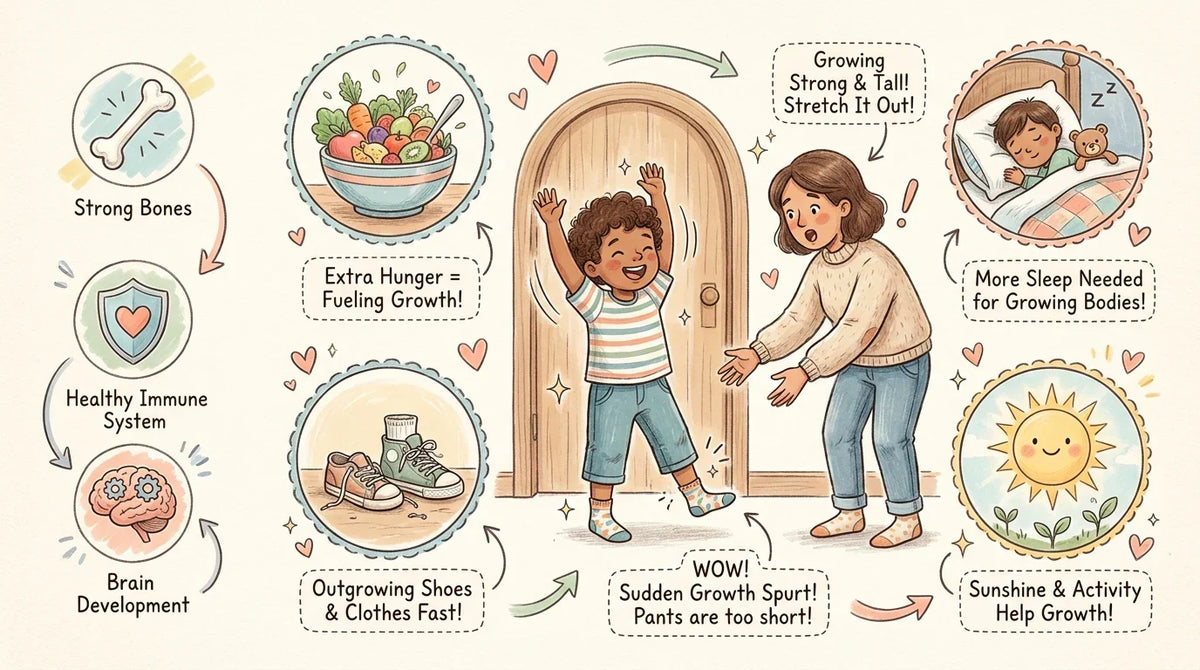
You know the spurt is happening before you can explain it. Pants that fit in September are ankle-high by January. Shoes that were roomy two months ago pinch at the toe. Your kid is suddenly eating like it's a competitive sport, then falls asleep on the couch at 7:30pm on a school night.
"I worry about his growth more than I admit. I always ask myself if I am doing enough for him." Amanda R., verified Tallori customer (Loox)
That's the question this post is built to answer honestly, not with a sales pitch.
What Does "Nutritional Support" Actually Mean During a Growth Spurt?
It means giving a child's body the raw materials bone growth requires, at the volume a growth spurt requires. Bone doesn't build itself from nothing. During peak height velocity, a child's skeleton is laying down new bone faster than at almost any other point in life outside infancy. Calcium, vitamin D, and vitamin K2 handle the bone-building itself. Magnesium and zinc support the enzyme systems and hormone pathways that drive the process. Miss the volume and the spurt has less to work with.
How Much More Does a Growing Kid Actually Need to Eat?
More than most parents assume, and the jump happens fast. Nutrient RDAs step up meaningfully between the 4 to 8 age band and the 9 to 18 age band, right as growth spurts start showing up. Calcium moves from 1,000mg to 1,300mg a day. Magnesium moves from 130mg up to 240mg (ages 9 to 13) and then to 360 to 410mg by late teens. Zinc moves from 5mg to 8 to 11mg. That's not a small nutritional bump. It's close to a 30 percent increase across the board, landing right when appetite and school schedules make consistent nutrition harder, not easier.
Which Nutrients Matter Most During a Growth Spurt?
Four nutrients do most of the work: calcium (the building block), vitamin D3 (drives calcium absorption from the gut), vitamin K2 in the MK-7 form (directs that calcium to bone instead of soft tissue), and magnesium (roughly 50 to 60 percent of the body's magnesium is stored in bone itself, per NIH data). Zinc and omega-3 DHA round it out, supporting immune function and focus while the body is under the extra metabolic load of rapid growth.
Does Calcium Alone Cover a Growth Spurt?
No, and this is the mistake a lot of "growth gummy" marketing leans on. Calcium without vitamin K2 has nowhere reliable to go. Without K2, calcium is more likely to pool in soft tissue instead of reaching bone, which is why K2 status matters as much as the calcium number on the label. If your kid is a picky eater who's also light on zinc, magnesium, or omega-3, calcium alone is closer to a 30 percent solution than a complete one. A bone-only gummy is solving one part of a four-part problem.
How Much Zinc, Magnesium, and Vitamin D Does My Child Actually Need During a Spurt?
Here's how the daily targets shift as kids move into the age range where growth spurts typically land, per NIH Office of Dietary Supplements data.
Sources: NIH Office of Dietary Supplements, Calcium, Zinc, Magnesium.
Food should be the majority of these totals. A daily multivitamin, including Tallori's 300mg calcium and full nutrient stack per serving, is built to help close the gap on the days food alone doesn't get there, not to replace meals.
Read the table as a floor, not a ceiling. These are the minimum amounts the NIH considers adequate for most kids in each age band, not a target to hit exactly and stop. A kid in the middle of a visible spurt, with the shoes and the pants and the appetite to match, is metabolically closer to the top of that range than the bottom.
Can a Growth Spurt "Catch Up" a Nutrient Deficiency on Its Own?
Not really, and the research is honest about this. A large JAMA Pediatrics trial (n=8,851 children over 3 years) found that vitamin D supplementation did not add height in kids who were already sufficient. The nutrient has to be missing for supplementing it to matter. Where deficiency is present, the picture changes: a Thai zinc study in 140 children found measurable height gains in the deficient group over 6 months (5.6cm versus 4.7cm in the placebo group). The honest takeaway: nutrition can't override genetics, and it can't manufacture a deficiency that isn't there to solve. What it can do is make sure a real gap doesn't quietly limit a spurt that's otherwise ready to happen.
Does Protein Matter During a Growth Spurt, Too?
Yes, and it's easy to overlook next to the calcium and vitamin D conversation. Bone isn't just mineral, it has a protein matrix (mostly collagen) that the minerals attach to, and muscle growth during a spurt has its own protein demand on top of that. Most kids in the US get enough protein from a normal diet without needing to track grams, but a consistently light eater, or a kid who fills up on snacks instead of meals, can end up short here too. Lean meat, eggs, dairy, beans, and fish are the simplest sources.
What Foods Deliver These Nutrients Without a Nightly Fight at the Table?
Dairy, fortified plant milks, and leafy greens cover most of the calcium. Fatty fish, egg yolks, and fortified cereal cover vitamin D. Pumpkin seeds, beef, and beans cover zinc. Nuts, whole grains, and dark leafy greens cover magnesium. Fatty fish again for omega-3 DHA. That's a long list to land on a plate every single day, especially for a kid going through a picky-eater phase during the exact window when the RDA numbers are climbing. Food first, supplement to close what food realistically misses on a Tuesday night when dinner was chicken nuggets.
Does Sleep Matter as Much as Nutrition During a Growth Spurt?
Sleep and nutrition work together, not against each other. Deep sleep is when a child's body does the bulk of its overnight repair and hormonal work, so a kid who's nutritionally supported but chronically short on sleep is still working against himself. Consistent bedtimes matter more during a growth spurt than at almost any other point in childhood, not less.
What Are the Signs My Child Needs More Support Right Now?
Outgrown shoes and pants within a single season, a sudden appetite increase, more fatigue than usual, and joint or leg aches at night are the most common early tells. We cover the full list in Signs of a Growth Spurt in Kids. If your child is showing several of these at once, that's the window to double-check the nutrition side of things, not to wait and see.
It's also worth checking in on how they're eating during that window, not just how much. A kid who's suddenly hungrier but filling up on the same handful of "safe" foods (crackers, pasta, chicken nuggets) is getting more calories without necessarily getting more of the nutrients that matter most right now.
Does Sugar Undermine Growth Spurt Nutrition?
It can undermine the delivery, even when the label looks fine. A gummy multivitamin loaded with added sugar is working against the same K2 pathway that's supposed to be directing calcium to bone. That's the whole reason Tallori is formulated at zero added sugar with monk fruit and xylitol instead, so the nutrients on the label aren't fighting the sugar in the same gummy.
How Long Before I'd Actually Notice a Difference?
Eight to twelve weeks is the honest timeline, not thirty days. Nutrient supplementation works cumulatively. Most parents notice earlier signals first, appetite regulating, energy steadier through the afternoon, better focus at school, before they notice anything height-related. Anyone promising visible growth in a month is selling urgency, not nutrition science.
Where Genetics Fits Into All of This
Genetics sets the ceiling. Research puts genetics at roughly 60 to 80 percent of final adult height, with the rest influenced by nutrition, sleep, and overall health during the growth window. No supplement, gummy, or diet change overrides that ceiling. What consistent nutrition can do is help a kid reach the top of their own genetic range instead of quietly falling short of it because of a fixable gap in calcium, D3, K2, magnesium, or zinc. That's a meaningfully different promise than "taller," and it's the one we're comfortable standing behind.

One Gummy, the Full Growth-Spurt Stack
Calcium, D3, K2 (MK-7), magnesium, zinc, and omega-3 DHA in a zero-sugar, strawberry gummy kids ages 5 to 18 actually want to take. Backed by a 60-day money-back guarantee.
Support Their Growth WindowRelated Reading
Frequently Asked Questions
What is growth spurt nutritional support?
Growth spurt nutritional support means matching a child's rising nutrient needs, especially calcium, vitamin D3, vitamin K2, zinc, and magnesium, to the faster bone growth that happens during a growth spurt. RDAs for several of these nutrients step up by roughly 30 percent between ages 4-8 and 9-18.
How many extra calories does a kid need during a growth spurt?
There is no single fixed number. Most parents notice increased appetite as the clearest signal, and pediatric guidance generally suggests following the child's hunger cues within a normal, balanced diet rather than counting calories during a spurt.
Is calcium enough to support a growth spurt?
No. Calcium needs vitamin K2 to direct it to bone and vitamin D3 to help the body absorb it. A child who is also light on magnesium, zinc, or omega-3 is only getting part of what a growth spurt requires from a calcium-only approach.
Can a supplement make up for a missed growth spurt?
No. A growth spurt is driven by genetics, hormones, and overall health, not by any single supplement. Nutrition can help ensure a real deficiency does not limit a spurt that is otherwise ready to happen, but it cannot manufacture a spurt or override genetics.
How long does it take to see results from growth nutrition supplements?
Eight to twelve weeks is a realistic timeline. Parents typically notice appetite, energy, and focus improvements before any height-related changes, since nutrient supplementation works cumulatively rather than immediately.
Does sugar in growth gummies cancel out the nutrients?
Added sugar does not cancel the nutrients outright, but it works against the same insulin-sensitive pathway that vitamin K2 relies on to direct calcium to bone. That is why Tallori is formulated with zero added sugar, sweetened with monk fruit and xylitol instead.
Does sleep affect a child's growth spurt as much as food does?
Sleep and nutrition work together rather than separately. Deep sleep is when a child's body handles much of its overnight repair, so consistent bedtimes matter as much during a growth spurt as consistent nutrition does, not less.