Non-Hormonal Growth Support: A Natural Path for Kids
Last updated: July 13, 2026
Your pediatrician said "wait and see." Your endocrinologist said your child doesn't qualify for growth hormone therapy. So now what?
Non-hormonal growth support means using nutrition, sleep, and daily habits, not synthetic growth hormone, to help a child reach the upper end of their genetic height range. It does not override genetics and it does not replace a medical diagnosis. It closes nutrition gaps that can quietly hold a child back during the years their growth plates are still open.
That distinction matters more this year than ever. The FTC took action against a leading growth gummy brand in April 2026 for deceptive height claims. Parents researching "growth support without hormones" are not naive. They are skeptical, and they should be.
What does "non-hormonal growth support" actually mean?
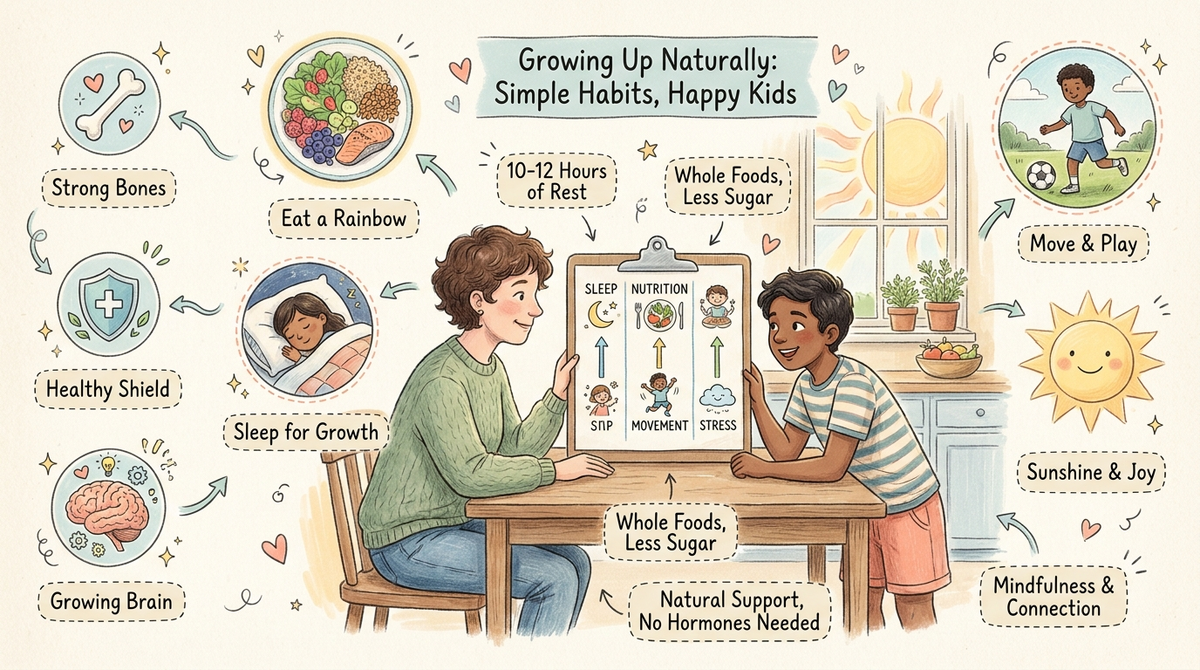
Non-hormonal growth support is any approach that helps a child's body use the height potential it already has, without introducing synthetic hormones. That includes adequate sleep (most growth hormone releases during deep sleep), regular physical activity, and a complete nutrient stack: calcium, vitamin D3, vitamin K2, zinc, magnesium, and omega-3 DHA. None of these add height beyond a child's genetic ceiling. What they do is remove the preventable deficiencies that keep a child from reaching that ceiling.
Why are parents searching for growth support without hormones?
Two reasons show up constantly in parent forums. First, growth hormone therapy is reserved for children with a diagnosed deficiency or a specific medical condition. Most short children do not qualify, and insurance typically will not cover it otherwise. Second, after the FTC's 2026 action against a major growth gummy brand for unsubstantiated height claims, parents are done trusting vague promises. They want the mechanism explained, not the outcome guaranteed.
Sound familiar? You've already been told to wait. You don't have to just wait and do nothing.
What changed after the FTC action against growth gummy brands in 2026?
In April 2026, the FTC took formal action against a leading height-gummy brand for deceptive, unsubstantiated advertising. That single event reshaped how parents shop this category. The well got poisoned, and researching parents got sharper, not softer. They now ask for the exact milligram doses on the label. They ask whether a claim is backed by a trial or just a testimonial. They notice when a brand won't say "supports" and reaches for "guarantees" instead.
That skepticism is healthy. A brand that publishes every ingredient dose, cites the actual research behind each one, and never promises a specific number of inches has nothing to hide from that scrutiny.
What does growth hormone therapy actually involve?
Growth hormone (GH) therapy is a daily injection prescribed by a pediatric endocrinologist, typically for children with a confirmed GH deficiency, Turner syndrome, chronic kidney disease, or a small-for-gestational-age diagnosis that didn't catch up by age two to four. It requires bloodwork, bone-age X-rays, and ongoing monitoring. It is not something a parent can start on their own, and it is not the right comparison for a child who is simply on the shorter end of a normal growth curve.
That's an important line. Nutrition-based support and GH therapy are not competing options for the same child. They serve different situations entirely. A child with a confirmed deficiency needs the injection, monitored by a specialist. A child with normal growth and a nutrient gap needs the gap closed. Confusing the two is how parents end up either overpaying for the wrong service or underestimating what a genuine deficiency actually requires.
Can nutrition actually support growth without using hormones?
Genetics sets roughly 60 to 80 percent of a child's final height. Nutrition, sleep, and overall health influence the rest. No gummy makes a short kid tall. What a complete formula can do is help a child hit the upper end of their own genetic range instead of leaving inches on the table from a preventable gap.
The research backs specific pieces of this, not the whole story. A Thai randomized trial found children with low zinc status grew 5.6cm over six months on zinc supplementation, compared to 4.7cm on placebo. That's a real, measurable difference, but only in children who were deficient to begin with. A JAMA Pediatrics trial of 8,851 children in Mongolia found that giving vitamin D to kids who already had sufficient levels did not add height. The nutrient only matters where the gap exists.
What nutrients matter most for non-hormonal growth support?
Six nutrients keep showing up in the research on growth-window nutrition. Here's how they compare, and what role each plays without touching hormone levels.
| Nutrient | Role in growth support | RDA (ages 9-18) | In Tallori |
|---|---|---|---|
| Calcium | Structural mineral for bone | 1,300mg | Yes, 300mg per serving |
| Vitamin D3 | Calcium absorption in the gut | 600 IU | Yes, 25mcg per serving |
| Vitamin K2 (MK-7) | Directs calcium to bone, not soft tissue | 60-75mcg (adequate intake) | Yes, MK-7 form specifically |
| Zinc | Growth and immune function, deficiency slows growth | 8-11mg | Yes |
| Magnesium | 50-60% of the body's magnesium is stored in bone | 240-410mg | Yes |
| Omega-3 DHA | Brain and focus support during school years | No pediatric DHA-specific RDA, ALA intake 0.7-1.6g | Yes, algae-sourced (no fish conversion step) |
No gummy on this list touches a child's hormone levels. That's the point. This is a nutrition floor, not a hormone switch.
Does ashwagandha count as non-hormonal growth support?
Ashwagandha is often lumped in with "growth boosters," which is misleading. A 2026 randomized, double-blind trial in Frontiers in Nutrition gave 85 healthy children ages 6 to 12 a standardized ashwagandha extract, 300mg per day for 8 weeks. Researchers found improved cognitive performance and sleep quality compared to placebo. The fatigue-reduction result did not reach statistical significance. Nothing in that trial measured height or hormone levels. Ashwagandha's role here is sleep and stress support, and since most growth hormone naturally releases during deep sleep, better sleep quality is a reasonable, honest mechanism. It is not a hormone itself and it does not raise hormone levels.
NIH's Center for Complementary and Integrative Health notes ashwagandha is generally well tolerated in trials up to about three months, with mild side effects like stomach upset in some cases. Children with thyroid disease, autoimmune conditions, or upcoming surgery should check with a pediatrician first.
How is Tallori different from growth hormone therapy?
Growth hormone therapy changes hormone levels directly, under medical supervision, for a diagnosed condition. Tallori doesn't touch hormone levels at all. It's a daily gummy with zero added sugar and 12 targeted ingredients, built so the nutrients your kid needs during the growth window actually reach the places they're supposed to. Sugar in most growth gummies competes with that goal. Tallori's monk fruit sweetener is FDA GRAS certified and keeps the formula sugar-free, so K2, D3, and calcium aren't fighting an insulin response on the way to the bones that need them.
"I'd already spent $200 on two other brands before Tallori. By month three, my daughter had grown 2.5 inches and was eating her morning gummy without a fight."
Sarah Mitchell, Tallori parent

Is non-hormonal growth support safe for kids?
Yes, when it's built from ingredients with an established pediatric safety profile and made in a GMP-compliant facility. Tallori is manufactured in a cGMP-compliant facility, contains no added hormones, and every ingredient dose is printed on the label instead of hidden inside a "proprietary blend." That last part matters more than most parents realize. If a label lists "proprietary growth blend: 500mg" without breaking out the individual doses, that's not privacy. That's hiding the math. A brand that publishes every milligram gives you something to actually check.
How long does non-hormonal growth support take to show results?
Anyone promising visible results in 30 days is either lying or selling sugar. Nutrient supplementation works cumulatively. Most parents report early signs, appetite, energy, better focus at school, within 6 to 8 weeks. Visible growth changes take months of consistent daily use, not days. That's not a marketing hedge. That's how nutrition actually works in a growing body.
When should a parent consider growth hormone therapy instead?
If a child's growth has stalled, they've dropped multiple percentiles on their growth chart, or a pediatrician has flagged something at a routine checkup, that's a conversation for a pediatric endocrinologist, not a supplement aisle. Bloodwork and a bone-age X-ray can rule in or out an actual deficiency. Nutrition-based support is not a substitute for that evaluation. It's what fills the gap for the vast majority of kids whose growth is normal, but whose diet isn't giving their body everything it needs to get there.
Related Reading
Zero sugar. Twelve targeted nutrients. No hormones.
Tallori supports growing years with a complete, transparent formula. Backed by a 60-day money-back guarantee.
Shop Tallori Growth GummiesFrequently Asked Questions
What does "non-hormonal growth support" mean?
Non-hormonal growth support means using nutrition, sleep, and daily habits to help a child reach the upper end of their genetic height range, without introducing synthetic growth hormone. It fills nutrient gaps like calcium, vitamin D3, K2, zinc, and magnesium. It does not override genetics and it is not a substitute for a medical diagnosis.
Can vitamins replace growth hormone therapy?
No. Growth hormone therapy is a medically supervised treatment for children with a diagnosed deficiency or specific condition. Vitamins and nutrition support fill dietary gaps for children with normal growth, they do not treat a hormone deficiency. A pediatric endocrinologist is the right resource for a suspected deficiency.
Is Tallori a substitute for growth hormone treatment?
No. Tallori is a daily nutrition gummy designed to fill common gaps in calcium, vitamin D3, K2, zinc, magnesium, and omega-3 DHA. It does not contain hormones and does not treat a diagnosed growth hormone deficiency. Children with a suspected deficiency should see a pediatric endocrinologist for bloodwork and evaluation.
What nutrients matter most for non-hormonal growth support?
Calcium, vitamin D3, vitamin K2 in the MK-7 form, zinc, magnesium, and omega-3 DHA show up most consistently in pediatric nutrition research. Calcium and D3 build bone. K2 MK-7 directs that calcium to bone instead of soft tissue. Zinc and magnesium support growth and bone density. Omega-3 DHA supports brain and focus.
Does ashwagandha affect hormones?
A 2026 randomized trial in children ages 6 to 12 found ashwagandha improved sleep quality and cognitive performance, not hormone levels. Since most growth hormone releases naturally during deep sleep, better sleep is a reasonable, honest mechanism. Ashwagandha is not a hormone and does not raise hormone levels directly.
How long before non-hormonal growth support shows results?
Early signs like appetite, energy, and focus typically show up within 6 to 8 weeks of consistent daily use. Visible growth changes take months, since nutrient supplementation works cumulatively rather than instantly. Any brand promising results in 30 days is overselling how nutrition actually works in a growing child.
Is non-hormonal growth support safe for kids?
Generally yes, when ingredients have an established pediatric safety profile and doses are printed on the label rather than hidden in a proprietary blend. Tallori is made in a cGMP-compliant facility with no hormones added. Parents should still consult a pediatrician before starting any supplement, especially for children under 5 or with existing conditions.
When should a child see a pediatric endocrinologist instead?
If a child's growth has stalled, they've dropped multiple percentiles on a growth chart, or a pediatrician flags a concern at a checkup, a pediatric endocrinologist can order bloodwork and a bone-age X-ray to rule a deficiency in or out. Nutrition support fills gaps for normal growth. It does not replace that evaluation.
These statements have not been evaluated by the Food and Drug Administration. This product is not intended to diagnose, treat, cure, or prevent any disease. Consult a healthcare professional before starting any supplement, especially for children under 5 or with existing medical conditions.